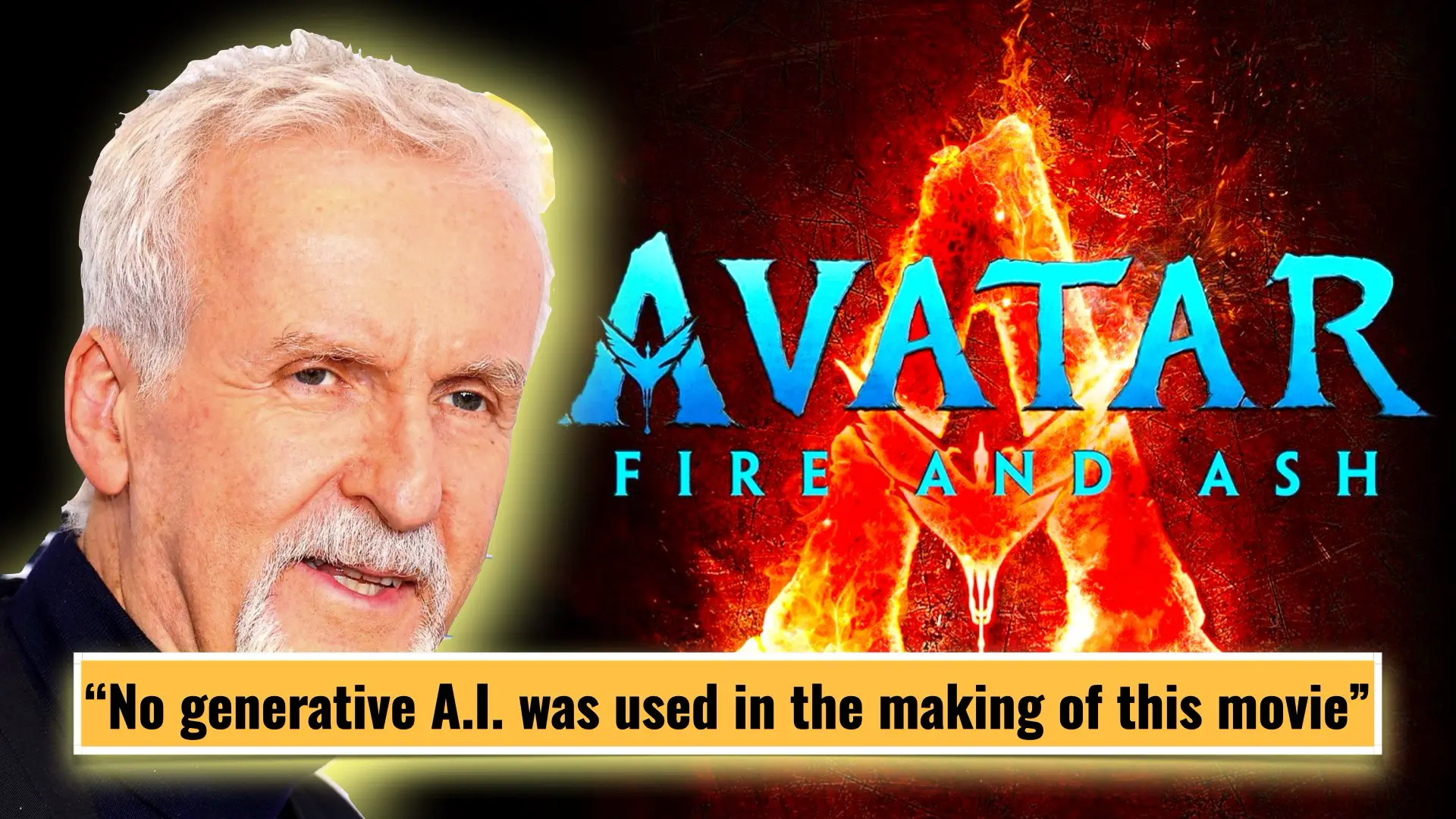
"Avatar: Fire and Ash" director James Cameron on generative AI: "That’s horrifying to me." Legendary filmmaker James Cameron, the visionary behind the monumental "Avatar" franchise, recently shared his profound concerns regarding the rise of generative artificial intelligence in the creative industries, labeling the prospect of AI-created performances as "horrifying." His remarks come as anticipation builds for his latest cinematic endeavor, "Avatar: Fire and Ash," the third installment in the saga that has redefined visual storytelling. The interview, conducted by CBS News correspondent Jonathan Vigliotti and updated on November 30, 2025, delved into Cameron’s meticulous filmmaking process, his storied career, and his unwavering commitment to human artistry, which stands in stark contrast to the burgeoning capabilities of AI.
The breathtaking landscapes and sentient life forms of Pandora, the Earth-like moon central to the "Avatar" universe, may appear otherworldly, but much of their genesis lies within the confines of a soundstage in Los Angeles. It was here that pivotal scenes for the second and third "Avatar" films were meticulously brought to life. "We had to build an ocean," Cameron explained, detailing the immense practical challenges his team overcame. "We could make a two-meter swell. We could make a wave crash up on a shoreline if we built the shoreline." This hands-on, engineering-driven approach underscores Cameron’s philosophy: to build and craft a world, even if it’s a virtual one, through tangible effort and human ingenuity.
Actors like Sigourney Weaver, Zoe Saldaña, and others immersed themselves in a massive, nearly 250,000-gallon tank to shoot their demanding underwater sequences. These raw performances, captured with sophisticated technology, then served as the bedrock for digital artists. These artists meticulously rendered the final, fantastical versions of the characters audiences witness on screen, using the actors’ nuanced expressions and movements as their primary guide. Cameron elaborated on the sophisticated "performance capture" technique: "So, performance capture, we use a whole bunch of cameras to capture the body performance of the actor. And we use a single camera (or now we use actually two) to video their face. They’re in a close-up 100% of the time. But there’s a beautiful thing about being in a close-up 100% of the time. It’s very much like theater rehearsal." This method, far from replacing actors, elevates their performance by translating every subtle flicker of emotion and physicality into their digital avatars, ensuring the soul of the human performance remains intact.
"Avatar: Fire and Ash" continues the epic narrative of the indigenous Na’vi people’s valiant struggle to protect their pristine paradise from the encroaching, colonizing humans. The franchise, celebrated for its immersive world-building and profound environmental themes, is a testament to Cameron’s lifelong imagination. Even as a child growing up in rural Canada, Cameron was a prodigious dreamer. "I lived in a world of my imagination — it was comic books, it was science fiction. I read a lot. There were movies, TV shows," he recalled, acknowledging the rich tapestry of influences that shaped his early creative mind. "I mean, I had a pretty fertile imagination." This fertile ground of childhood fantasy laid the groundwork for the intricate worlds he would later bring to life.
Cameron’s journey to Hollywood was anything but conventional. After moving to Los Angeles as a teenager, he briefly explored marine biology at a community college before dropping out. He supported himself with a series of odd jobs, including truck driving, a far cry from the glittering world of filmmaking. The catalyst for his career shift came with the release of George Lucas’s "Star Wars." "Watching ‘Star Wars,’" he said, describing the transformative experience. "I used to put my headphones on and listen to fast electronic music and imagine space battles, hyperkinetic space battles with all kinds of maneuvers and energy weapons, and people going through debris fields and all that. If the things I’m seeing in my mind can be the same things that are in a movie that’s the number one movie in movie history, then I’ve got a salable imagination." This realization ignited his ambition, pushing him to pursue filmmaking with a relentless self-taught drive.
He returned to education, albeit unofficially, embarking on a rigorous self-study program in visual effects. "I didn’t have the money to go to USC or anything like that. So what I used to do is, I’d go down to USC, I’d go bury myself on a Saturday, when I wasn’t driving a truck, in the stacks," he recounted. "And I’d read everything I could find on optical printing and front-screen projection and, you know, sodium process traveling mattes. All self-taught. I’d Xerox all these scholarly papers, put them all in binders. And I had this shelf full of black binders that had essentially a graduate course in visual effects and cinematography." This extraordinary dedication to mastering the technical craft quickly propelled him through the ranks, securing him jobs in visual effects departments and production design, where his technical acumen was immediately apparent.
In the early 1980s, a literal dream about a robot exoskeleton sparked the idea for "The Terminator." Cameron co-wrote and directed the film, which not only put him firmly on the cinematic map but also definitively proved his ability to transform his most vivid imaginings into compelling, tangible realities on screen. In an era predating sophisticated CGI, the groundbreaking effects of "The Terminator" were achieved predominantly through ingenious practical methods and puppeteering. "We just figured out how to do it all practically," Cameron stated, emphasizing the resourcefulness that defined early visual effects work. He offered a glimpse into this era by showcasing his private museum in Los Angeles, filled with iconic movie props. Among them was the terrifying Alien Queen from "Aliens," a marvel of practical effects that brought Sigourney Weaver’s powerlifter character and her monstrous adversary to life. "Her head had, I think, seven or eight different axes of movement that were controlled by cables that went basically out her butt," Cameron explained, detailing the intricate mechanics. "And we had to hide all that stuff, so there was a lotta steam and smoke and backlight and things like that." These anecdotes highlight a filmmaking philosophy rooted in problem-solving and hands-on creation, a stark contrast to purely digital generation.
Cameron’s first significant foray into computer-generated imagery came with the science fiction epic "The Abyss," a film that also marked his initial cinematic exploration of another lifelong fascination: the deep sea. This profound interest in the ocean’s mysteries would later culminate in "Titanic," his second oceanic film. "Titanic" transcended its genre to become the then-highest-grossing movie of all time, earning Cameron three Academy Awards for Best Picture, Best Director, and Best Film Editing. Yet, for Cameron, the film itself was, surprisingly, a secondary objective. He confessed that he primarily wrote the script as a means to fund and explore the wreck of the actual Titanic. "It was a little bit of a means to an end, you know?" he admitted. "I thought, ‘I can just go do this. All right, I need a story. Okay, ‘Romeo and Juliet.’ You know, young, doomed love on the Titanic.’ Boom! Like, instantaneous." This candid revelation underscores his unique approach, leveraging the commercial power of Hollywood to fuel his deep-seated passion for scientific exploration. "Yeah, exactly," he affirmed, confirming that he found a way to merge his artistic and scientific pursuits. His expeditions proved so captivating that he took an "eight-year hiatus from Hollywood, an eight-year sabbatical," embarking on six more deep-sea expeditions for a total of seven, before finally commencing work on "Avatar."
The concept for "Avatar" had been brewing in Cameron’s mind long before "Titanic," with a treatment written years prior. However, it wasn’t until 2005 that he felt the available technology had finally caught up to his ambitious vision, enabling him to realize the immersive world of Pandora. Even then, he faced skepticism within the Hollywood establishment. "For years, there was this sense that, ‘Oh, they’re doing something strange with computers and they’re replacing actors,’ when in fact, once you really drill down and you see what we’re doing, it’s a celebration of the actor-director moment," he asserted. His performance capture method is designed to faithfully record and translate every nuance of a human actor’s performance, thereby amplifying their contribution rather than diminishing it.
It is precisely this dedication to authentic human performance that puts him at odds with the emerging capabilities of generative AI. "Now, go to the other end of the spectrum, and you’ve got generative AI, where they can make up a character," Cameron continued, his tone shifting to one of profound unease. "They can make up an actor. They can make up a performance from scratch with a text prompt. It’s like, no. That’s horrifying to me. That’s the opposite. That’s exactly what we’re not doing." Cameron’s "horrifying" reaction stems from a belief that generative AI, by creating performances from algorithms and text prompts, bypasses the essential human element—the soul, intention, and unique artistry of an actor and a director’s collaborative vision. For him, performance capture is a tool that extends human creativity; generative AI, in its current form, risks supplanting it entirely, potentially divorcing art from its human origin and rendering the actor-director relationship obsolete. This ethical concern resonates deeply within Hollywood, where debates about AI’s impact on employment, intellectual property, and artistic integrity are increasingly prominent.
As "Avatar: Fire and Ash" prepares for its premiere next month, Cameron admits to the familiar pre-release jitters. "Nervous!" he laughed. "Are you kidding? Always. Always." Despite the inherent uncertainties of filmmaking, Cameron remains undaunted, perpetually drawn to the unknown and the challenge of new frontiers. "I’m attracted, in case you haven’t noticed, by things I don’t know how to do," he mused. "Because you grow and you learn. If I’m still making movies when I got an oxygen tube up my nose and I’m 87 or whatever, should I be that lucky, I want to still be doing things I don’t know how to do." This enduring philosophy of continuous learning and artistic exploration, always anchored by human endeavor and ingenuity, defines James Cameron’s legacy and stands as a powerful counter-narrative to the encroaching world of purely generative creation.
(For those interested, an extended interview with James Cameron is available for viewing. Additionally, a trailer for "Avatar: Fire and Ash" offers a glimpse into the upcoming film, and an archived YouTube video provides further insight into James Cameron’s deep-sea explorations.)