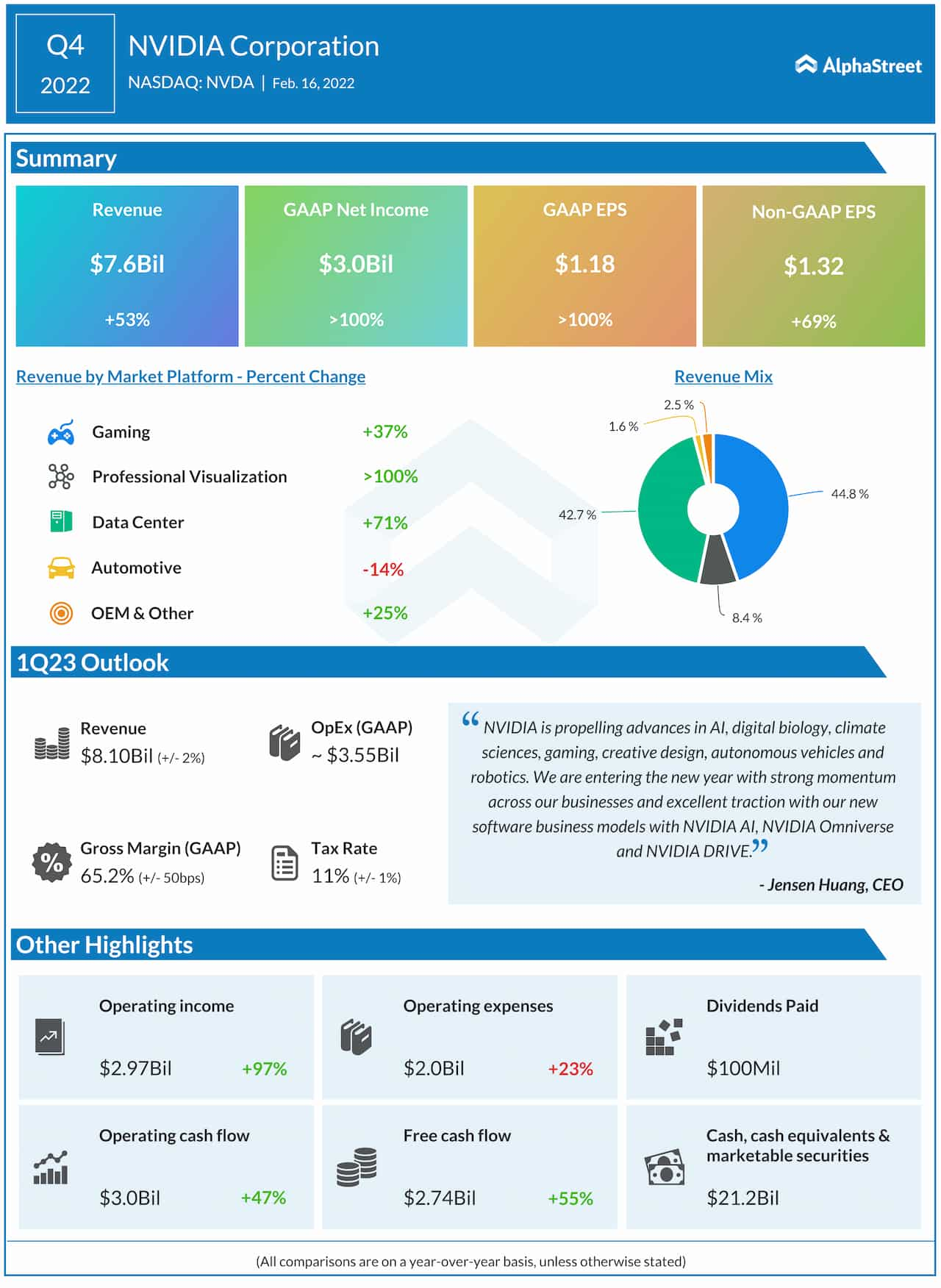
Nvidia reports strong quarterly earnings, topping Wall Street forecasts. The artificial intelligence chip giant shattered analyst expectations in its third-quarter financial results, underscoring the relentless demand for its cutting-edge AI chips and alleviating investor concerns about a potential bubble in the burgeoning AI market.
The Santa Clara, California-based company reported a staggering $31.9 billion in earnings on a record revenue of $57 billion for the third quarter of its fiscal year 2026. This stellar performance marks a significant acceleration in growth, with revenue surging an impressive 22% from the previous quarter and an even more remarkable 62% year-over-year. Diluted earnings per share (EPS) reached $1.30, comfortably surpassing the $1.26 per share anticipated by analysts polled by FactSet. Similarly, the reported revenue figure blew past the consensus estimate of $54.9 billion, demonstrating Nvidia’s ability to consistently exceed market expectations amidst booming demand for its specialized hardware.
Nvidia CEO Jensen Huang, the visionary leader at the helm of the company, articulated a vivid picture of exponential growth and pervasive AI adoption in his statement released on Wednesday. "Blackwell sales are off the charts, and cloud GPUs are sold out," Huang declared, referencing Nvidia’s next-generation superchips that are crucial for powering large language models and advanced AI applications. His remarks painted a picture of insatiable demand across the globe, with "compute demand keeps accelerating and compounding across training and inference – each growing exponentially." This distinction between "training" (teaching AI models) and "inference" (using trained models to make predictions) highlights the comprehensive and deepening integration of AI across various computational tasks.
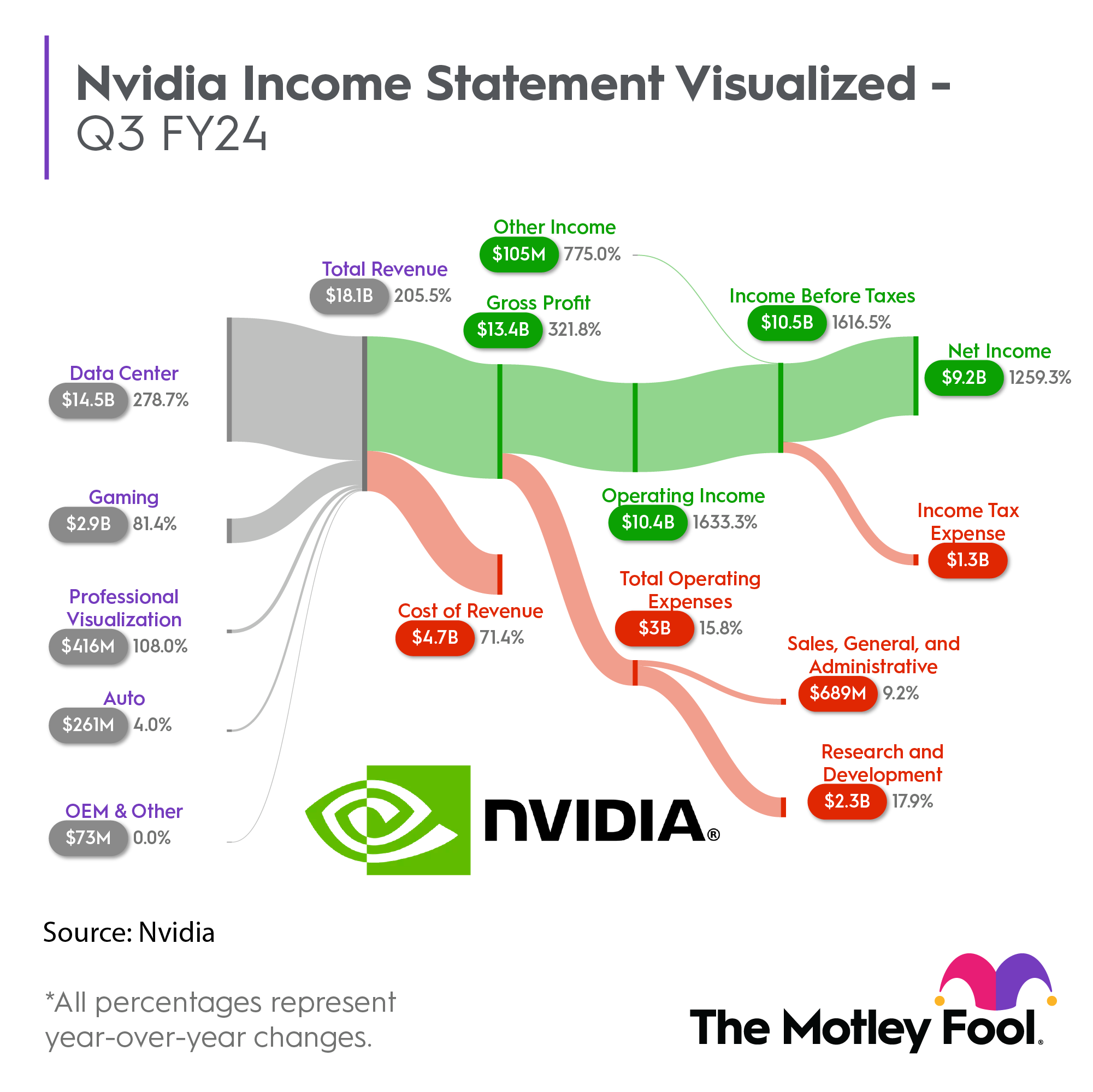
Huang further emphasized that the industry has unequivocally "entered the virtuous cycle of AI." This cycle, he explained, is fueled by an expanding AI ecosystem marked by an increasing number of foundation model makers, innovative AI startups, and diverse industry applications spanning numerous countries. "AI is going everywhere, doing everything, all at once," he asserted, underscoring the technology’s transformative reach and its foundational role in driving future innovation and economic growth.
Looking ahead, Nvidia provided an exceptionally optimistic outlook for the fourth quarter, forecasting revenue of an astonishing $65 billion. This robust guidance further cements expectations of continued strong growth and signals the company’s confidence in its product pipeline and market position. The market responded enthusiastically to the news. Nvidia’s shares, which had already seen a remarkable 39% jump year-to-date prior to the announcement, surged nearly 4% in after-hours trading, reaching $193.80. This significant uptick signals renewed investor confidence and a strong belief in Nvidia’s dominant and indispensable position within the rapidly expanding AI hardware landscape.
Wall Street analysts were quick to praise the exceptional results and guidance. Dan Ives, a prominent analyst at Wedbush Securities known for his bullish stance on technology stocks, characterized the report as a "huge print and guidance from Nvidia that should reignite the bullish tech trade into year-end." Ives, a vocal observer of market trends, went on to dismiss broader market anxieties, stating unequivocally that "fears of an AI Bubble are way overstated." This sentiment resonates with Nvidia’s recent achievements, including becoming the first publicly listed company to reach a staggering $5 trillion market capitalization in October. This historic valuation milestone was largely driven by soaring expectations for its unparalleled AI chip prowess and its pivotal role in the global AI infrastructure build-out.
Despite Nvidia’s stellar performance and the widespread enthusiasm, the broader discourse around an "AI bubble" has been a persistent undercurrent in recent weeks. Some investors and market observers have voiced caution regarding the intense hype surrounding artificial intelligence and whether the stratospheric market valuations of companies deeply tied to this technology are truly justified. The skepticism stems from the observation that, for many companies implementing AI solutions, a measurable increase in productivity or profits has yet to fully materialize, leading to legitimate questions about the immediate return on investment for the massive capital flowing into the sector. Historically, periods of intense technological innovation have often been accompanied by speculative bubbles, prompting a cautious approach from some corners of the market.
However, for those tracking the foundational infrastructure of AI, Nvidia remains an undisputed linchpin. Chris Zaccarelli, chief investment officer for Northlight Asset Management, underscored this critical importance, noting that "Nvidia earnings are such an important event both because of the weighting that the stock has in the major equity indices and because it is ground zero for the entire Artificial Intelligence build out." Zaccarelli acknowledged the presence of "signs that it was [a bubble]" but stressed the tangible reality of current investments. He highlighted that "the largest technology companies in the world are extremely profitable, and they are reinvesting billions of dollars into data centers, servers and chips, and the spending is real." This perspective differentiates between the speculative hype around some AI applications and the concrete, massive capital expenditures on the underlying hardware infrastructure, where Nvidia reigns supreme.
Indeed, the rapid and extensive construction of new data centers across the United States has emerged as a primary driver of the colossal demand for Nvidia’s specialized chips. According to S&P Global, this significant investment in data center infrastructure, which encompasses substantial spending on AI research and development, has become the single largest contributor to U.S. economic growth this year. This infrastructural boom directly translates into orders for Nvidia’s Graphics Processing Units (GPUs), which are the computational backbone of modern AI, providing the parallel processing power essential for complex AI workloads. The broader market’s performance this year further illustrates this trend. The S&P 500’s impressive 15% gain year-to-date has been disproportionately fueled by a select group of mega-cap technology companies with substantial AI investments. Dubbed the "Magnificent 7" – comprising Google-owner Alphabet, Amazon, Apple, Meta, Microsoft, Nvidia, and Tesla – these seven companies collectively account for a remarkable 37% of the index’s total market value, as reported by Morningstar. Nvidia’s results provide strong validation for the investment thesis underpinning these tech behemoths, whose collective success is deeply intertwined with the ongoing AI revolution.
Despite navigating significant geopolitical headwinds, particularly U.S. export restrictions that block the company from a crucial Chinese market, Nvidia reported robust demand for its chips globally. The U.S. government’s measures, aimed at curbing China’s advancements in artificial intelligence and maintaining American technological supremacy, have forced Nvidia to adapt its product offerings and market strategy. In an earnings call with analysts, Nvidia Chief Financial Officer Colette Kress expressed the company’s "disappointment" over its inability to ship advanced products to China. Kress emphasized a strategic imperative for the U.S. to ensure long-term leadership in the AI domain: "To establish a sustainable leadership and position in AI computing, America must win the support of every developer and be the platform of choice for every commercial business, including those in China." She affirmed Nvidia’s commitment to continuously advocating for broader access to the Chinese market, recognizing its immense potential as a consumer and innovator in AI. Wedbush’s Dan Ives, ever the optimist regarding a resolution to trade tensions, ventured a prediction that these export controls could potentially be removed in 2026, contingent on ongoing trade negotiations and a thawing of relations between the U.S. and China.
In conclusion, Nvidia’s third-quarter results are not merely a reflection of a single company’s success but a powerful testament to the accelerating pace and profound impact of the AI revolution. By consistently exceeding financial benchmarks and demonstrating unparalleled technological leadership, Nvidia continues to solidify its position at the forefront of this transformative era, even as it navigates complex market dynamics and geopolitical challenges. The company’s performance reinforces the notion that the foundational build-out for artificial intelligence is very real, very substantial, and far from reaching its peak, promising continued significant impact on both the technology sector and the global economy for years to come.