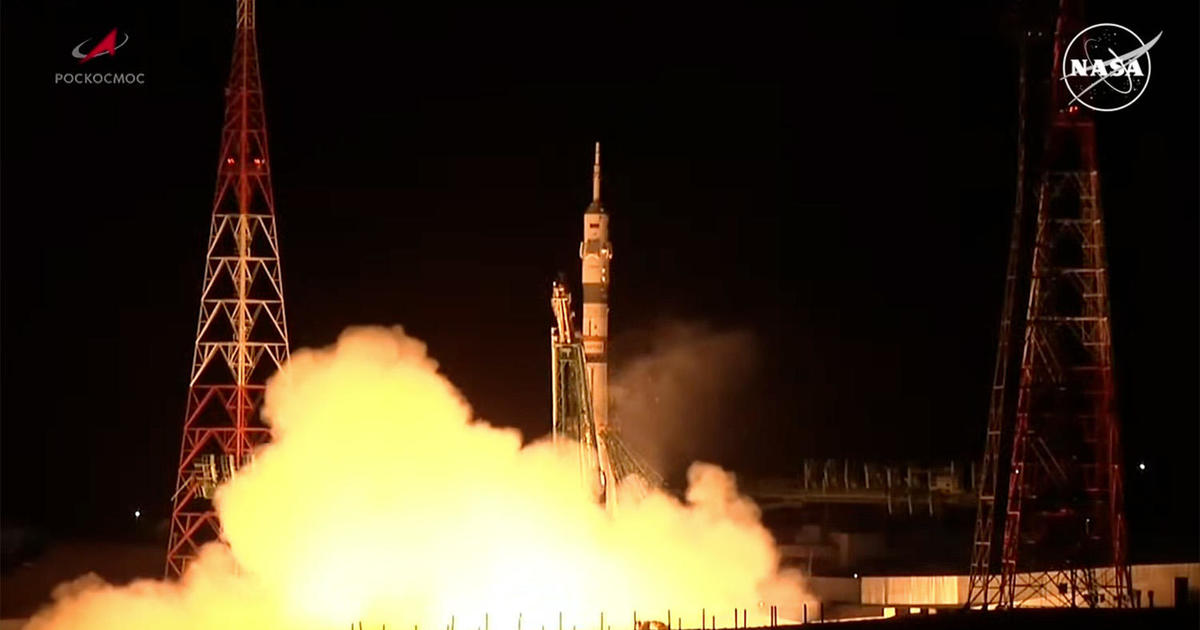
NASA astronaut joins Russian cosmonauts for Thanksgiving Day ride to International Space Station.
In a poignant display of international cooperation and human endeavor, NASA astronaut Chris Williams embarked on his inaugural journey to the International Space Station (ISS) this Thanksgiving Day. He joined two seasoned Russian cosmonauts aboard a Soyuz ferry ship, soaring into the predawn sky from Kazakhstan. The launch, a symbolic blend of tradition and pioneering spirit, saw the trio begin an ambitious mission that underscores the enduring partnership in space exploration between the United States and Russia.
The Soyuz MS-28/74S spacecraft, commanded by veteran cosmonaut Sergey Kud-Sverchkov and flanked by fellow flight engineer Sergey Mikaev and NASA’s Chris Williams, ignited its powerful Soyuz 2.1a booster at precisely 4:27 a.m. Eastern Time. From the historic Baikonur Cosmodrome, a site synonymous with groundbreaking spaceflights, the rocket majestically climbed away, leaving a fiery trail against the still-dark sky. The precision of Russian engineering was evident as the launch proceeded flawlessly, a testament to decades of spacefaring expertise.
Just nine minutes and 45 seconds after liftoff, the Soyuz spacecraft separated from its booster’s upper stage, its two solar wings gracefully unfolding like cosmic petals. This critical maneuver marked the successful insertion into Earth orbit, setting the crew on an automated two-orbit pursuit of the orbiting laboratory. The intricate ballet of orbital mechanics culminated in a seamless docking at the ISS’s Earth-facing Rassvet module at 7:38 a.m. Eastern, uniting the new arrivals with the station’s existing crew.
Chris Williams, whose remarkable career trajectory has spanned astronomy, medical physics, and now space exploration, brings a unique blend of scientific acumen and practical experience to the mission. Before his selection to NASA’s astronaut corps in 2021, Williams had carved a distinguished path. He earned a Ph.D. in astrophysics from MIT, a testament to his early passion for understanding the cosmos. However, his dedication extended beyond academic pursuits. Williams also served as a volunteer firefighter and emergency medical technician (EMT), experiences that instilled in him a profound sense of service and the ability to perform under pressure – qualities invaluable for a career in space.
His transition from studying distant stars to treating terrestrial ailments, then to preparing for space, is particularly compelling. As a board-certified medical physicist at Harvard Medical School, Williams applied his understanding of physics to the critical field of radiation oncology, utilizing radiation to treat cancer. He often recounted how the mathematical principles and imaging techniques he mastered in radio astronomy found direct parallels in medical imaging, allowing him to make significant contributions to patient care. This adaptability and intellectual curiosity were key factors in his selection by NASA.
For Williams, this flight marks his first foray into space, a long-held dream now realized. He is the second member of NASA’s 2021 astronaut class to reach orbit, an achievement that comes after rigorous and demanding training. The preparation for flying on a Russian Soyuz spacecraft involved extensive travel and immersion in Russian culture and language, a challenge Williams openly acknowledged. He credited his wife, Aubrey, for her unwavering support and for maintaining stability at home, allowing him to focus on the arduous training schedule.
Commander Sergey Kud-Sverchkov, leading the mission, is a seasoned space veteran, having logged 185 days aboard the ISS during his 2020-2021 mission. His experience provides invaluable leadership and calm under pressure for the crew, especially for first-time flyers like Williams and Sergey Mikaev. Mikaev, a flight engineer, is also making his maiden voyage to space, sharing the excitement and challenges of a new frontier with Williams.
Williams spoke glowingly of his crewmates, highlighting the strong bond forged during their training. "It’s a really great crew," he shared in a NASA interview. "Sergey and Sergey are both just absolutely wonderful people, really kind, super interested, super intellectually curious, which is really fun. Had a lot of really, really great discussions, just talking and talking about things." He emphasized the positive experiences of training together in both Star City, Russia, and Houston, Texas, underscoring the collaborative spirit that defines international space missions.
The arrival of the Soyuz MS-28 crew initiates a carefully orchestrated crew exchange on the ISS. Williams, Kud-Sverchkov, and Mikaev are replacing Soyuz MS-27/73S commander Sergey Ryzhikov, flight engineer Alexey Zubritsky, and NASA astronaut Jonny Kim, who have been orbiting since April. After an eight-month stay dedicated to scientific research and station maintenance, Ryzhikov, Zubritsky, and Kim are scheduled to return to Earth on December 9.
Awaiting the new arrivals aboard the station was a diverse and experienced seven-member crew: NASA Crew 11 commander Zena Cardman, Michael Fincke, Japanese astronaut Kimiya Yui, and cosmonaut Oleg Platonov. This group launched atop a SpaceX Falcon 9 rocket last August and is slated to return home in February or March, after their replacements, Crew 12, arrive. The momentary expansion to an 11-person crew signifies a busy period for the orbiting outpost, with a flurry of activities planned.
Following their docking and the customary leak checks, all 11 station fliers were set to gather for a traditional welcome aboard video call with mission managers and family members back in Moscow and Houston. This poignant moment, often filled with smiles and emotional greetings, would be followed by a crucial safety briefing and the commencement of the new crew’s familiarization with the ISS’s intricate systems and emergency procedures.
Williams’ personal journey reflects a relentless pursuit of knowledge and a deep commitment to service. An Eagle Scout with a private pilot’s license, he embodies the spirit of exploration. His initial foray into volunteer firefighting and EMT work, which began during his graduate studies at Stanford, provided a grounding in direct human impact that resonated deeply with him. "I got a lot of satisfaction out of knowing that… at the end of the shift, I would have really made a very direct and immediate positive impact on somebody’s life," he explained. This desire to contribute meaningfully ultimately guided his pivot from theoretical astronomy to the practical application of physics in medicine.
His discovery of the need for physicists in radiation oncology proved to be a pivotal moment. Conversations with medical professionals and former astronomers who had transitioned into the field revealed a fascinating convergence of disciplines. Williams recognized that much of his astronomical knowledge, particularly in areas like signal processing and imaging mathematics, was directly applicable to medical diagnostics and treatment planning. "A lot of the math behind (medical) imaging is the exact same math that actually you use in a radio telescope to make an image," he noted, highlighting the unexpected synergy between observing the universe and healing the human body.
Now, as an astronaut, Williams is poised to merge these diverse experiences. His goals for the eight-month mission are clear and deeply rooted in his scientific and service-oriented background. He expresses a fervent desire to "truly be able to put my training into practice and to do a really good job to push forward the science and research that we’re doing on the space station." The ISS serves as a unique microgravity laboratory, enabling groundbreaking research in human physiology, materials science, Earth observation, and fundamental physics – studies critical for understanding our planet, developing new technologies, and preparing for future deep-space missions to the Moon and Mars.
Williams articulated a profound sense of purpose, emphasizing the broader significance of his work. "I think it’s incredibly important. I think it’s incredibly interesting and incredibly inspiring, and I feel really lucky to have the opportunity to contribute to that." His journey, launched on a day of national reflection and gratitude, embodies the spirit of exploration, collaboration, and the relentless human drive to understand and improve our world, both on Earth and beyond. The Thanksgiving Day launch serves as a reminder that even amidst global challenges, the pursuit of scientific discovery and the bonds of international partnership continue to propel humanity forward, reaching for the stars together.