
In Alex Karp’s World, Palantir Is the Underdog
In a landscape increasingly dominated by tech giants and their consumer-focused empires, Palantir CEO Alex Karp cultivates a singular image: that of a defiant outsider, leading a company that, in his view, remains an underdog. This fascinating paradox—a billionaire CEO at the helm of a highly successful, publicly traded company valued in the tens of billions, yet persistently framing his enterprise as an underdog—was a central theme explored in a recent revealing interview conducted by WIRED editor-at-large Steven Levy for the Uncanny Valley podcast. The conversation delved deep into Karp’s unique background, Palantir’s often-misunderstood operations, its controversial government contracts, and the underlying techno-state ideology that has come to define both the company and, increasingly, a segment of Silicon Valley.
Alex Karp is no typical Silicon Valley executive. His background is a rich tapestry of intellect, unconventionality, and personal challenge. Born to a Jewish-American pediatrician father and an African-American artist mother in Philadelphia, Karp’s early life was marked by dyslexia, a condition that, while presenting academic hurdles, also sharpened his intellect and fostered a distinctive perspective. He often credits a supportive teacher at Philadelphia’s Central High School—a magnet school renowned for its academic rigor, which Levy himself also attended—with recognizing his high IQ and encouraging him to pursue greater ambitions despite his struggles. This formative experience, Karp suggests, was a turning point, shaping his intellectual journey. His path diverged significantly from the typical tech founder’s trajectory, leading him to earn a PhD in neoclassical social theory from Germany’s Goethe University, where he even studied under the globally acclaimed philosopher Jürgen Habermas. This profound philosophical grounding informs much of Karp’s worldview and his company’s mission, setting him apart from peers who often emerge from engineering or business schools.
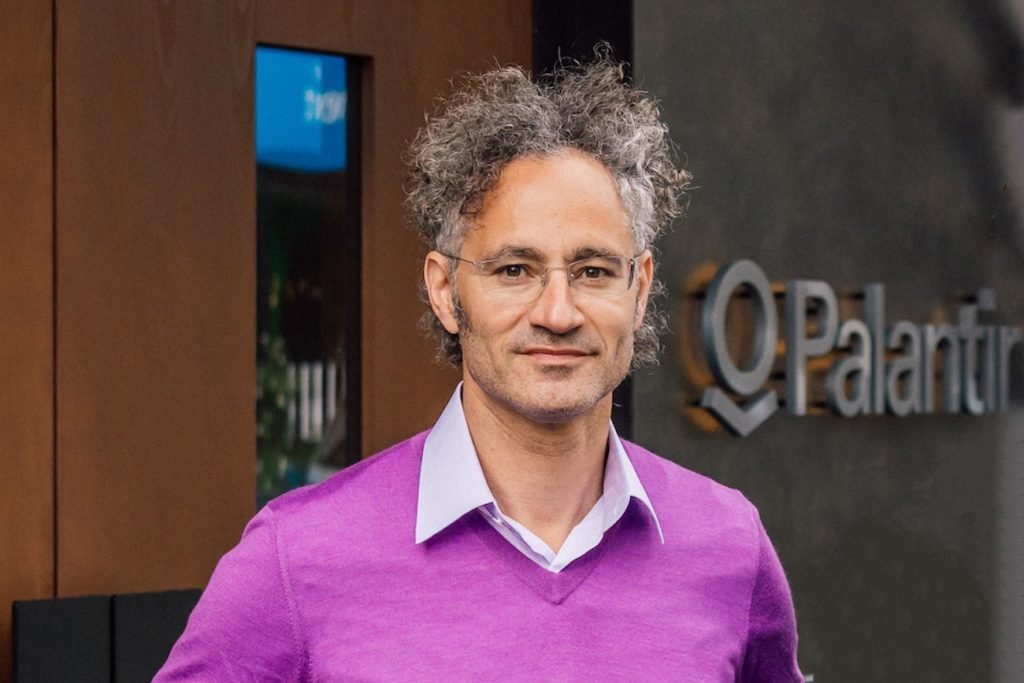
Palantir Technologies, co-founded by Karp and Peter Thiel in the early 2000s, remains an enigma to many, despite its growing public profile and controversial contracts. Dispelling common misconceptions, Palantir is not, at its core, a surveillance company that collects and centralizes vast troves of data. Instead, it operates as an infrastructure provider, offering sophisticated software platforms designed to help large organizations—be they government agencies or private corporations—integrate, analyze, and make sense of their own disparate data sources. Think of it as a complex plumbing system for data, allowing clients to derive actionable insights without having to undertake a monumental, ground-up rewiring of their existing, often antiquated, IT systems.
The company’s flagship products include Foundry, tailored for private corporations, and Gotham, predominantly used by government agencies, alongside its newer AI Intelligence Platform (AIP). Historically, Palantir’s business model leaned heavily on embedded engineers, almost functioning as a consulting firm that sent specialists to solve complex data challenges. This made profitability elusive for years. However, with the maturation of AI technology and the refinement of its software offerings, Palantir has transitioned to a more scalable software-as-a-service model, leading to its recent financial successes, including nearing $1 billion in annual revenue and becoming a top performer in the S&P 500.
Yet, this success is intertwined with significant ethical and political controversy. Palantir’s contracts with clients such as Immigration and Customs Enforcement (ICE), the CIA, and the Israeli government have drawn fierce criticism from human rights advocates, former employees, and the public. In his interview with Levy, Karp staunchly defended these partnerships, particularly those with ICE. He addressed the recent $30 million contract for the ImmigrationOS tool, designed to help ICE gather information on individuals suspected of visa overstays or self-deportation. Critics argue such tools facilitate potentially illegal or inhumane enforcement actions, conflicting with Palantir’s own explicit code of conduct, which pledges to protect privacy, civil liberties, and democratic values.
Karp, however, maintains that ICE’s actions have not crossed an ethical "line" that would compel Palantir to sever ties. He frames the criticism as politically motivated and dismisses claims that current immigration enforcement actions are unprecedented. Similarly, regarding Palantir’s work with the Israeli military, Karp invoked Israel’s status as a "persecuted country," arguing that it is difficult to disengage over "tiny aggressions"—a characterization Levy challenged, specifically mentioning the situation in Gaza. Karp pointed to past instances where he claims Palantir acted on principle, such as refusing to build a Muslim database during the first Trump administration, as evidence of the company’s adherence to its values. However, for many critics, these isolated examples fail to outweigh the broader implications of enabling state surveillance and enforcement capabilities that are seen as detrimental to human rights.
This brings us back to Karp’s insistence on Palantir as an "underdog." Despite its market capitalization and substantial government contracts, Karp frequently expresses a sense of being an outsider, often portraying Palantir and its employees—or "Palantirians"—as operating against the grain of mainstream Silicon Valley. He candidly admitted to Levy that while being unpopular isn’t "fun," this outsider mentality is "useful." It filters out those who seek an easy path, attracting instead a specific type of individual—the "fifth person" who finds the challenge and unique mission compelling. Karp even, somewhat dramatically, referred to himself as a "sacrifice" in this regard, a billionaire living on a 500-acre New Hampshire compound, yet seeing himself as a figure of opposition. This narrative, akin to Philadelphia Eagles legend Jason Kelce’s "Nobody likes us, and we don’t care" rallying cry, serves to galvanize his workforce and differentiate Palantir from its perceived rivals.
Karp’s definition of "competition" further illuminates this "underdog" worldview. When pressed by Levy about traditional business competitors, Karp pivoted, declaring Palantir’s true adversaries to be "political"—specifically, the "woke left and the woke right." He expressed concern that if these ideological factions "get into power," they would "hurt Palantir." This unique framing reveals a deep-seated belief that Palantir is engaged in a cultural and political battle for the soul of technology, rather than merely a commercial one. He sees his company as providing uniquely effective services that no one else can match, implying that any challenge to its market dominance comes from ideological opposition rather than superior products.
Indeed, Palantir and Karp’s "techno-state ideology"—the belief that technology should primarily serve the interests of the state rather than individual consumers—is increasingly gaining traction within Silicon Valley. For years, defense work was considered a pariah in the tech industry. Google employees famously pushed back against Project Maven, an AI contract with the Department of Defense, leading Google to abandon it—a contract Palantir subsequently picked up. However, as Levy highlighted, this sentiment has shifted dramatically. Companies like Anduril, another defense tech startup, thrive, and even established giants like Amazon now openly embrace defense technology. Meta, despite its founder Mark Zuckerberg’s past disagreements with Anduril’s Palmer Luckey, has even forged partnerships in this space. Karp rightly perceives this shift as a victory, stating, "We’ve won that." The industry appears to be returning to its roots, heavily tied to the military-industrial complex, a relationship that was perhaps temporarily overshadowed by the consumer tech boom of the 2000s and 2010s.
This re-alignment of Silicon Valley with national security interests stands in stark contrast to the consumer-centric focus that often leads to what writer Cory Doctorow and professor Tim Wu describe as "enshittification"—the process by which platforms, once useful to users, extract increasing value, becoming less beneficial to their audience and more self-serving. Karp’s disdain for consumer tech, exemplified by his critique of Apple’s Macintosh for its focus on "satisfying people and being fun to interact with" rather than "building patriotic technology," positions Palantir as an antithesis to this trend. Palantir aims for profound, impactful state-level applications, even if those applications remain controversial, rather than the ephemeral delights of consumer apps.
In Alex Karp’s world, Palantir is not merely a software company; it is a philosophical project, a bulwark against what he perceives as the ideological excesses and inefficiencies of both the tech industry and political discourse. His "underdog" narrative, though seemingly at odds with Palantir’s burgeoning success, is a carefully constructed identity that reinforces its unique mission and rallies its adherents. As Silicon Valley continues its complex dance with power, politics, and national security, Palantir, guided by its philosopher-CEO, stands as a potent symbol of this evolving relationship, determined to carve its own path, consequences and criticisms notwithstanding.