The Best Golf Rangefinders
Golf, often lauded as a gentleman’s game, is in reality a relentlessly challenging sport that demands precision, strategy, and an intimate understanding of distance. For any avid golfer striving to shave strokes off their score, embracing technology that offers a tangible advantage is not just desirable, but essential. Among these game-improving tools, the golf rangefinder stands out as a crucial piece of equipment, providing the pinpoint accuracy needed to conquer the Herculean task of guiding a tiny dimpled ball into a small hole from hundreds of yards away.
In the pursuit of identifying the truly exceptional, we’ve undertaken extensive testing of some of the very best rangefinders available on the market. Our rigorous evaluation pits these devices against each other across numerous rounds of golf, scrutinizing key traits such as unwavering accuracy, robust durability, feature-rich functionality, and intuitive ease of use under a diverse array of course conditions. From the verdant fairways to the challenging bunkers, we’ve pushed these rangefinders to their limits, ensuring our recommendations are grounded in real-world performance. We are continuously testing new models as they emerge, so be sure to revisit this guide for the most up-to-date insights and the latest and greatest advancements in golf rangefinder technology.
Whether you’re a seasoned pro or just beginning your golf journey, the right rangefinder can profoundly impact your game, offering confidence with every swing.
Our Top Picks for The Best Golf Rangefinders
Our selection represents the pinnacle of performance and value across various categories, ensuring there’s a perfect rangefinder for every golfer’s needs and budget.
The Best Overall Rangefinder: Nikon Coolshot Pro III Stabilized
Price: Approximately $341 – $530
The Nikon Coolshot Pro III Stabilized emerges as our top recommendation for its unparalleled blend of precision, speed, and revolutionary image stabilization. Nikon, a name synonymous with optical excellence, brings its expertise to the golf course, delivering a rangefinder that significantly reduces the natural hand shake that can plague accurate distance readings. This stabilization technology is a game-changer, especially when targeting distant pins or trying to acquire a reading in windy conditions, ensuring a steady, clear view every time.
Beyond its stabilization prowess, the Coolshot Pro III boasts an incredibly fast measurement response, locking onto targets almost instantaneously. Its bright, high-resolution OLED display provides a crisp, easy-to-read overlay of distances, even in varying light conditions. The device also features a reliable slope compensation function, providing "plays like" distances that account for elevation changes, which can be easily toggled off for tournament play via an external switch and a visible LED indicator. Encased in a robust, weather-resistant body, it feels premium in hand and is built to withstand the rigors of frequent use on the course. For serious golfers who demand the utmost in accuracy and a stable viewing experience, the Nikon Coolshot Pro III Stabilized is an investment that truly pays dividends.
Pros: Exceptional image stabilization, rapid target acquisition, bright OLED display, premium optics, accurate slope compensation with tournament mode, robust build quality.
Cons: Premium price point.
The Best Budget Rangefinder: Shot Scope Pro L2 Rangefinder
Price: Approximately $130 – $150
For golfers who prioritize essential functionality and reliable performance without a hefty price tag, the Shot Scope Pro L2 Rangefinder is an undeniable champion. This device proves that you don’t need to spend a fortune to get accurate distances and enhance your game. The Pro L2 excels at the fundamentals, offering quick and precise laser measurements to the flag or any other target on the course.
Its clear, crisp LCD display is easy to read, and the device features a reliable flagpole lock function with vibration feedback, confirming when you’ve successfully targeted the pin rather than a background object. The ergonomic design ensures a comfortable grip, and its compact size makes it easy to carry in your pocket or attach to your bag. While it may not boast advanced features like image stabilization or a sophisticated OLED screen, the Shot Scope Pro L2 delivers exactly what most golfers need: accurate, consistent distances in a user-friendly package. It’s an ideal choice for beginners, casual players, or anyone looking for a dependable rangefinder that offers incredible value for money.
Pros: Outstanding value, highly accurate laser, easy-to-use interface, flagpole lock with vibration, compact and ergonomic design.
Cons: Lacks image stabilization, more basic display compared to premium models.
The Best Compact Rangefinder: Bushnell A1-Slope Rangefinder
Price: Approximately $230 – $300
Bushnell has long been a titan in the golf rangefinder market, and their A1-Slope Rangefinder reinforces their reputation, particularly for those who value portability without compromising on performance. Designed with a minimalist aesthetic and an incredibly compact footprint, the A1-Slope is perfect for golfers who prefer to walk the course or simply want a device that slips easily into a pocket or a small compartment on their bag.
Despite its diminutive size, this rangefinder packs a punch. It features Bushnell’s renowned accuracy and a reliable slope compensation technology that provides adjusted distances for uphill and downhill shots, crucial for precise club selection. Like other top models, it includes a tournament mode that deactivates the slope function, indicated by a visible external switch. The optics are clear, allowing for quick target acquisition, and its durable, weather-resistant casing ensures it can handle various course conditions. The Bushnell A1-Slope is the ideal companion for golfers seeking a lightweight, unobtrusive rangefinder that still delivers the precision and features expected from a top-tier brand.
Pros: Ultra-compact and lightweight, highly accurate slope readings, Bushnell’s trusted reliability, clear optics, durable and weather-resistant.
Cons: Smaller form factor might not appeal to everyone, no image stabilization.
The Best All-in-One: Mileseey Golf GenePro G1 GPS Rangefinder
Price: Approximately $499 – $600
The Mileseey Golf GenePro G1 GPS Rangefinder redefines what an "all-in-one" golf device can be, seamlessly integrating the pinpoint accuracy of a laser rangefinder with the comprehensive course intelligence of a GPS system. This innovative device is designed for the tech-savvy golfer who desires maximum data and strategic insights directly from their rangefinder.
The GenePro G1 features a vibrant touchscreen display that provides not only laser-measured distances but also dynamic 2D course maps, detailed hazard information, and distances to the front, middle, and back of greens. With preloaded courses, it eliminates the need for a separate GPS watch or app, streamlining your on-course data. The laser functionality includes a flagpole lock with vibration feedback, ensuring you’re targeting the correct object. While the integrated GPS functionality is incredibly powerful for course management, especially on unfamiliar layouts or for blind shots, it’s worth noting that using the touchscreen and GPS features continuously can impact battery life more significantly than a laser-only device. For golfers who want every piece of information at their fingertips and a truly versatile tool, the Mileseey GenePro G1 is an advanced and powerful choice.
Pros: Combines laser accuracy with full GPS course maps and hazard data, intuitive touchscreen interface, preloaded courses, vibration feedback, comprehensive all-in-one solution.
Cons: Higher price point, integrated GPS can lead to faster battery drain, potential for "data overload" for some users.
Understanding Golf Rangefinders: A Comprehensive Buyer’s Guide
Navigating the myriad of features available in modern golf rangefinders can be daunting for novices and experienced players alike. To help you make an informed decision, here’s a deeper dive into the key aspects to consider.
1. What Kind of Rangefinder Features Should I Expect?
Modern rangefinders are packed with technologies designed to make your game easier and more accurate. The most critical features we assess include:
- Slope Measurement: This is arguably one of the most impactful features. It calculates the "plays like" distance by factoring in elevation changes (uphill or downhill). This data is invaluable for selecting the correct club, ensuring you don’t under- or over-club on elevated shots.
- PinSpotter/Flagpole Lock: This technology helps the rangefinder lock onto the flagstick, ignoring background targets like trees or hills, and often provides a vibration to confirm acquisition.
- Image Stabilization: As seen in the Nikon Coolshot Pro III, this feature counteracts natural hand tremors, providing a steady view and making it easier to lock onto targets, especially at longer distances.
- Weatherproofing: Look for devices with good water and dust resistance (often indicated by an IPX rating) so you can play confidently in light rain or misty conditions.
- Tournament Mode: Since slope measurement is generally prohibited in sanctioned tournaments, most high-end rangefinders include a switch to easily toggle the slope function off, typically indicated by an LED or a visible stripe on the device.
- Cart Magnet: A convenient feature that allows you to attach your rangefinder directly to your golf cart frame, keeping it easily accessible.
- Display Type: OLED (Organic Light Emitting Diode) displays offer brighter, clearer visuals, especially in low light, compared to traditional LCDs.
- Bluetooth Connectivity: Some models offer Bluetooth to pair with smartphone apps for score tracking, course updates, or seamless integration with other golf devices like smartwatches for GPS data.
- Advanced Features: Premium models might offer even more data, such as wind speed and direction, temperature compensation, or even shot tracking capabilities. While impressive, consider if you truly need these extras, as they often come with a significant price increase.
2. Laser vs. GPS: The Right Choice for You
This is a common point of confusion.
- Laser Tracking: The majority of rangefinders primarily use laser technology. They emit a laser beam to a target and measure the time it takes for the beam to return, providing highly precise, real-time distances to anything you point it at. The main limitation is that you need a clear line of sight to your target.
- GPS Data: GPS-enabled devices (like smartwatches or dedicated handheld GPS units) provide distances to pre-mapped points on the course (front, middle, back of green, hazards). They don’t require line of sight, making them great for blind shots or understanding overall course layout. Their accuracy can vary, and they rely on updated course maps.
- Hybrid Devices: Some innovative rangefinders, like the Mileseey GenePro G1 or certain Garmin models, integrate both laser and GPS. This offers the best of both worlds: pinpoint laser accuracy when you have line of sight, and comprehensive GPS data for strategic overview, hazards, and blind shots. Be aware that constant GPS usage can drain battery life more quickly.
We primarily rely on laser tracking as the most important guideline and performance metric for our testing due to its unparalleled precision to specific targets. However, when properly integrated, GPS can be a handy addition, especially for playing new courses or navigating longer, complex holes.
3. The Importance of Slope Measurement
As mentioned, slope in relation to golf rangefinders is essentially the measurement of how many yards upward or downward the ball must travel to reach its destination. It is a key feature for providing accurate "plays like" club data. All of the rangefinders we test can be set to measure slope, giving you both the actual distance and the adjusted distance by accounting for elevation gained or lost. This significantly improves shot accuracy. Remember, for competitive tournament play, slope measurement is generally prohibited, which is why all recommended models offer an easily accessible Tournament Mode to display only the actual distance.
4. What Kind of Magnification Do I Need?
All of the rangefinders on our list offer a minimum of 6X object magnification, which is adjustable with a lens focus. In our extensive tests, this magnification level proved more than sufficient for accurately measuring any distance on the course. While some models may boast 7X magnification or higher, which might be useful for individuals who require additional visual assistance, for the vast majority of players, 6X magnification will provide all the clarity and precision needed. Higher magnification can sometimes also reduce the field of view, making it slightly harder to initially locate targets.
5. Is a Rangefinder’s Maximum Range Important?
The short answer for most golfers is probably not. Every rangefinder featured on our list offers more than enough range for any practical shot on a golf course, with even our most budget-friendly recommended model providing a minimum range of 700 yards. Considering that even the longest drives typically fall well short of 400 yards, and approach shots are rarely beyond 250-300 yards for most players, any range beyond 700 yards is largely "stat padding" by the manufacturer. While it theoretically could come into play in extremely niche scenarios, focusing on accuracy, speed, and features within a practical golf range is far more important than chasing exaggerated maximum distance specifications.
Honorable Mentions
The golf rangefinder market is rich with excellent options, and while not every model makes our top-tier list, many could still be a fantastic fit depending on your specific needs and preferences.
- Bushnell Tour V6 Shift: A consistently high-performing rangefinder from a leading brand. The Tour V6 Shift is renowned for its BITE magnetic mount, PinSeeker with Visual JOLT technology, and an incredibly fast, accurate laser. Its "Shift" mechanism allows for seamless toggling between slope-compensated and tournament-legal distances. It offers a premium feel and reliable performance that makes it a favorite among many serious golfers.
- Garmin Approach Z30: For those deeply embedded in the Garmin ecosystem, the Approach Z30 offers exceptional integration. While primarily a laser rangefinder, it can leverage Garmin’s extensive GPS data when paired with a compatible Garmin smartwatch or smartphone app, providing comprehensive course information. It boasts a crisp display and Garmin’s reputation for robust, user-friendly technology.
Our Rigorous Testing Process for Golf Rangefinders
We believe that the only true way to properly assess the performance of golf rangefinders is exactly how they’re intended to be used: on the golf course, under real playing conditions. While they might be fun to experiment with elsewhere—essentially being small, sophisticated telescopes—their true capabilities and limitations only become apparent on the links.
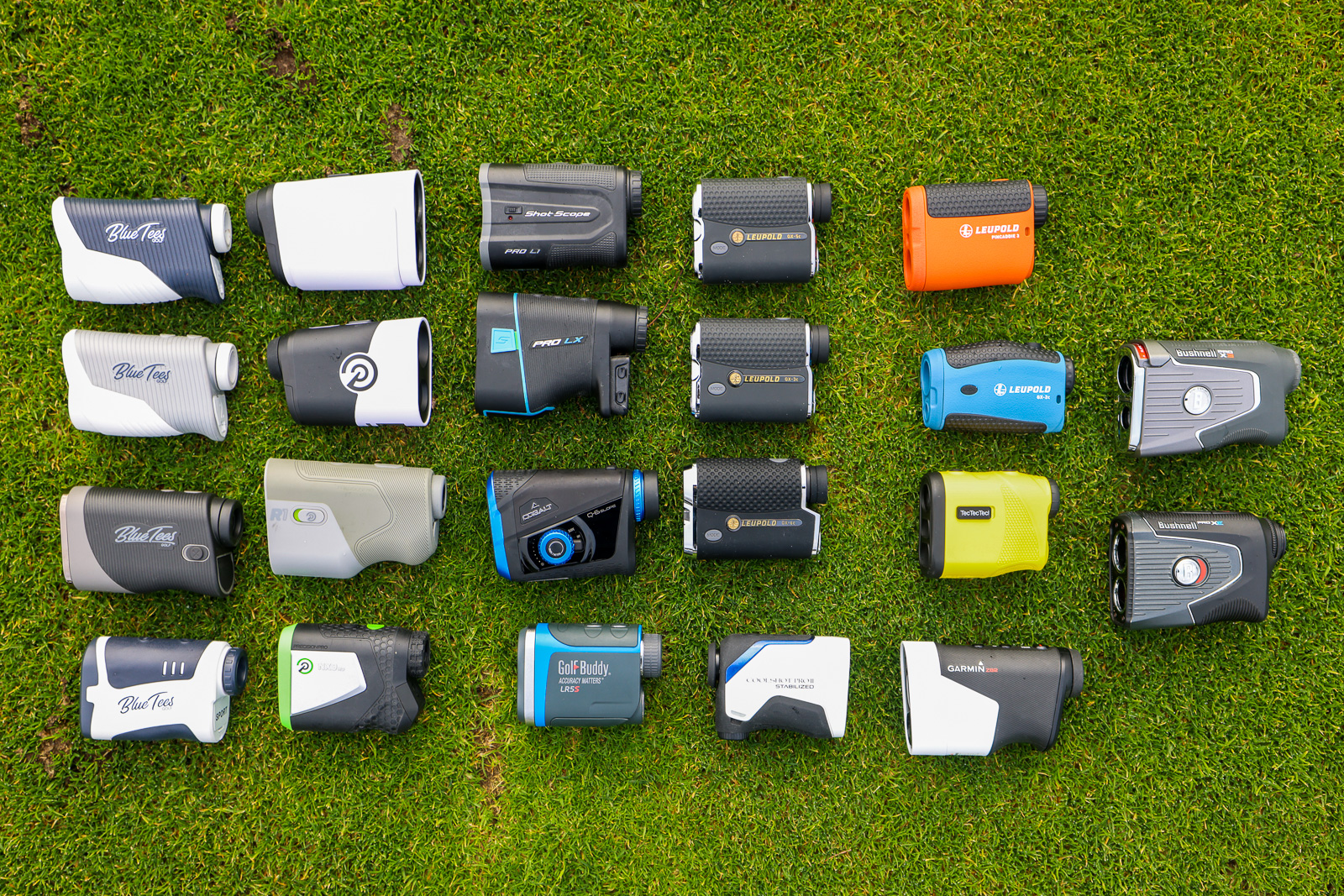
Our testing regimen is designed for thoroughness and practical relevance. We test all featured rangefinders across multiple local courses, encompassing a variety of terrains from flat, open layouts to hilly, tree-lined, and water-heavy designs. This diversity allows us to evaluate performance across different scenarios. Crucially, we use these rangefinders back-to-back (often carrying three or four at a time) for direct comparison on the same targets, over multiple rounds. This might occasionally raise an eyebrow from our fellow golfers, but it is indispensable for accurately gauging differences in accuracy, clarity of optics, and overall ease of use.
Every feature is meticulously tested: from navigating menu settings and engaging pin targeting modes, to assessing how reliably their side magnets adhere to a golf cart. We evaluate the speed of target acquisition, the consistency of readings, the brightness and readability of displays in varying light, battery life, and ergonomic factors like grip comfort and button placement. Furthermore, we treat these devices as roughly as you might expect to treat your own gear, exposing them to light bumps, dust, and occasional moisture to gauge their real-world durability. Our goal is to provide recommendations based on comprehensive, real-world performance that golfers of all skill levels can trust to enhance their game.