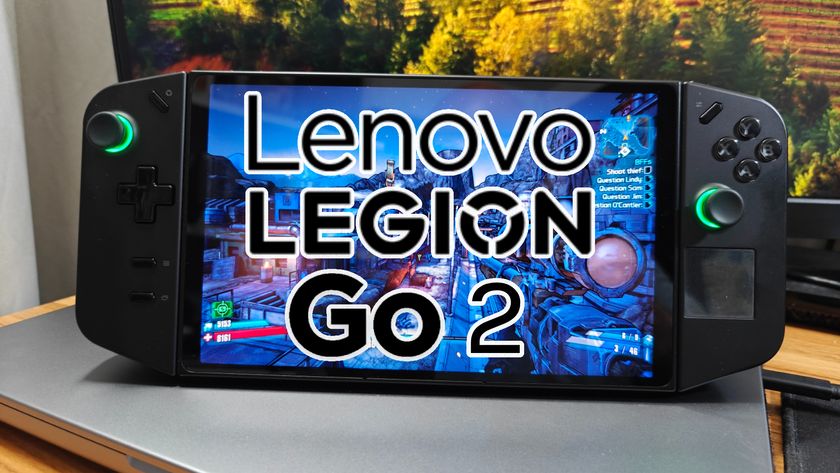
Lenovo’s Legion Go 2 Is a Good Handheld for Power Users
The Lenovo Legion Go 2 emerges as a formidable contender in the rapidly expanding handheld gaming PC market, meticulously designed with the discerning "power user" in mind. It distinguishes itself not merely through raw specifications but through a thoughtful integration of features that enhance portability, usability, and overall gaming immersion. From its innovative modular design to its high-fidelity display and robust internal hardware, the Legion Go 2 aims to redefine expectations for what a portable gaming device can achieve, providing a comprehensive solution for gamers who demand flexibility, performance, and a premium experience on the go.
One of the most striking and immediately beneficial aspects of the Legion Go 2’s design is its system of detachable controllers. This ingenious feature goes a long way towards making the device significantly more portable and adaptable to various usage scenarios. Unlike fixed-controller handhelds that often force a singular mode of interaction, the Legion Go 2’s removable controllers unlock a spectrum of possibilities. This modularity not only aids in reducing the overall footprint of the device when packed away, making it easier to slip into a bag, but also fundamentally alters how one can engage with their games. The ability to separate the controllers from the main display unit means that users are no longer tethered to a single, potentially uncomfortable, ergonomic position. This flexibility is a game-changer for extended play sessions, preventing fatigue and offering a level of comfort that fixed-controller designs simply cannot match.
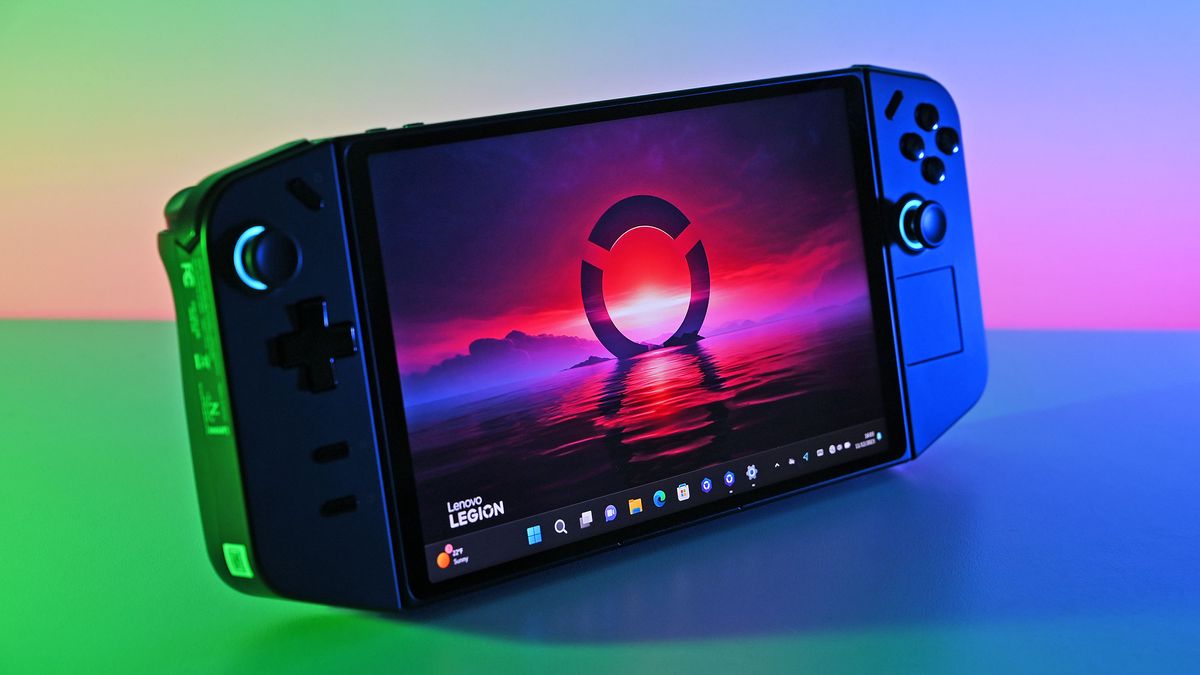
Complementing this modularity is the hefty flip-out kickstand located on the back of the screen. This robust stand transforms the Legion Go 2 into a versatile mini-console. I’ve personally found it far more comfortable and ergonomic to park the main console unit on a table, a bar, or even a tray table during travel, and then hold the detached controllers at a more natural lap level. This setup mimics the experience of playing on a home console, allowing for a relaxed posture without the strain of holding the entire device’s weight for prolonged periods. The kickstand itself is engineered for stability, providing a secure base for the vibrant display, and its sturdy construction suggests durability, an important consideration for a device intended for frequent travel and varied environments. This dual approach to design—detachable controllers and a reliable kickstand—underscores Lenovo’s commitment to user-centric ergonomics and versatility, catering to the nuanced preferences of serious gamers.
The substantial build quality of the Legion Go 2 extends directly to its controllers, which boast comfortable built-in grips. These grips are meticulously sculpted to fit naturally into the hands, providing a secure and pleasant hold that significantly reduces hand strain during intense gaming marathons. Beyond the physical comfort, the controllers are equipped with smooth magnetic Hall effect sticks. For the uninitiated, Hall effect joysticks utilize magnets and electrical fields rather than physical contacts, virtually eliminating the dreaded stick drift that plagues traditional potentiometric joysticks. This translates to superior accuracy, greater durability, and a consistently responsive gaming experience—a crucial detail for power users who demand precision and longevity from their hardware. The buttons, too, are a delight; they possess a soft yet distinct touch, offering satisfying tactile feedback without being overly clicky or mushy. This careful balance ensures that every input feels intentional and precise, contributing to an overall premium control experience. The triggers and shoulder buttons also follow suit, providing a responsive and comfortable actuation that stands up to the demands of various gaming genres, from fast-paced shooters to intricate RPGs.
Beyond the core hardware, there are two minor yet highly impactful inclusions that profoundly elevate the user experience. The first is the provision of an included carrying case. While seemingly a small detail, its significance cannot be overstated in the realm of handheld gaming consoles. Many competing devices in this category often ship without a case, leaving users scrambling to find adequate protection. Given that these handhelds are rarely standard-sized, sourcing a suitable third-party case, particularly around the time of release, can be a frustrating and often expensive endeavor. Lenovo preempts this issue by bundling a semi-soft pouch with the Legion Go 2. While I wouldn’t necessarily entrust this pouch to protect my new device in the harsh environment of a checked airline bag, it provides ample peace of mind for daily commutes or adventures. I’m totally comfortable tossing it into my backpack for a bike ride, knowing that the device is shielded from minor bumps and scratches. An additional thoughtful touch within the case is a dedicated spot for the FPS mode accessories, highlighting Lenovo’s attention to detail and catering to users who might leverage the Legion Go 2’s more unique features. This inclusion not only adds immediate value but also saves users time and potential hassle.
The second thoughtful feature is the integrated fingerprint sensor. In an age where security and convenience are paramount, this sensor proves to be an invaluable addition. It works consistently and quickly, allowing for swift and secure authentication. This is a monumental improvement over the cumbersome process of trying to type in a complex password on a touchscreen every time you wake the system up—a common annoyance on other portable devices. While its placement might be slightly awkward initially, requiring a small adjustment period, the sheer convenience it offers far outweighs this minor ergonomic consideration. The ability to instantly unlock the device and jump straight into gaming or productivity tasks streamlines the user flow, making the Legion Go 2 feel more refined and user-friendly. These two seemingly minor inclusions collectively contribute significantly to the overall polish and practicality of the device, cementing its status as a well-rounded option for power users.
Stepping into the heart of the machine, the performance of the AMD Z2 processor in the Legion Go 2 is thankfully a substantial leap forward, much better than the Z2 Go found in the previous Legion Go S model. This upgrade is critical for power users who prioritize raw gaming capability. To put its prowess into perspective, I ran Cyberpunk 2077‘s benchmark at native resolution with settings maxed out (though ray tracing was thankfully off for a fair comparison). The Legion Go 2 delivered a respectable 20 FPS. While this might sound rough when compared to high-end desktop gaming numbers, it is genuinely impressive for a compact gaming handheld. The sheer graphical intensity of Cyberpunk 2077 makes achieving such frames at native, maxed settings on a portable device a testament to the Z2’s capabilities. For reference, the Z2 Go, in contrast, only managed the same 20 FPS with graphics settings dialed all the way down to low at the same resolution. This direct comparison starkly illustrates the significant generational performance uplift, demonstrating that the Legion Go 2 is engineered to tackle modern AAA titles with far greater competence. With just a little tweaking, such as lowering a few non-essential settings or opting for a slight resolution drop (perhaps leveraging FSR or similar upscaling technologies), you could easily break the coveted 60 FPS barrier in one of the most demanding modern games, providing a smooth and highly enjoyable experience.
The performance narrative brightens even further with indie titles. On recently released games like Ball x Pit, the frame rate meter stays glued to the screen’s impressive 144-Hz limit. This is excellent news for power users, as it means you’ll regularly be able to take full advantage of the display’s buttery-smooth refresh rate. Whether it’s a fast-paced platformer, a rhythm game, or a visually rich indie adventure, the Legion Go 2 ensures a fluid and responsive experience that enhances immersion and playability. This consistent high frame rate capability on less demanding titles not only showcases the Z2’s efficiency but also highlights the synergy between the powerful internal hardware and the high-refresh-rate display.
The panel itself is a true showstopper. It’s an OLED display, and it is undeniably one of the best gaming handheld screens I’ve tested yet. The benefits of OLED technology are immediately apparent: full, vivid colors burst forth, and black levels are profoundly deep and dark, creating an unparalleled sense of contrast and immersion. This visual fidelity elevates every game, making environments feel richer and characters more lifelike. The screen measures a respectable 336 nits at maximum brightness, ensuring visibility in most indoor and even some outdoor conditions. More impressively, however, is its color accuracy and coverage. It covers a full 100 percent of the sRGB spectrum and an exceptional 94 percent of the AdobeRGB spectrum, with an incredibly low .86 color accuracy delta. To put this into context, these figures are not just excellent for a gaming handheld; they are on par with some of the best professional-grade laptops and dedicated computer monitors. This level of color precision means that games are displayed exactly as their creators intended, with no washed-out hues or inaccurate tones. It’s a delight to play on, offering a visual experience that rivals much larger and more expensive setups. Despite its glossy finish, which typically invites reflections, I didn’t encounter any game-breaking issues with heavy reflections or glare in practical use, further cementing its status as a premium display solution. The combination of OLED’s inherent advantages, high brightness, exceptional color accuracy, and a swift 144Hz refresh rate makes the Legion Go 2’s display a cornerstone of its appeal for power users who demand nothing but the best visual experience.
In conclusion, the Lenovo Legion Go 2 is a genuinely good handheld for power users, meticulously crafted to meet the demanding expectations of those who seek more than just casual gaming on the go. Its innovative design, highlighted by the versatile detachable controllers and robust kickstand, offers unparalleled flexibility and ergonomic comfort, adapting seamlessly to various playstyles and environments. The thoughtful inclusion of a protective carrying case and a swift fingerprint sensor underscores Lenovo’s commitment to a polished and convenient user experience, addressing common pain points found in other handhelds. Underneath its elegant exterior, the upgraded AMD Z2 processor delivers a commendable performance boost, capable of handling demanding AAA titles with surprising competence while excelling with indie games. However, it is the stunning OLED display that truly sets the Legion Go 2 apart. With its vibrant colors, deep blacks, high refresh rate, and professional-grade color accuracy, it provides an immersive visual feast that elevates every gaming session. The Legion Go 2 doesn’t just offer raw power; it provides a holistic, premium, and highly customizable gaming experience that caters directly to the discerning power user, solidifying its position as a top-tier contender in the portable gaming market.