The Best Motorola Phones (2025), Tested and Reviewed
Motorola phones are experiencing a significant resurgence, moving beyond their traditional role as a distant third or fourth contender behind industry giants like Samsung and Google. The winds of change are indeed blowing, with Motorola now recognized as one of the fastest-growing mobile companies globally. This impressive growth is underpinned by strategic innovation, particularly in the competitive foldable market, where its Razr flip smartphones have claimed the number one spot in North America’s flip category. The company has also masterfully diversified its Android phone lineup, experimenting with vibrant colors and unique textures that help its devices stand out in a sea of generic glass slabs, offering a refreshing aesthetic alternative.
For an eager buyer, navigating Motorola’s extensive annual release schedule can be daunting. Having rigorously tested almost every model, this comprehensive guide will dissect the pros and cons, steering you toward the standout Moto models of 2025. From the premium Razr Ultra to the budget-friendly Moto G Stylus 2025, we cover all the bases to help you make an informed decision.

Beyond this guide, explore our other mobile buying resources, including the Best Android Phones, Best Samsung Phones, Best Cheap Phones, Best Pixel Phones, and Best Phones With a Headphone Jack. This guide has been meticulously updated in November 2025, incorporating the latest models such as the Moto G Play 2026 and providing insights into the new Moto G lineup.
What’s WIRED About Motorola Phones?
Motorola phones feature a clean Android interface. One of Motorola’s most enduring strengths is its commitment to a near-stock Android experience. This philosophy means the company avoids heavily skinning the software, resulting in a simple, intuitive, and easy-to-use interface that appeals to Android purists. While there has been an increasing presence of bloatware in recent years, the good news is that most of it can be easily uninstalled, allowing users to maintain a clutter-free environment.
They come with ample storage. Motorola consistently offers generous internal storage, often setting 256 GB as the standard even for some of its more affordable models. This stands in stark contrast to many Android flagship devices that still ship with a mere 128 GB. Furthermore, Motorola remains one of the few brands to still include a microSD card slot on many of its devices, offering users the flexibility to expand storage further. The popular Moto G series notably retains the beloved 3.5mm headphone jack, a feature that has all but vanished from higher-end smartphones.
There’s broad carrier support. Unlike some niche Android phone brands, such as Nothing, which can have inconsistent carrier compatibility in the US, Motorola phones typically offer broad support across most, if not all, major networks. The company provides clear carrier support details in the specifications section of all its phones, ensuring compatibility with the big three: T-Mobile, AT&T, and Verizon. Always ensure you purchase an unlocked model for maximum flexibility.
The prices frequently dip. A golden rule for Motorola buyers: never purchase a Motorola phone at its Manufacturer’s Suggested Retail Price (MSRP). These devices almost invariably go on sale a few months (or even weeks) after launch, often with significant discounts, making them an even more attractive proposition for budget-conscious consumers.
What’s TIRED About Motorola Phones?
Motorola’s software updates are lackluster. Despite some gradual improvements, Motorola’s software update policy continues to lag behind its primary competitors. While high-end smartphones are now promised three Android OS updates and four years of bimonthly security updates, this still falls short compared to industry leaders. Most Moto G phones traditionally received only one OS Android update, though newer devices are now getting two, alongside three years of security updates. Fewer updates mean users miss out on new Android features and crucial security patches more quickly. Even when updates are promised, they often take a considerably long time to arrive, impacting the user experience and device longevity.
The cameras are underwhelming. One of the most significant factors holding Motorola back from truly competing with powerhouses like Samsung, Apple, and Google is its camera performance. While Moto phones are capable of taking decent photos in ideal conditions, they are consistently eclipsed by their peers, especially in challenging lighting or complex scenes. Although Motorola has made some strides with its high-end phones, the overall camera system still trails behind the competition, lacking the consistency, computational photography prowess, and dynamic range found in rival devices.
There’s no always-on display (on most models). A common and highly appreciated feature on most Android phones is the always-on display, which shows a clock, notifications, and other glanceable information even when the screen is "off." Motorola’s alternative, Peek Display, requires users to move the phone or tap the screen to activate it. While not a deal-breaker for everyone, it’s a feature many users migrating from other Android phones will undoubtedly miss. It’s worth noting that newer Razr devices have finally incorporated always-on displays, but this functionality is still notably absent from the company’s other product lines.
Razr Ultra (2025)
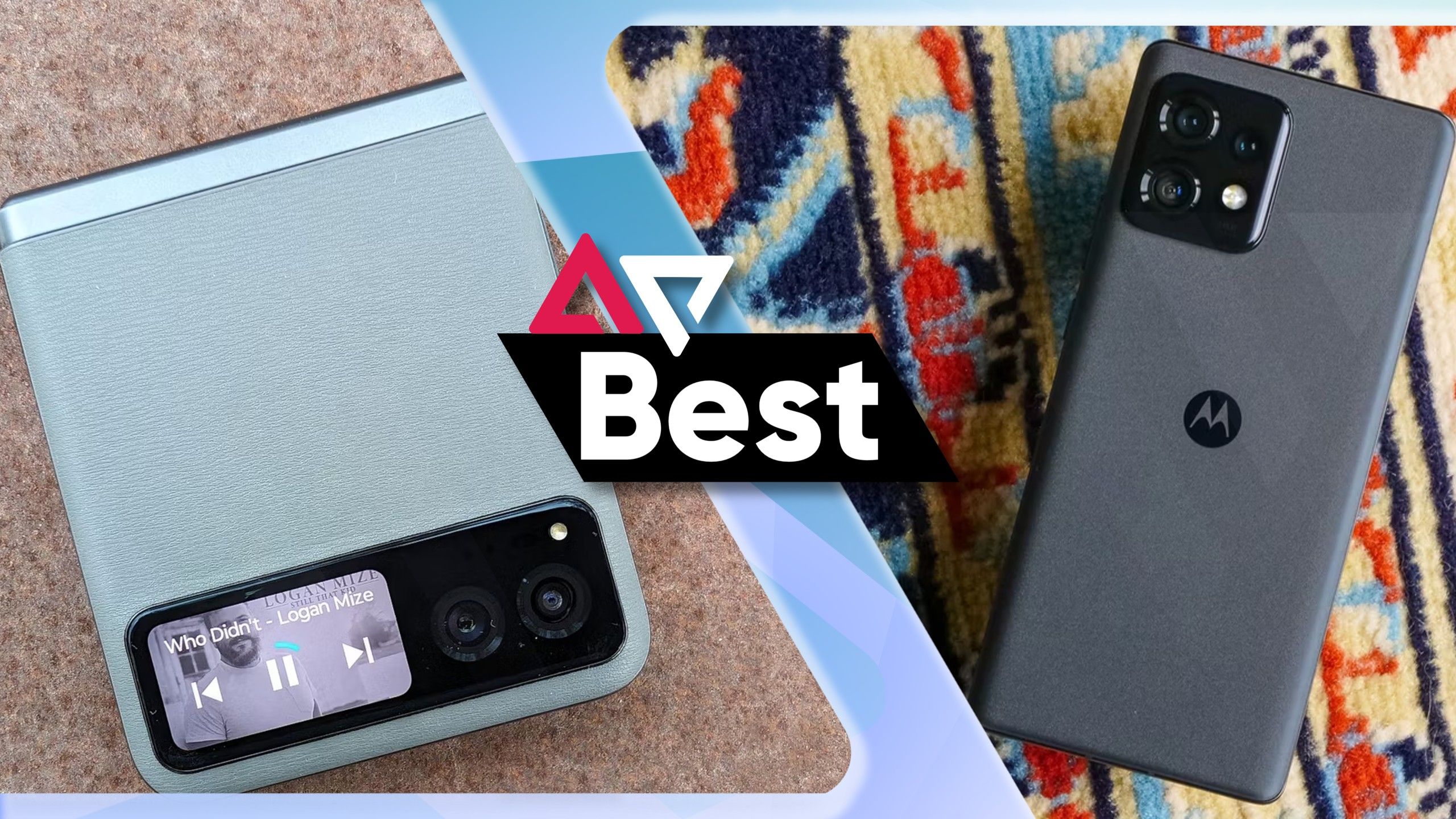
The Razr Ultra (2025) stands out as Motorola’s most compelling argument against its Samsung, Apple, and Google counterparts. More than just a compact folding flip phone, it’s a true statement piece, offered in an array of sophisticated and stylish designs that inject personality into a market often criticized for its uniformity. The "Mountain Trail" variant features sustainably sourced wood, providing a unique tactile and eco-conscious appeal. "Scarab" marks the first-ever use of luxurious Alcantara on a smartphone, offering an unparalleled soft-touch finish. The "Rio Red" boasts a premium leather-inspired texture, while "Cabaret" captivates with a satin-like feel. You’ll be hard-pressed to find another phone that exudes such fashion-forward elegance and individuality today.
The expansive 4-inch external OLED screen has received significant enhancements, offering more customization options than ever before. Users can now add a greater variety of widgets for at-a-glance information, minimizing the need to constantly open the phone. Once unfolded, the device reveals a stunning 7-inch AMOLED display that is exceptionally sharp, vibrantly bright, and incredibly smooth, thanks to its impressive 165 Hz refresh rate. Motorola has also bolstered the Razr Ultra’s durability, incorporating a new Gorilla Glass Ceramic mixture for the screens, which significantly improves crack resistance. The titanium-reinforced hinge design is engineered for enhanced strength and longevity. Crucially, it now carries an IP48 rating, offering a degree of proper dust protection and splash resistance, though it’s not designed for full submersion.
Under the hood, Motorola has packed the Razr Ultra with flagship-grade features, justifying its premium price tag. From a generous 512 GB of internal storage to the cutting-edge Snapdragon 8 Elite chipset, performance is unequivocally robust. Apps launch instantly, and demanding games run smoothly without a hitch. This iteration of the Razr Ultra also boasts the largest battery ever integrated into a Razr, a substantial 4,700 mAh unit. In my testing, it reliably powered through a full day of average use, though power users who accumulate extensive screen time might find themselves reaching for the charger before bedtime. Fortunately, it supports both fast wired charging (Motorola’s 68W TurboPower) and wireless charging, offering flexible power-up options.
The camera system on the Razr Ultra (2025) represents a notable improvement. The 50-megapixel primary camera and the equally capable 50-megapixel ultrawide sensor can capture impressive photos in good lighting conditions. However, achieving great results in low light still requires careful technique, as Motorola’s Night mode function is confusingly tucked away in the "More" tab of the camera app and does not automatically activate. The most significant advantage is the ability to utilize these superior primary cameras—traditionally located on the "back" of the phone but now accessible on the front when folded—to snap high-quality selfies, with real-time previews on the external screen. These yield some of the sharpest and most detailed selfies you’ll ever capture.
Video capture has also seen substantial enhancements on the Ultra, surpassing any previous Motorola phone. By manually enabling Dolby Vision, users can record well-exposed footage that exhibits minimal graininess or shakiness. While the overall camera results, both in photos and videos, may not quite match the absolute best at this price point from competitors, this still represents Motorola’s most advanced and capable camera system to date.
The software experience is largely excellent, though it’s somewhat marred by Motorola’s aggressive marketing of its artificial intelligence features. With a plethora of options like Copilot, Perplexity, Gemini, and Moto AI, there’s even a dedicated AI button. However, in practice, I found Moto AI to be less intuitive or helpful than advertised. Features like "Pay Attention," which initiates recording with real-time transcriptions, are handy for interviews but are common across many phones, and Motorola’s implementation often feels inferior. The enduring disappointment remains Motorola’s software update policy, which continues to lag behind its rivals, a significant drawback for a flagship device.
As always, I strongly recommend waiting for a major sale event, as Motorola phones are frequently discounted. While the Razr Ultra is the most expensive Razr to date, it becomes an exceptional purchase once its price drops closer to the $1,000 mark. Its ultra-compact form factor fits effortlessly into any pocket or purse, its fashionable design will turn heads, and the satisfying snap of ending a call with a flip remains an unmatched experience.
The Best Cheap Folding Phone: Razr (2025)
You don’t need to break the bank to own a quality folding flip phone. The Razr (2025) justly earns our "Most Improved" award, primarily because its performance is finally not as choppy as on previous models. While you might still encounter an occasional stutter, it’s no longer a defining characteristic of this phone. My overall experience with it wasn’t drastically different from the Razr Ultra in day-to-day tasks—battery life is roughly comparable, comfortably lasting a full day with average use, and both internal and external screens are bright and vibrant, even if slightly smaller.
The cameras are the Razr (2025)’s primary weak point when compared to its Ultra sibling. While it can still capture pleasing photos in good lighting, it struggles more noticeably in high-contrast scenes, produces grainier images in low light, and the processing can result in a somewhat artificial look. Skin tones and colors also tend to be less accurate than on the pricier model, and video capture quality is distinctly inferior. Nevertheless, considering its compelling $700 price point for a folding smartphone, the Razr (2025) offers incredible value, all while maintaining a gorgeous and stylish design.
Best Moto G Phone: Moto G Stylus 2025
The Moto G Stylus 2025 currently stands as the best Moto G phone, a status that might seem obvious given it’s the priciest model in the family. However, at an MSRP of $400 (and frequently on sale for under $300), it represents one of the best smartphone values on the market. As its name implies, it comes equipped with a built-in stylus—a feature rarely found outside of Samsung’s premium $1,300 Galaxy S25 Ultra, making it a unique offering in its price segment.
This phone boasts a slim profile and a strikingly beautiful blue finish. My own mother complimented its aesthetics, and I even had a stranger inquire about the phone I was using! The "Surf the Web" blue truly pops against the vegan leather back, though it’s also available in a more subdued "Gibraltar Sea" color. Practical features abound, including a headphone jack on the bottom, a rarity in today’s smartphone landscape, and a microSD card slot accessible via the SIM tray—another rapidly disappearing feature. Motorola also generously includes 256 GB of internal storage, a significant advantage over many pricier smartphones that still offer only 128 GB.
You’ll enjoy a vibrant 6.7-inch AMOLED screen with a smooth 120 Hz refresh rate, which remains perfectly bright and legible even in sunny conditions. Performance, powered by the Snapdragon 6 Gen 3 chipset, is satisfactory and largely stutter-free. While it may not feel blazing fast, it delivers the smoothest experience among Moto G devices, with rarely any choppy animations in the interface. On the software front, the Android 15 operating system does come with a fair amount of bloatware apps, but thankfully, they are easy to uninstall.
The robust 5,000 mAh battery consistently lasted me a full day with average to high usage, often leaving around 35 percent charge by bedtime. While it’s not quite a two-day phone, its endurance is commendable. Recharging is quick thanks to Motorola’s 68-watt TurboPower wired charging system, but I’ve also effortlessly topped it up using my Qi wireless charger without any issues.
I’ve been genuinely impressed with the 50-megapixel main camera. It captures crisp and detailed photos in good lighting, and in low-light environments, Motorola’s Night mode performs admirably in preserving details and shadows. The crucial caveat is the need for absolute stillness—any movement will likely result in a blurry shot, a common limitation in this price bracket. Overall, I believe most users will be pleased with the photographic results.
The primary challenge for the Moto G Stylus 2025 is the existence of a significantly better phone for just $100 more: the Google Pixel 9a. The Pixel offers a staggering seven years of software support, coupled with flagship-grade performance, superior cameras, and a suite of smart software features. The Moto G Stylus, by contrast, will only receive two Android OS upgrades and three years of security updates. This disparity in software longevity is precisely why purchasing the Moto G Stylus 2025 on sale is highly recommended to maximize its value.
Best Moto G Under $300: Moto G Power (2025)
If you’re patient enough to wait for the Moto G Power (2025) to go on sale, it transforms into an excellent purchase. Last year’s Moto G Power (2024) was a standout device, introducing wireless charging—a true rarity on a sub-$300 phone—along with solid performance, ticking many essential boxes. This year’s iteration retains many of those strengths while adding even more value: it now boasts an impressive IP68/69 rating, meaning it can withstand heavy rain and even brief submersion in water without issue. Furthermore, Motorola is now promising two Android OS upgrades for these budget phones, significantly extending their usable lifespan.
Unfortunately, this progress came with a slight setback: a minor hit to performance. The MediaTek Dimensity 6300 chipset, paired with 4GB of RAM, delivers decent speed, but the stutters are more noticeable than its predecessor. While it’s not frustrating to operate, I do wish it were as fluid as the 2024 Moto G Power.
Despite this performance nuance, the Moto G Power (2025) remains a capable and attractive budget Android phone. I particularly appreciate the vibrant green color and the pleasant fake leather texture on the back, which imbues the phone with a distinctive character. The 6.8-inch LCD is sharp and sufficiently bright for most conditions. Essential features like a side-mounted fingerprint scanner, a 3.5mm headphone jack, and a microSD card slot are all present, enhancing its utility. The substantial 5,000 mAh battery is a highlight, often lasting well into a second day with average use, though heavy usage typically leaves me with around 30 percent charge by bedtime.
The camera system comprises a 50-megapixel main camera, an 8-megapixel ultrawide, and a 16-megapixel selfie camera. Photos from the primary shooter are adequate, even in low light, though skin tones and colors can sometimes appear inaccurate. The ultrawide and selfie cameras are best reserved for daytime use or well-lit environments. Much of this performance is typical for phones in this affordable price bracket.
If its performance were just a touch smoother, this Moto G would be an undisputed home run. It’s certainly worth considering if your budget is tight, but if possible, stretching for the Moto G Stylus 2025 is advisable, even if you don’t foresee extensive stylus use. Keep in mind that Motorola will likely announce a new version, the Moto G Power 2026, early next year.
Other Motorola Phones to Consider
While I generally recommend sticking to the models highlighted above for the best overall experience, here are a few other Motorola alternatives if your specific needs aren’t met:
Motorola Edge 2025 for $400 (on sale): Motorola is one of the few manufacturers still producing smartphones with "waterfall" displays, where the screen curves dramatically into the phone’s frame for an almost bezel-less effect. While aesthetically pleasing, this trend largely fell out of fashion due to usability issues (bezels can be good for grip!). I’ve experienced fewer touchscreen issues on this particular model, and while the overall aesthetic, especially with the vegan leather back, is quite nice, the Edge struggles to impress against stiff competition at its $550 MSRP. Performance can be a little too choppy, with noticeable lag in the camera app. The main camera is solid, but the lackluster software update policy makes it hard to recommend at full price. It becomes a much better deal when it dips during major sale events.
Motorola Razr+ (2025) for $650 (on sale): The Razr+ (2025) is virtually identical to its 2024 predecessor, with the primary improvement being Motorola’s titanium-reinforced hinge for enhanced durability. The internal specifications remain unchanged. This model occupies an awkward middle ground; it doesn’t offer a significant leap over the more affordable Razr 2025, nor does it stand far enough apart from the flagship Razr Ultra to justify its initial price. You might find the absence of an ultrawide camera frustrating, especially for group selfies, and its battery is the smallest in the current Razr lineup. You can often save a substantial amount by purchasing last year’s Razr+ (2024) (7/10, WIRED Recommends), which offers good performance and solid cameras. However, I highly recommend waiting for a sale, as this phone has been seen for as low as $580, which is fantastic value for a folding phone.
Moto G Play 2026 for $180: Motorola’s cheapest phone always occupies a challenging position. Yes, for under $200, this is a serviceable handset that now features essential 5G connectivity. You get a commendable two-day battery life, a headphone jack, expandable storage, and a surprisingly nice design for its price point. However, the MediaTek Dimensity 6300 chip with 4 GB of RAM results in a very sluggish experience—be prepared to wait a second or two, sometimes more, for apps to launch or webpages to load. Photo quality is merely passable, with most images exhibiting lackluster colors. I also received several complaints about my audio quality during calls, which is not ideal. While it’s positive that this ultra-budget phone will receive two Android OS updates, when the Moto G Power 2025 is often on sale for $190 on Amazon and generally offers faster performance, double the storage, and better camera quality, the Play is tough to justify. Motorola has also announced the Moto G 2026 ($200), launching soon, which is virtually the same as the Play but with 128 GB of storage and slightly upgraded cameras. I’d at least spring for that model, given the minimal $20 price difference. But realistically, the Moto G Power 2025 on sale (or waiting a few months for the inevitable Moto G Power 2026) offers superior value.
What Motorola Phones to Avoid
Motorola phones tend to depreciate in value fairly quickly, which impacts the recommendation for older models. You should generally avoid buying any Moto G phones from 2024 or earlier. These devices are unlikely to receive any further Android version updates, and their prices are not drastically different enough from the latest models to warrant the compromise in software longevity and performance. I also do not recommend buying the Moto G 2025 anymore, as its successor is already on the horizon. The oldest models I would consider are last year’s Motorola Edge 2024 or the aforementioned Razr+ 2024, provided they are heavily discounted. Anything older than these should be steered clear of.
The Competition
Motorola’s strongest competition comes from Google, Nothing, and Samsung, each offering compelling alternatives in various price segments. If I were asked to recommend a single phone that offers incredible value, I would point you directly to the Google Pixel 9a ($499). It boasts most of the features users desire in a smartphone, including wireless charging, and critically, Google provides an industry-leading seven years of software support.
Nothing has also made waves with its new devices, the Phone (3a) and the Phone (3a) Pro. These are attractive, elegantly