How to Get the Perfect Surround Sound Speaker Setup
George Lucas famously said, "sound is 50 percent of the movie-going experience," and his wisdom resonates deeply with anyone who truly appreciates cinema. The magic of the big screen isn’t just in the visuals; it’s in the enveloping soundscapes that pull you into the story, making every explosion more impactful, every whisper more intimate, and every musical score more stirring. But what if you want to bring this full, thrilling excitement of the movies home? How can you ensure you’re getting an audio performance that will do justice to the stunning pictures you’re watching, transforming your living room into a private cinematic sanctuary?
The answer lies in investing in a meticulously crafted surround sound setup. A well-sorted surround sound system offers the cinematic scale, the precise directional audio, and the sonic immersion that elevates movie night from a casual viewing to an authentic, unforgettable event. While opting for one of the best soundbars can certainly provide a significant improvement over your TV’s built-in speakers, offering enhanced clarity and a wider soundstage, if your goal is to genuinely replicate the immersive experience of a movie theater in your own home, a dedicated surround sound speaker setup is not just an option—it’s a necessity. This article will guide you through everything you need to know about getting started with surround sound, detailing the various configurations and components required to achieve an audio performance so compelling, you might never feel the need to set foot inside a commercial cinema again.
What Is Surround Sound?
At its core, surround sound is an audio setup explicitly designed to surround the listener with sound. Unlike traditional television audio or even a high-fidelity stereo system, where sound primarily emanates from speakers positioned in front of you, a surround sound setup utilizes multiple speakers strategically arranged in a near-circular fashion around your primary listening position. The fundamental principle is to create a seamless, three-dimensional audio environment that mirrors the visual action on screen, drawing you deeper into the narrative.
This multi-speaker approach is precisely why surround sound is often referred to as "multichannel audio." Instead of the two channels (left and right) that constitute a conventional stereo setup, surround sound splits the audio information into numerous individual "channels." Each of these channels carries distinct audio data, which is then delivered to a dedicated speaker. This discrete channel separation allows for precise placement and movement of sound effects within the listening space. For instance, a car driving from left to right on screen will have its sound pan smoothly across your front speakers, while a helicopter flying overhead might involve signals sent to speakers above you. Naturally, a system with more speakers and channels also demands more amplification, meaning you’ll need an amplifier capable of powering the specific number of speakers in your chosen home cinema configuration.
Common Surround Sound Setups: 5.1 and 7.1-Channel Systems
You’ve likely encountered surround sound systems described using numerical designations—most commonly 5.1-channel or 7.1-channel systems. In the realm of spatial audio, you might even see an additional number, such as 5.1.2, which we’ll explore shortly. Simply put, these numbers denote the total number of speakers in the system and the type of audio experience they deliver.
To put it in context, a standard stereo system can be expressed as 2.0. This signifies two channels: the familiar "left" and "right" speakers. When these two speakers are carefully positioned, they can create a surprisingly convincing stereo image, allowing you to perceive a soundstage and discern the individual positions of elements like voices or instruments within a musical recording. However, for the dynamic and immersive demands of film, stereo falls short.
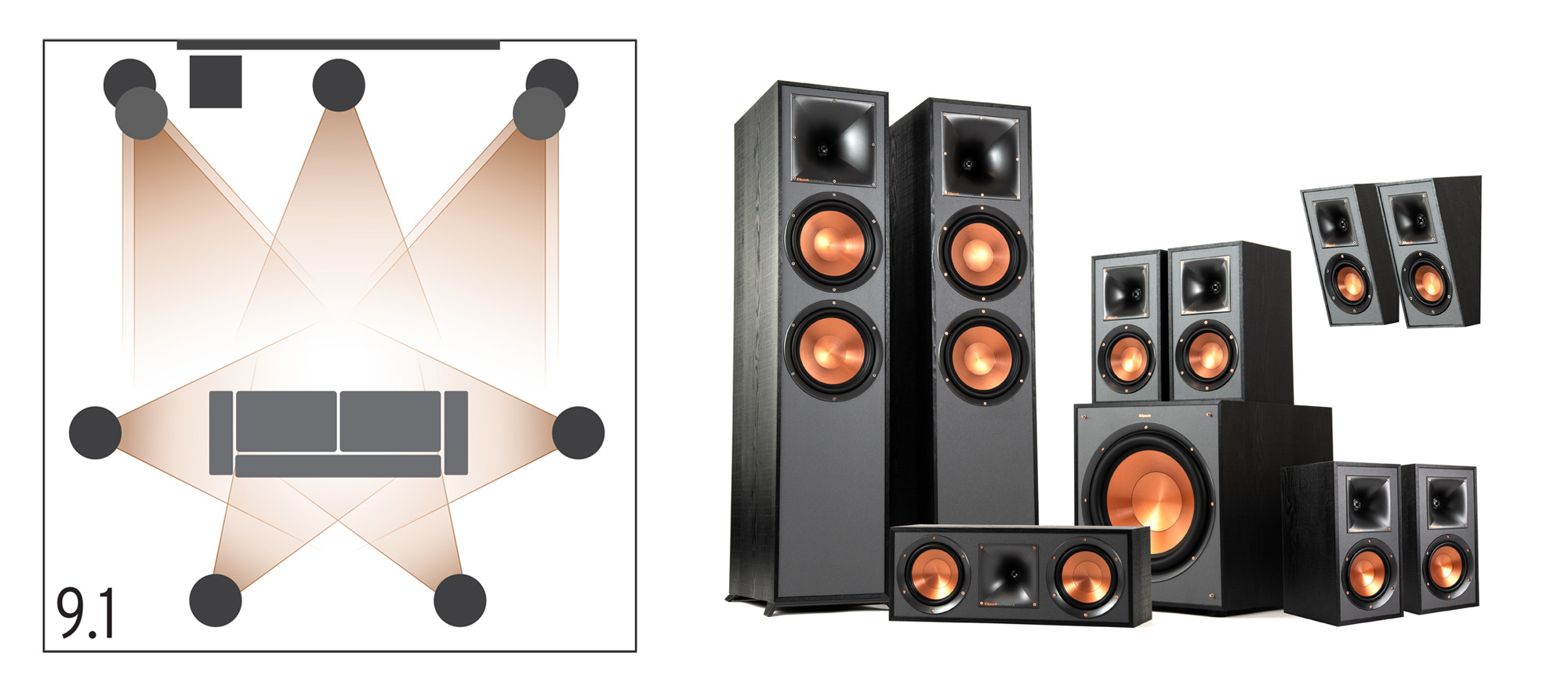
A true surround sound system typically begins with a minimum of five speakers, represented by the "5" in the "5.1" designation. This foundational five-speaker array consists of:
- Front Left and Front Right Channels: These form the primary soundstage, delivering much of the music, ambient effects, and general sound information, much like a stereo system, but integrated within the larger soundfield.
- Center Channel: This is the linchpin of the experience, a dedicated speaker ideally positioned directly above or below your TV or projector screen, and as close to the visual source as possible. This placement is critical because the overwhelming majority of dialogue in a movie soundtrack is routed through the center channel. There’s nothing more disconcerting than a disconnect between the sound of voices and the on-screen mouths producing them; a well-placed center speaker anchors the dialogue directly to the visuals.
- Surround Left and Surround Right Channels: These two speakers are positioned to the sides of your primary seated position, ideally slightly behind it. With this rough circle of five speakers enveloping your listening spot, the sensation of sonic movement, particularly for on-screen motion, environmental effects, or special effects, becomes far more pronounced and, consequently, much more immersive than when all sound is confined to the front. You’ll hear rain falling around you, a distant explosion rumble from the side, or a creature moving past you.
If you have the luxury of space and a more flexible budget, you can elevate this setup to a 7.1-channel system. As the numbers suggest, this configuration accommodates two additional speakers. In a 7.1 setup, speakers six and seven are designated as "rear left" and "rear right" channels. These are designed to be positioned directly behind the listener, working in conjunction with the side surround channels to create an even more unified and seamless 360-degree surround sound layout. The presence of these dedicated rear channels significantly increases the scope for accurate movement and precise positioning of sound objects within the expansive soundfield, making for a truly enveloping experience.
And what about the ".1"? This crucial component refers to the Low-Frequency Effects (LFE) channel, more commonly known as a subwoofer. This speaker is exclusively dedicated to reproducing the lowest, most visceral bass sounds in a soundtrack. It’s designed to deliver all the rumble, punch, and sheer power that action-packed movie soundtracks are so often fond of, from explosions and car crashes to the deep thrum of a spaceship. Creating these deepest, most impactful bass sounds demands the movement of a substantial amount of air, which is why subwoofers tend to be larger and more boxy than their accompanying speakers, housing sizable drivers. Fortunately, low frequencies are far less directional than the rest of the frequency range; our ears are not adept at pinpointing the source of deep bass. This means subwoofers offer considerably more flexibility in their placement within your surround sound setup compared to other speakers.
Understanding Height Channels (Spatial Audio)
Remember those extra numbers we mentioned at the end of the 5.1 and 7.1 setups, like 5.1.2 or 7.1.4? These indicate the inclusion of height channels, which are essential for creating the most effective spatial audio experience. There’s no escaping the term "spatial audio" these days. Its ubiquity, especially under brand-specific monikers like Dolby Atmos and DTS:X, is increasing daily, with promises of immersive experiences even from headphones and soundbars.
However, a promise is not the same as delivery. Much like soundbars attempting to replicate a full surround sound setup, it is incredibly challenging to create a true sensation of spatial audio without the necessary physical equipment. For home cinema enthusiasts, "spatial audio" can confidently be interchanged with "3D sound." Unlike 5.1 or 7.1 surround sound, which primarily creates a horizontal circle of sound around the listener, a spatial audio system constructs a sonic dome, where sound is delivered not only from the front, sides, and rear but also from above.
Imagine your 7.1-channel system, then add two or four overhead speakers, each capable of receiving its own discrete audio information from the soundtrack. What you now have is a 7.1.2 or 7.1.4 system, respectively. Content mixed specifically for spatial audio systems boasts an extraordinary amount of scope for the precise steering of effects within this immersive dome of sound. You’ll hear rain genuinely falling from above, helicopters flying directly overhead, or debris scattering across the ceiling of your room, adding an unparalleled layer of realism and engagement.
The optimal way to achieve a convincing spatial audio effect from height channels is by precisely positioning speakers directly into the ceiling of your home cinema room. While this offers the most accurate and seamless overhead experience, it is a relatively complex process, often involving professional installation, and is certainly not what one might call "cheap." Recognizing these challenges, many loudspeaker brands have developed upwards-firing modules. These units are designed to sit on top of some of the existing speaker cabinets in your surround sound setup and reflect sound off the ceiling, aiming to replicate the effect of dedicated overhead speakers. This method is similar to how many spatial audio soundbars operate with their upward-facing drivers, but on a larger, more powerful scale. While a compromise, these up-firing modules can provide a surprisingly effective and more accessible entry point into the world of 3D audio.
Does Surround Sound Actually Sound Better?
For the most dedicated movie fans and serious cinephiles, the answer to this question is an unequivocal yes. If you choose to invest in a properly configured surround sound setup, the audio that accompanies the movies you watch will be utterly transformed, revealing layers of detail, impact, and atmosphere that were previously unattainable. However, whether it’s the "right" choice for you depends on several factors, including your budget, the available space, and your priorities. It’s always worth weighing the other available options for improving your home cinema sound before making a significant investment.
Surround Sound vs Stereo Sound
Deciding which is "better" between surround sound and stereo sound isn’t really an absolute comparison; it’s akin to asking whether apples or onions are better—they serve different purposes. It’s fair to say, though, that if your primary interest lies in home cinema rather than exclusively in music listening, a surround sound setup will bring you infinitely closer to realizing the artistic objectives of the filmmaker and their sound designer than any stereo alternative could hope to achieve.
All modern movie soundtracks are meticulously mixed to be delivered by a multichannel surround sound setup. This holds true whether you’re accessing your content from a cutting-edge streaming service or enjoying the pristine quality of legacy physical media like 4K Blu-ray. While a stereo downmix is always available for those listening through a TV’s internal speakers or a simple stereo system, this is a necessary compromise. The true intentions, nuances, and directional cues of a sophisticated surround sound mix will only become fully apparent when heard through a system designed to reproduce them—a dedicated surround sound system.
Surround Sound vs Soundbars
For anyone torn between a full surround sound system and a soundbar, the best choice ultimately comes down to your budget, the physical space you have available, and how deeply you prioritize a full-on, immersive home cinema experience. Yes, a soundbar undeniably offers superior convenience compared to a multi-speaker surround sound setup, and it’s almost certainly a more affordable entry point. Furthermore, even the most basic soundbar will make a significant improvement over your television’s (almost certainly terrible) built-in speakers, often with fewer wires and less clutter, which is a major advantage for smaller spaces or minimalist aesthetics.
But is a soundbar a true surround sound solution? You already know the answer: generally, no. The fundamental acoustic challenge is that a soundbar, by its very nature, is a single enclosure attempting to do the job of multiple, discretely placed speakers. It doesn’t matter how many individual speaker drivers are crammed inside, how many carefully considered directions they’re pointing in, or how clever the digital sound processing algorithms are—a single soundbar cannot defy the laws of physics and acoustically convince you that sound is genuinely originating from alongside or behind you with the same precision and immersion as physically separated speakers.
That being said, there are hybrid solutions. You can invest in some of the more advanced, and usually pricier, soundbar "surround sound systems." These often come as a package including a central soundbar unit, wireless satellite surround speakers, and a separate subwoofer. These systems represent an excellent middle-ground option if a full, wired surround sound setup feels too daunting or out of reach, but you’re keen to go beyond the limitations of a standalone soundbar and experience genuine surround effects.
Surround Sound vs Dolby Atmos
If you’ve reached the point of deciding to invest in surround sound, choosing not to include Dolby Atmos capabilities would feel like a missed opportunity in the current landscape. Most new movies, and an increasing number of popular TV series, are now mixed for spatial audio. Adding even just two height channels (a .2 to your 5.1 or 7.1 system) will ensure you can fully experience and benefit from this next-generation audio format.
Moreover, unlike a traditional surround sound setup that primarily focuses on film, a spatial audio system like Dolby Atmos also has compelling applications for music lovers. Many of the best music streaming services now offer content specifically mixed for Dolby Atmos audio systems. While the effect can vary depending on the mix, there’s no denying that this can make music sound bigger, fuller, and altogether more immersive than its straight stereo equivalent, adding another layer of versatility to your home cinema investment.
How to Create the Best Surround Sound Setup
Embarking on the journey to build your perfect surround sound setup requires careful consideration of a few fundamental factors. The two most critical questions you need to ask yourself from the outset are: "How big is my home cinema room?" and "How much am I prepared to spend?"
The size and acoustics of your room will play a colossal role in determining the ideal type and scale of system you ultimately choose. A speaker setup that is too large for its allocated room will likely be overpowering, resulting in boomy, uncontrolled bass, harsh highs, and a generally muddled sound. If there isn’t enough space for a speaker system to "breathe" and project sound naturally, individual speakers will compete with—rather than complement—each other, leading to a coherent but ultimately messy and confused soundfield. Conversely, a large room equipped with speakers that are too small will struggle immensely. The system won’t be able to form a seamless circle of sound, audible gaps will appear in the sonic canvas, and the overall scale and impact of the presentation will be underwhelming. While it’s tempting to simply buy the biggest system your budget allows, your decision needs to be far more nuanced, focusing on matching the speakers to the environment.
Your budget is, of course, the other major determining factor. Even at the entry level, a basic surround sound speaker package will cost considerably more than even the most affordable soundbars. For those with a more flexible budget, a high-end, reference-grade system can easily push into five figures before you know it.
But that’s not the end of your outlay. These speakers require power, which means investing in a multichannel amplifier, or more commonly, a home cinema receiver. This "brain" of your system must be equipped with enough channels of power to drive every speaker in your setup, including height channels if you opt for spatial audio. If you’re building a 5.1-channel system, nearly every reputable brand from Denon and Yamaha to JBL and Sony offers appropriate devices. And naturally, if your budget is flexible enough, these brands and many others will sell you a receiver capable of dealing with 7.1.4 spatial audio and beyond. When choosing a receiver, also consider its HDMI inputs, processing capabilities (Dolby Atmos, DTS:X), and crucially, its built-in room correction software, which can dramatically optimize your system’s sound for your specific room.
What else? You’ll need a source of sound, of course. This could range from a top-tier subscription to one of the streaming services we’ve discussed, providing access to a vast library of content, to a high-quality 4K Blu-ray player paired with an accompanying library of physical discs, offering the ultimate in uncompressed picture and sound quality. You’ll also need decent interconnects between your source player and the amplifier (high-speed HDMI cables are essential), and a generous quantity of worthwhile speaker cable to connect all those speakers to the receiver. None of these accessories come for free, and their quality can impact overall performance.
At this point, you might be tempted to throw up your hands in exasperation and declare that a soundbar will be perfectly fine, thank you very much. And there’s certainly no arguing with the convenience of a soundbar solution, nor its undeniable ability to make your TV sound significantly better than it does without one. However, if this is the path your thoughts are taking, I must implore you: never, ever listen to a properly sorted, calibrated, and optimized surround sound setup. Because once you do, once you experience the true sonic immersion, the precise placement of effects, the visceral impact of bass, and the enveloping atmosphere that only a dedicated home cinema system can deliver, nothing else is ever going to fully satisfy your cravings for the ultimate cinematic experience at home. It’s an investment in pure, unadulterated cinematic joy that pays dividends with every single movie night.