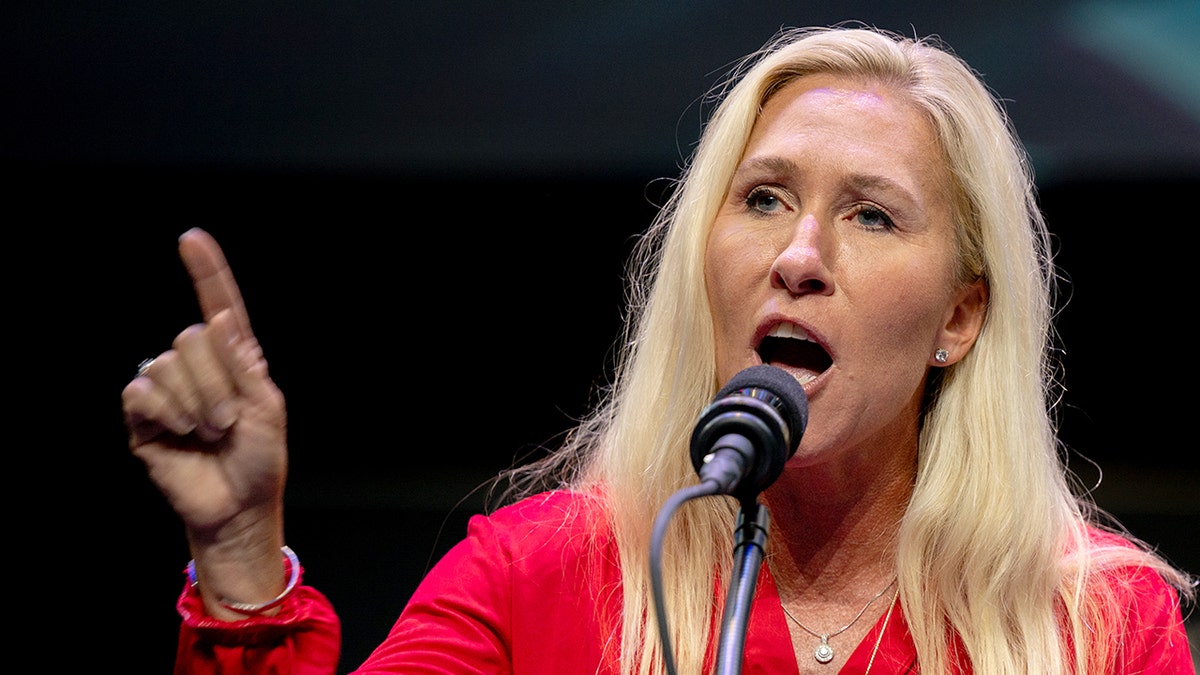
Marjorie Taylor Greene Refutes Reports That She’s Considering Running For President. The Georgia Republican, renowned for her outspoken conservative stance and often controversial political maneuvering, definitively denied swirling rumors of a potential presidential bid on Sunday, November 23, 2025. This firm rebuttal arrived just days after she made the surprising and impactful announcement of her resignation from Congress, a move widely interpreted by political analysts as a direct consequence of her escalating frustrations with her own party and a significant public break with former President Donald Trump.
In a direct address to the pervasive speculation, Representative Greene took to X (formerly Twitter) to clarify her position with characteristic bluntness. "I’m not running for President and never said I wanted to and have only laughed about it when anyone would mention it," she posted, aiming to decisively quash the persistent narrative that she was eyeing the Oval Office. Her comments were a specific and pointed response to an article published by Time magazine, which had suggested the Georgia Republican was contemplating a run for the White House in the distant 2028 election cycle. This wasn’t the first instance Greene had been compelled to push back against such reports; she had previously dismissed similar claims from NOTUS, an outlet that had alleged she had been privately discussing her presidential ambitions with various individuals within her political circle. The repeated nature of these rumors underscores the intense scrutiny and speculation surrounding her political future, especially given her recent actions.
The immediate backdrop to this latest denial is Greene’s bombshell announcement on Friday that she intends to resign from her congressional seat in January of the coming year. This decision, she indicated, stems from deep-seated frustrations with the direction and leadership of the Republican Party and, crucially, a dramatic and highly public rift with former President Donald Trump. Just a week prior to her resignation announcement, Mr. Trump had publicly withdrawn his support for Greene, signaling a profound fracture in what was once a robust and mutually beneficial political alliance. For years, Greene had been one of Trump’s most ardent and vocal defenders, making his public repudiation a significant turning point. This unexpected and dramatic turn of events inevitably fueled the speculation about her future intentions, with many political observers pondering whether a presidential campaign was her strategic next step, a calculated maneuver to leverage her newfound independence and conservative celebrity.
Greene, however, provided a detailed and rather scathing assessment of the realities of a presidential campaign, painting a picture that left little room for personal ambition or the allure of high office. She articulated a profound disillusionment with the grueling process itself, detailing the arduous and often dehumanizing aspects of seeking the nation’s highest office. She spoke of the relentless travel required, the constant, arduous task of "begging for donations all day everyday" to amass the "hundreds of millions of dollars" necessary for a competitive bid. Beyond the financial grind, she highlighted the intellectual and emotional toll, describing the daily grind of "arguing political talking points everyday to the point of exhaustion," which she asserted would inevitably lead to "destroying your health and having no personal life." This candid portrayal painted a grim picture of the immense personal sacrifices demanded, suggesting that the pursuit of the presidency comes at an unbearable human cost, one she is unwilling to pay.
Her critique didn’t stop at the personal sacrifices, delving deeper into a fundamental belief that even if one were to endure such an arduous journey and succeed, the systemic impediments within Washington would render genuine, impactful change impossible. "The fact that I’d have to go through all that but would be totally blocked from truly fixing anything is exactly why I would never do it," Greene asserted, underscoring her conviction that the current political landscape is fundamentally broken and designed to thwart meaningful reform. This statement is a powerful indictment of the entrenched power structures she believes dominate the American political system.
Her rationale extended beyond the practical demands of campaigning, delving into the very nature of political power and her personal motivations. Greene explicitly declared that she is "not motivated by power and titles," positioning herself as someone driven by principles and a desire for genuine change rather than personal aggrandizement or the prestige of office. She further argued that the "Political Industrial Complex has destroyed our country and and will never allow someone like me or you to rise to power and actually solve the crises that plague all of us." This statement reflects a populist sentiment often echoed by figures who perceive the political establishment—comprising lobbyists, entrenched bureaucracies, partisan gridlock, and fundraising dependence—as an insurmountable barrier to the will of the people. It suggests a belief that the system’s entrenched interests and its self-perpetuating machinery are too powerful for any single individual, regardless of their mandate or popular support, to truly disrupt or reform from within the presidency.
Marjorie Taylor Greene burst onto the national political scene in 2021, quickly establishing herself as a prominent and often controversial voice within the Republican Party. From the outset, she cultivated an image as a conservative rabble-rouser, unafraid to challenge established norms, confront perceived political enemies, and articulate views that resonated strongly with a significant segment of the populist right. For much of her congressional tenure, she was regarded as one of former President Trump’s most ardent and vocal allies, frequently defending his policies, echoing his rhetoric, and participating in high-profile political stunts that garnered significant media attention. Her unwavering support for Trump, combined with her knack for generating headlines, solidified her position as a significant and influential figure in the conservative movement, particularly among those who felt their voices were ignored by the mainstream establishment.
However, the past several months have seen a noticeable and increasingly dramatic shift in Greene’s political trajectory. She grew progressively critical of Republican leadership in Congress, particularly concerning their handling of key legislative issues such as healthcare reform, the rising cost of living and inflation, and contentious government shutdown negotiations. Her public criticisms mounted, indicating a growing rift between her and the party’s establishment wing. While her dissent within her own party grew, she remained steadfast on certain issues that resonated with her base, notably her insistence on the full and transparent release of the "Epstein files," a stance she maintained even when faced with pressure for party unity and strategic silence. This growing dissent within her own party, culminating in the very public withdrawal of support from Mr. Trump, marked a profound and uncharacteristic turn for a politician who had previously been defined by her unyielding loyalty to the former president and the party’s more extreme wing. It was this dramatic pivot—from staunch ally to disillusioned critic—that sparked widespread speculation about her future intentions, including the possibility of a presidential bid, as observers tried to decipher the strategic implications of her break from the establishment.
The pervasive speculation surrounding Greene’s potential presidential run was not unfounded, given her unique political profile. For many political analysts, her high national profile, her proven ability to mobilize a dedicated base of supporters through grassroots efforts and social media, and her recent, very public disentanglement from the Trump orbit all pointed towards the possibility of a new, independent political path. It’s a common trajectory in American politics for ambitious figures, especially those with a strong media presence and a loyal following, to leverage congressional experience—or a dramatic departure from it—into a higher office aspiration. The media, in turn, often amplifies such possibilities, transforming even tentative considerations into full-blown narratives and generating significant public interest. Reports from outlets like Time and NOTUS, while ultimately denied by Greene, reflected a genuine curiosity within the political landscape about what an unmoored Marjorie Taylor Greene might do next. The 2028 election cycle, still years away, provided a convenient and logical timeframe for such forward-looking speculation to take root.
Her impending departure from Congress in January raises several questions about the immediate future, not just for Greene herself but for the political landscape she inhabits. For her constituents in Georgia’s 14th congressional district, it means a special election to fill her seat, which will undoubtedly become a hotly contested race. For the House Republican Conference, it signifies the loss of a highly visible, if often contentious and polarizing, member, potentially altering the dynamics within the party’s conservative flank. While Greene has explicitly ruled out a presidential campaign, her statements do not preclude other forms of continued political engagement. She could remain a powerful voice through media appearances, launch a new political organization, engage in grassroots activism, or even consider a return to a different form of public service down the line. Her influence within the broader conservative movement, particularly among those who feel disenfranchised by the traditional political system and attracted to anti-establishment rhetoric, is likely to endure, regardless of her official title or lack thereof.
Greene’s articulate frustration with the "Political Industrial Complex" taps into a broader vein of disillusionment prevalent among a significant portion of the American electorate. Her rhetoric resonates deeply with those who feel that Washington is out of touch, beholden to special interests, gridlocked by partisan divisions, and fundamentally incapable of addressing the pressing issues faced by everyday citizens, from economic hardship to cultural grievances. This sentiment, often skillfully exploited by populist movements across the political spectrum, highlights the enduring challenge for any political figure who seeks to operate outside the conventional power structures or to truly reform them. Her belief that the system is fundamentally resistant to change, and that an "outsider" like herself would be "totally blocked from truly fixing anything," speaks to a deep-seated cynicism that many voters share, suggesting that her message, even without a presidential bid, will continue to galvanize a segment of the population.
In conclusion, while the rumors of a Marjorie Taylor Greene presidential campaign for 2028 gained considerable traction, particularly in the wake of her dramatic announcement to resign from Congress and her high-profile split with former President Donald Trump, Greene herself has unequivocally shut down such speculation. Her denial, delivered with characteristic directness on X, was accompanied by a detailed explanation outlining the grueling demands of a presidential run and her profound skepticism about the ability of any individual to enact meaningful change within what she perceives as a broken "Political Industrial Complex." As she prepares to exit Congress in January, her political future, though now clarified on the presidential front, will undoubtedly remain a subject of intense scrutiny and interest, given her established profile, her loyal base, and her evolving, often tumultuous, relationship with the Republican establishment. Her next move, whatever it may be, is certain to draw significant attention.