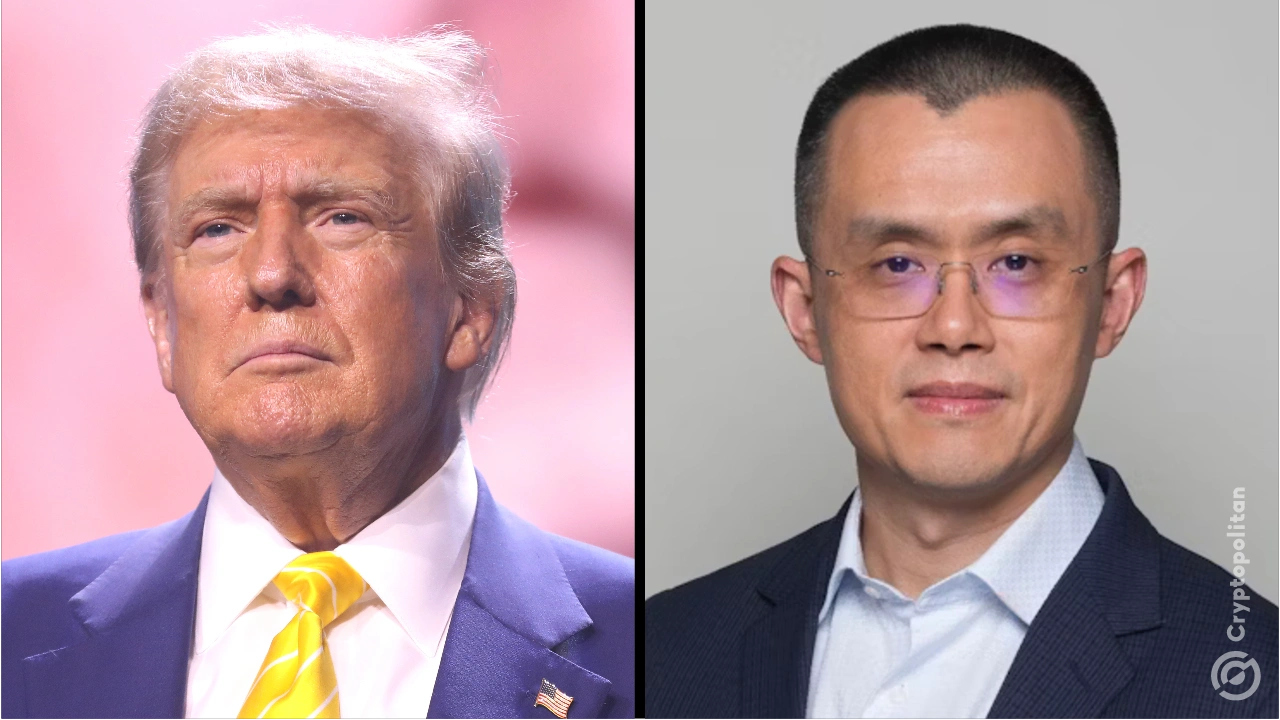
Trump’s CZ Pardon Has the Crypto World Bracing for Impact
The crypto world is reeling and bracing for profound repercussions following former US President Donald Trump’s controversial pardon of Changpeng Zhao, the multibillionaire founder of the world’s largest cryptocurrency exchange, Binance. This decision, coming just months after Zhao, known as CZ, served a four-month federal prison sentence, has ignited a firestorm of debate, raising questions about political influence, regulatory integrity, and the future landscape of the digital asset market.
Changpeng Zhao’s journey from a titan of the burgeoning crypto industry to a federal inmate was swift and stark. Last year, the visionary behind Binance found himself behind bars, a consequence of a plea agreement that saw him admit to grave failings in his company’s operations. In November 2023, Zhao pleaded guilty to charges of failing to maintain an effective anti-money-laundering (AML) program at Binance. The company itself simultaneously admitted to flagrant violations of US sanctions laws, settling with financial regulators over accusations of knowingly facilitating illicit transactions. These included transactions linked to notorious terror groups, insidious child exploitation networks, and sophisticated cybercriminals. Court documents vividly detailed the company’s egregious disregard for compliance, encapsulating it in a chilling exchange where one Binance employee candidly told a colleague, “We see the bad, but we close 2 eyes.” This candid admission underscored a corporate culture that prioritized growth and profit over legal and ethical responsibilities.
As part of the comprehensive settlement deals designed to address these systemic failures, Zhao agreed to relinquish his powerful role as Binance CEO, marking a significant personal concession. Binance, in turn, committed to a substantial retreat from the US market, accepted stringent supervision by a US-appointed compliance monitor, and was hit with a record-shattering $4.3 billion penalty – one of the largest corporate penalties in US history. The legal and financial consequences were immense, signaling a stern warning from US authorities to the often-unregulated crypto industry.
However, less than two years after these landmark agreements, the narrative surrounding CZ and Binance has been dramatically overturned by a single presidential act. On October 23, in a move that sent shockwaves through the financial and political spheres, Donald Trump formally struck the charges from Zhao’s criminal record. The accompanying rhetoric from a White House spokesperson was equally striking, declaring the Binance founder a victim of the "Biden administration’s war on crypto." This reframing instantly transformed a convicted felon into a perceived martyr, injecting a highly politicized dimension into a case previously defined by regulatory enforcement.
The immediate and long-term implications of this pardon are vast and complex, particularly for the fiercely competitive US crypto exchange market. Legal experts are now speculating that Binance, emboldened by the pardon, could seek to reenter this lucrative market, potentially disrupting the existing hierarchy dominated by compliant players like Coinbase. Beyond market dynamics, the pardon is also predicted to cast a long shadow over the political future of the crypto industry, potentially triggering a backlash and increased scrutiny from a future Democratic regime, regardless of the outcome of Trump’s current presidency.
The justification for Zhao’s pardon has become a focal point of intense dispute, especially in light of disconcerting connections between Binance and World Liberty Financial, a crypto business founded by Trump and his sons. These ties present a glaring potential for conflicts of interest. Through a corporate entity, the Trump family holds a significant 38 percent stake in World Liberty Financial’s parent company. Further fueling the controversy, in May, Binance reportedly agreed to receive a colossal $2 billion investment denominated in USD1, a stablecoin issued by World Liberty Financial. This arrangement could potentially funnel tens of millions of dollars directly to the Trump family. Adding another layer of complexity, Bloomberg reported in July that it was Binance itself that had developed the codebase for USD1, raising serious questions about the nature of their relationship and the quid pro quo implications of the pardon.
Remarkably, despite these intricate financial and developmental ties, Trump has maintained a perplexing distance from Zhao. In a notable interview with 60 Minutes aired on November 2, Trump claimed, “OK, are you ready? I don’t know who he is.” Yet, he conceded later in the same interview, “My sons are into [crypto].” This apparent disconnect between his actions and his stated awareness has only deepened suspicions and fueled accusations of opacity.
Conversely, Zhao’s legal representatives and a chorus of industry allies have vociferously defended the pardon as a rightful corrective, portraying it as a necessary pushback against what they perceive as overzealous regulatory actions. Teresa Goody Guillén, a partner at law firm Baker & Hostetler, which represents Zhao, argued in a post on X that “CZ is the first and only known first-time offender in US history to receive a prison sentence for this single, non-fraud-related charge.” This defense attempts to frame Zhao’s case as an anomaly, suggesting that his punishment was disproportionate given the non-fraudulent nature of his specific charge.
Beyond the immediate legal and personal ramifications, the alleged appearance of nepotism, cronyism, and self-dealing inherent in Trump’s crypto activities has sent shivers down the spine of the wider crypto industry. An industry that collectively poured hundreds of millions of dollars into supporting pro-crypto candidates in the 2024 congressional races is now bracing for potential retaliation from a future Democratic administration. Despite the Trump administration’s perceived friendliness to crypto, evidenced by new laws specific to stablecoins, many fear that the window for passing broad-based, comprehensive crypto legislation is rapidly closing.
Azeem Khan, founder of crypto startup Miden, expressed grave concerns, stating, “The [pardon] doesn’t look good. There’s going to be scorched earth to come with the midterm elections. There’s not enough being codified into law yet.” This sentiment reflects a fear that without clear legislative frameworks, the industry remains vulnerable to political whims and regulatory crackdowns. Nic Carter, general partner at crypto-focused VC firm Castle Island Ventures, acknowledged that “On balance, obviously the Trump admin has been good for crypto. There’s no denying that.” However, he criticized Trump’s apparent indifference to ethical optics, adding, “He doesn’t care about the appearance of impropriety—at all. His sons have been so active in the crypto industry. This has been my main complaint about the Trump administration.” In response to these ethical concerns, White House press secretary Karoline Leavitt issued a statement asserting, “Neither the president nor his family have ever engaged, or will ever engage, in conflicts of interest.”
In the meantime, the pardon’s destabilizing potential for US-based crypto exchanges is palpable. Binance, with its immense global footprint, now represents a significant latent threat to competitors like Coinbase. The market for these exchanges has already been eroded by the advent of crypto exchange-traded funds (ETFs), which allow mainstream investors to access crypto assets through traditional brokerages, bypassing direct exchange platforms.
From a strictly legal standpoint, the pardon’s immediate impact might appear limited. Daniel Silva, a partner at law firm Buchalter, emphasizes that both Zhao and Binance are still bound by their existing plea agreements. These agreements explicitly prevent Zhao from resuming an active role at Binance and prohibit the company from operating within the US. Furthermore, while Zhao’s criminal record has been expunged, his sworn testimony and admissions of guilt remain on the record. “He still admitted to all those things under penalty of perjury,” Silva notes. “While he’s no longer technically a felon, that doesn’t negate the admissions that he made.” Prospective business partners, Silva suggests, will undoubtedly factor these admissions into any future considerations.
However, Silva also points out a critical loophole: the pardon could potentially open the door for the US government to formally release Zhao and Binance from their existing obligations. Coupled with a perceived abdication of responsibility by the US Department of Justice in policing certain crypto-related crimes, Zhao might feel emboldened to defy the terms of his agreement and return to an active role at Binance. “You can breach any contract you want. The question is what consequences will there be?” Silva muses, highlighting the uncertainty.
Binance and Zhao themselves remained silent on requests for comment, but Zhao’s actions speak volumes. In an X post thanking Trump for the pardon, Zhao declared, “Will do everything we can to help make America the Capital of Crypto.” Even more tellingly, earlier in the year, The Wall Street Journal noted that Zhao quietly updated his biography on X, conspicuously swapping “ex-binance” for simply “binance.” These subtle but significant changes suggest a clear intention to reclaim his identity and influence within the crypto ecosystem.
The scale of Binance’s operations dwarfs its US counterparts. While Coinbase has meticulously cultivated an image as the “straightlaced, law-abiding alternative” to its freewheeling international competitors, Binance remains the undisputed global behemoth. It processes an staggering average of $22 billion in trades each day, a volume nearly eight times greater than Coinbase’s. The systemic importance of Binance to global crypto markets is often underestimated within the US, as Azeem Khan observes: “There’s an ethnocentrism people in North America have about being the best. Coinbase is in many ways the company. But Binance is the company for the rest of the world.”
With its immense financial war chest and unparalleled global reach, Binance possesses the capacity to severely squeeze the margins of smaller, US-based competitors. It could easily deploy loss-leading strategies, such as drastically slashing trading fees, to attract customers – tactics that smaller exchanges simply cannot afford to match.
In anticipation of this heightened competition, Coinbase has already embarked on an aggressive defensive strategy, engaging in a strategic shopping spree and forging key partnerships. Over the past year, Coinbase acquired a derivatives exchange, an angel investment platform, and a service for launching crypto tokens. It has also cemented partnerships with payment giants PayPal and American Express to roll out new services. This multi-pronged approach, Khan explains, is designed to erect a “walled garden” that incentivizes customers to remain within Coinbase’s ecosystem and diversifies its revenue streams away from a sole reliance on trading fees. “Competition is coming. I think that’s why Coinbase has been so aggressive for some time now,” Khan asserts. Coinbase declined to be interviewed for this story.
Experts universally predict that the US crypto exchange market will ultimately trend towards consolidation. “Fees get squeezed, and you have to scale to win,” states Chris Perkins, partner at crypto venture capital firm CoinFund. He anticipates the formation of “some holy or unholy alliances” as firms scramble to survive and thrive in a more challenging environment.
While Trump’s generally permissive stance towards crypto is viewed by many as a boon for the entire industry, there is a growing unease regarding the administration’s perceived ability to hand-pick winners and losers, either through specific policy adjustments or, as in CZ’s case, through presidential pardons. Nic Carter articulates this concern succinctly: “You want to win, but you want to win in a legitimate way. You don’t want your wins to be tinged by the appearance of corruption. You want to operate in a market economy, not a command-and-control economy where your ability to penetrate Washington determines whether you win or not.”
The pardon of Changpeng Zhao, therefore, is far more than a simple act of clemency. It is a seismic event that has not only reignited a complex legal saga but also exposed deep fissures within the crypto industry and the political establishment. As the dust settles, the crypto world waits with bated breath, bracing for the inevitable impact on market dynamics, regulatory oversight, and the very integrity of the burgeoning digital economy.