William Shatner and Neil deGrasse Tyson: When stars collide
Not long ago in the vibrant city of Seattle, an astronomical event of truly cosmic proportions unfolded: two titans, two veritable superstars from vastly different but surprisingly complementary realms, collided in a spectacular display of intellect, humor, and profound curiosity. William Shatner, the indelible captain of the USS Enterprise from "Star Trek" fame, and Neil deGrasse Tyson, America’s beloved and most articulate astrophysicist, took to the stage, not merely to entertain, but to embark on a shared voyage into the very nature of exploration itself. Imagine the legendary comedic duo Martin & Lewis, but instead of slapstick and song, their performance was punctuated by discussions of quantum mechanics, the mysteries of the cosmos, and the sheer absurdity of existence.
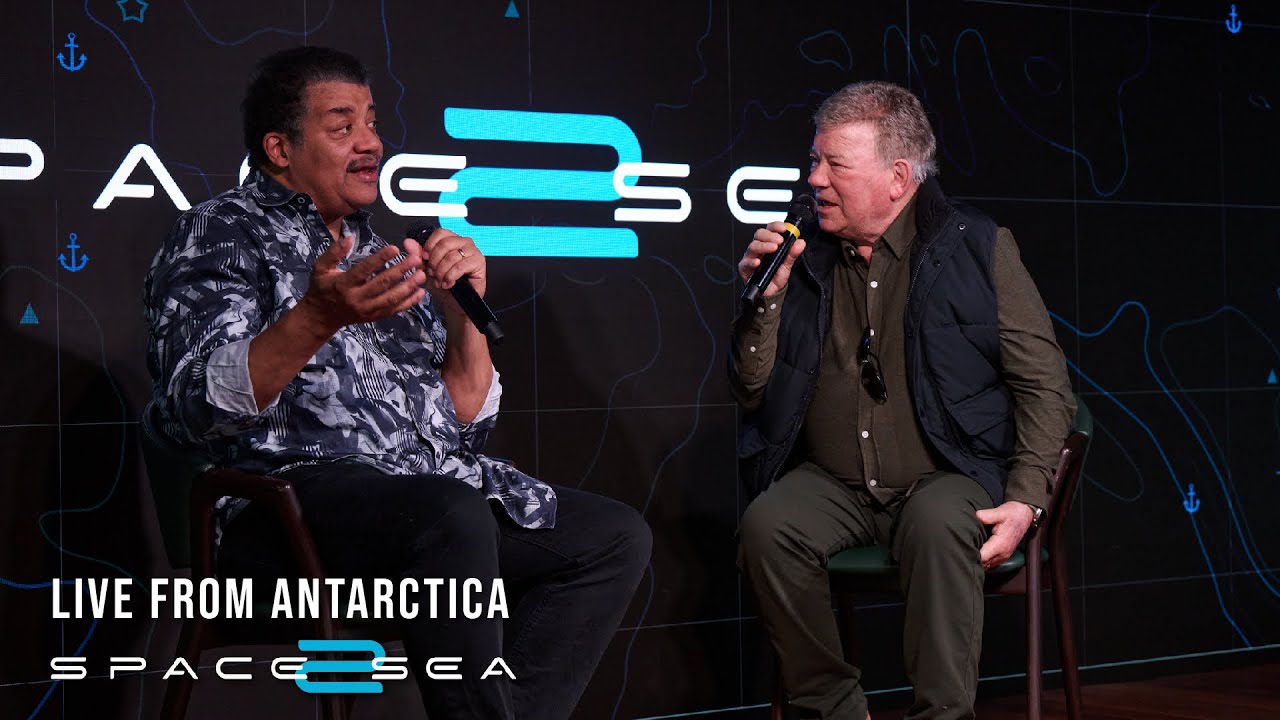
The chemistry between these two intellectual heavyweights was palpable, a bond that Tyson himself affectionately described as a "bromance." "I think what Bill Shatner and I have together should be the textbook definition of the bromance," Tyson declared, a sentiment echoed by Shatner, who responded with characteristic humility and warmth, "If we have a bromance, I’d be very privileged." Their unique friendship, forged in the crucible of shared adventure, began innocently enough last year on an upscale cruise to the remote and majestic landscapes of Antarctica. What started as casual conversations between dinner entertainment guests quickly blossomed into something more substantial. The cruise organizer, witnessing their natural rapport and the engaging discussions they sparked, wisely suggested, "Why don’t we put the two of you on this mini-stage that they have on the ship, and we just chew the fat?" The improvised sessions proved so popular, so intellectually stimulating, and so genuinely entertaining that the organizer’s next logical question sealed their fate: "Why don’t you guys take this on the road?"
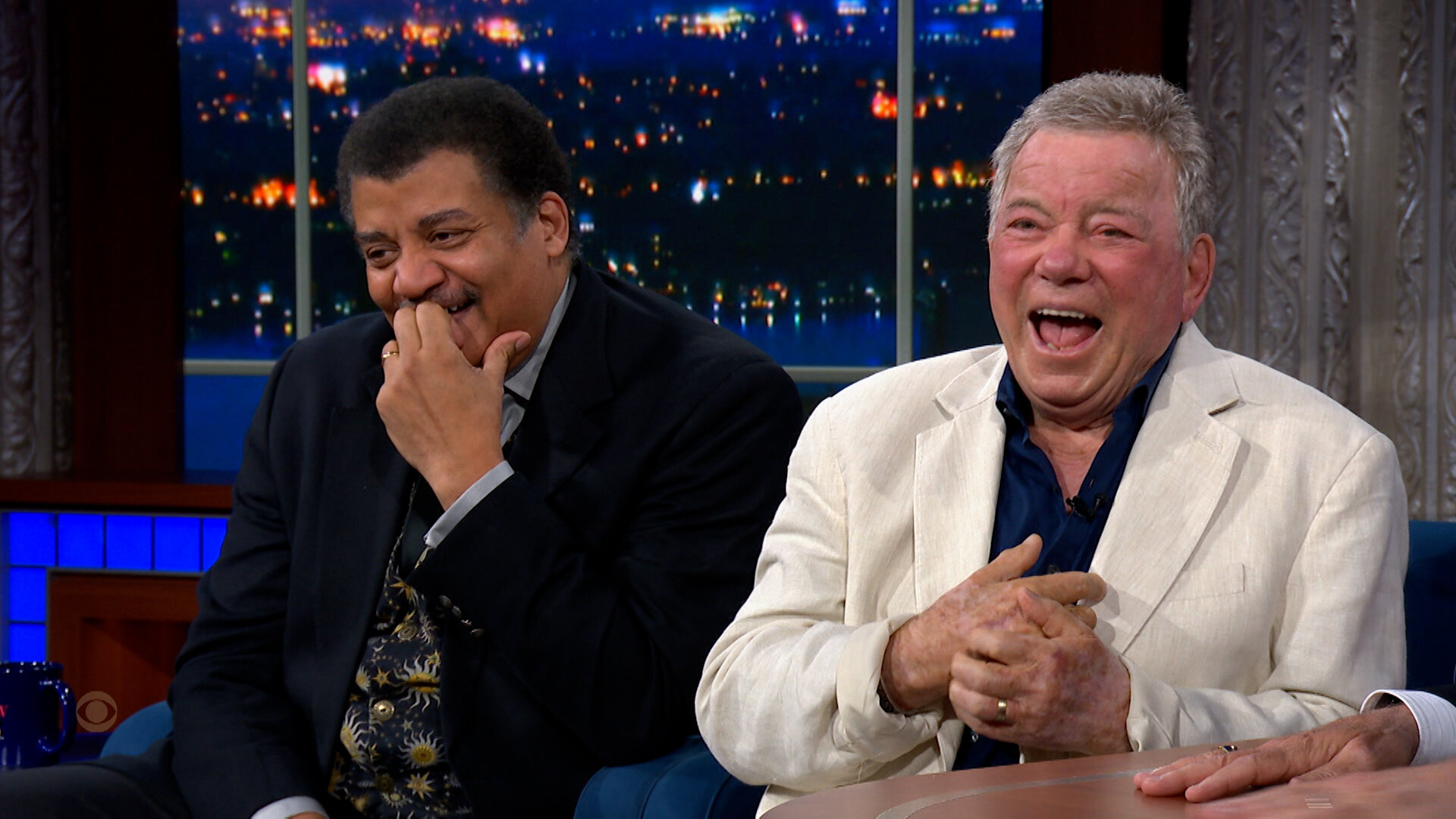
Their inaugural port of call for this unprecedented theatrical endeavor was Seattle, where they debuted their ambitious and aptly titled stage show, "The Universe Is Absurd!" The performance was a tapestry woven with wide-ranging anecdotes, sometimes delightfully meandering philosophical digressions, and always deeply intriguing explorations of science, life, and the human condition. It was a masterclass in intellectual improv, where the structured gave way to the spontaneous, mirroring the very unpredictability of the universe they so passionately discussed. The stage, bathed in a soft, ethereal light, became their personal bridge, connecting the fictional universe of Star Trek with the empirical universe of astrophysics.
One of the show’s most captivating segments involved Shatner’s playful challenge to Tyson for a succinct "sound bite" – a concise, mind-bending nugget of cosmic wisdom. DeGrasse Tyson, ever the showman and educator, turned to the audience, inviting their participation. "Pick anything out of the universe. Go. Anything. Doesn’t matter," he urged. A ripple of excitement spread through the crowd before an enthusiastic voice cut through the air: "Pluto!" Tyson, without missing a beat, launched into a concise yet profound explanation that perfectly encapsulated his scientific prowess and his gift for making complex ideas accessible. "More than half of Pluto is made of ice, so that, if it were where Earth is right now, heat from the Sun would evaporate that ice and it would grow a tail. And that is no kind of behavior for a planet!" A beat of silence, then a triumphant "Mic drop! That’s a sound bite!" The audience erupted in applause, not just for the scientific insight, but for the sheer theatricality of the delivery.
For Neil deGrasse Tyson, the distinguished director of New York City’s Hayden Planetarium and a veritable authority on nearly every facet of our understanding of the cosmos, this collaboration offered a unique opportunity. It was a chance to delve into the insatiably curious mind of the 94-year-old William Shatner, an icon who defies conventional notions of aging. "What kind of magic potion is he drinking?" deGrasse Tyson laughed, genuinely awed by Shatner’s vitality. He then shared a calculation that underscored Shatner’s profound longevity: "By the way, you can do the math, he’s been alive for three billion seconds, okay? I did the math, you don’t have to. So when Bill Shatner speaks, it’s coming from a place way deeper than any of the rest of us can possibly match." Tyson’s respect for Shatner’s lived experience was evident, recognizing that Shatner’s perspective was informed by nearly a century of witnessing human progress, scientific discovery, and the shifting paradigms of understanding.
Conversely, for Shatner, who never formally pursued astrophysics in his youth, this partnership was a cherished opportunity to compensate for what he perceived as lost time. "I feel bad about it, because that knowledge of what constitutes the construction of nature, we know so little, but the little we know is so awesome, it’s so spellbinding," he confessed, a wistful note in his voice. "The fact that I wasn’t conscious of how spellbinding it is as a youth, I could have been much more educated about it." This sentiment resonated deeply, revealing a man who, despite a lifetime of extraordinary achievements, still harbored a profound hunger for knowledge, a desire to grasp the fundamental truths of the universe that had once seemed beyond his grasp. His journey into space four years prior, making him the oldest person ever to achieve such a feat, wasn’t merely an adventure; it was a physical manifestation of this insatiable curiosity, a quest to experience the cosmos firsthand, not just intellectually.
The dynamic between them often revolved around Shatner’s probing questions and deGrasse Tyson’s illuminating answers. Shatner, the eternal seeker, asked Tyson, "Do you still scratch your head in awe?" To which Tyson, with a twinkle in his eye, simply replied, "Every night I look up." This exchange perfectly encapsulated their roles on stage, a beautiful dance between inquiry and elucidation. "Unfortunately, that’s the way it is," Shatner quipped, acknowledging the division of labor. But Tyson was quick to qualify, emphasizing the mutual benefit of their interaction. "No, but he’s got wisdom and life experience that I value, and I respect," deGrasse Tyson added, "So, I’m here to grab some of that." It wasn’t just a one-way street of information; it was a genuine exchange, with each drawing strength and insight from the other.
Shatner’s perspective on Tyson’s work offered a fascinating counterpoint, a blend of admiration and philosophical challenge. "He has access, both because of his mentality, and the books and the studies, so he’s into modern-day mysticism, which is the study of the stars and how it works and what goes on." Tyson, ever the scientist, paused, intrigued by the label. "You call that modern-day mysticism?" Shatner clarified, "Because you don’t know for sure that what you’re saying is absolutely truth until more experimentation." This was the crux of their intellectual sparring – Shatner’s embrace of the unknown, the poetic and the speculative, versus Tyson’s grounding in empirical evidence and the scientific method. "That’s the frontier. We’re scratching our heads," Tyson conceded, acknowledging the vastness of what remains undiscovered. "Exactly," Shatner affirmed. "So, he is an explorer. He is an explorer. He is on that verge. He teaches that. And it is mystical in every sense of the word."
Their respectful disagreements were a highlight of the show, illustrating the tension between the artist’s intuition and the scientist’s rigor. I observed, "This is where I think you are politely and respectfully in disagreement, because Dr. deGrasse Tyson will say something like, ‘We know what the speed of light is and what the fastest things can move is.’ And you say, ‘Well, we’ll see about that!’" Shatner readily admitted, "Yeah, we’ve had that argument." It was a testament to their mutual respect that such fundamental philosophical differences could be explored with such grace and good humor, enriching the audience’s understanding of both science and the human pursuit of knowledge.
DeGrasse Tyson, despite his vast knowledge, seemed perfectly at ease with the limits of human understanding. When confronted with the ultimate questions, such as what existed before the Big Bang or the profound concept of somethingness emerging from nothingness, his response was refreshingly candid: "We don’t know. Next question!" He elaborated, "No, as a scientist, you need to be comfortable in the presence of a question that does not yet have an answer." This humility in the face of the unknown is a hallmark of true scientific inquiry, a willingness to admit ignorance as a precursor to discovery.
Of course, the ultimate question, the one that eludes definitive scientific explanation and touches every human soul, is where we go when we die. This existential query, as Shatner reflected, becomes increasingly pertinent as one ages and witnesses the passing of friends and colleagues. "You know, I vary between the fear of death, my fear," he confessed, his voice tinged with a raw honesty. Yet, this fear was tempered by an overwhelming gratitude for the life he had lived. "I have so much love around me. I have a wife, and children, and grandchildren. I even have two great-grandchildren. And I have two great dogs. I’ve had dogs all my life, all my adult life. And so, all my life is fertile, is vibrant. And I don’t want to leave it. And that’s the sadness. I don’t want to go." His profound appreciation for the richness of his present existence was a powerful testament to living fully. When asked if he was curious about what lay beyond, Shatner, with a characteristic laugh, shot back, "Not enough to die!" His wit, even in contemplating mortality, remained undimmed. "Even your curiosity has a limit?" I pressed. "Right. It stops right there!" he declared, drawing another round of laughter.
Thus, William Shatner’s legendary curiosity, a force that propelled him through a lifetime of exploration both real and fictional, found its boundary at the precipice of his own mortality. As "The Universe Is Absurd!" concluded its Seattle run, Shatner brought the evening to a poignant close with one of his unique spoken-word songs, accompanied by the soulful trumpet melodies of Keyon Harrold. His voice, resonant with experience, filled the theater with words of wisdom and reflection:
Do not grow old
no matter how long you live.
Do not forget pain
but somehow learn to forgive.
The performance was a fitting end to an extraordinary evening, a reminder that while the universe may indeed be absurd in its vastness and unknowability, the human journey within it is an intensely interesting, vibrant, and ultimately beautiful ride. The collision of these two stars, William Shatner and Neil deGrasse Tyson, illuminated not just the cosmos, but the very essence of what it means to be human—to question, to explore, to laugh, to love, and to confront the profound mysteries of existence with an open heart and an endlessly curious mind.