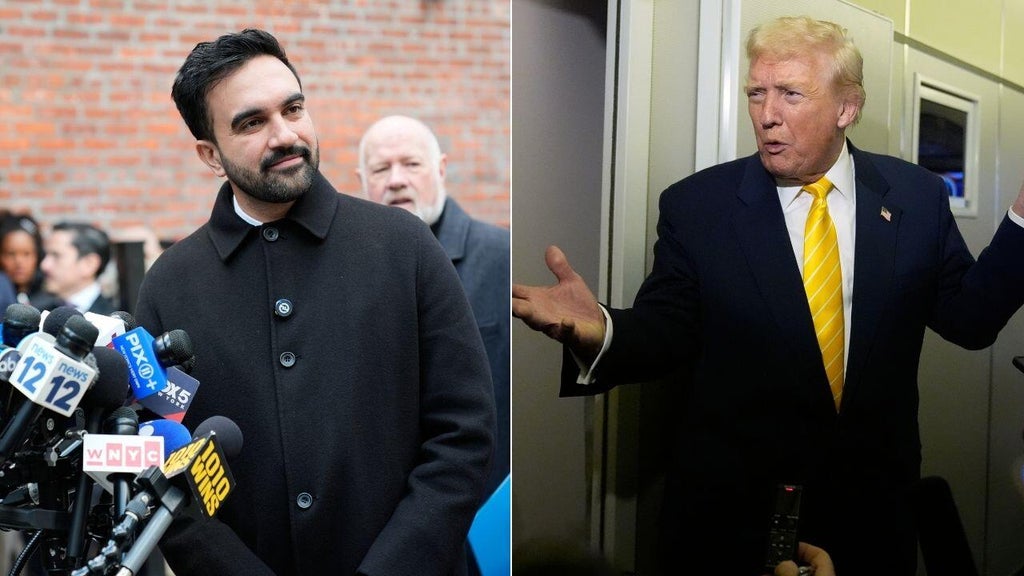
President Trump to host New York City Mayor-elect Zohran Mamdani at White House on Friday. The highly anticipated meeting between President Donald Trump and New York City Mayor-elect Zohran Mamdani is set to take place at the White House on Friday, a development confirmed by both the President and the Mayor-elect’s team on Wednesday. President Trump, announcing the meeting via a post on his Truth Social platform, specified that the encounter would occur in the iconic Oval Office, with "further details to follow." This confirmation marks a significant turn in the often-contentious relationship between the two political figures, whose public discourse has been characterized by sharp ideological clashes leading up to Mamdani’s recent electoral victory.
A spokesperson for Mayor-elect Mamdani released a statement confirming the meeting and outlining its primary objectives. "As is customary for an incoming mayoral administration, the Mayor-elect plans to meet with the President in Washington to discuss public safety, economic security and the affordability agenda that over one million New Yorkers voted for just two weeks ago," the statement read. This emphasis on key urban challenges—public safety, economic stability, and the high cost of living in New York City—underscores the practical necessities driving this seemingly unlikely dialogue between leaders from opposite ends of the political spectrum. The meeting, therefore, transcends mere protocol, signaling an acknowledgment of the shared responsibility for the well-being of the nation’s largest city, regardless of partisan differences.
The announcement of a meeting between Trump and Mamdani has generated considerable buzz, not least because of their fraught history. Earlier in the week, President Trump had indicated that a meeting in Washington was on the cards, but a definitive date had remained elusive until Wednesday’s revelation. Their past interactions have been anything but cordial. In the months leading up to the mayoral election, President Trump was an outspoken critic of Mamdani, frequently labeling the democratic socialist candidate as a "communist." This pejorative was often repeated in Trump’s public statements and social media posts, seeking to define Mamdani in stark ideological terms that resonate with a particular segment of his base. His Truth Social post announcing Friday’s meeting continued this trend, referring to the Mayor-elect as "Communist Mayor of New York City, Zohran ‘Kwame’ Mamdani," a clear indication that while a meeting is happening, the President’s rhetorical stance remains largely unchanged.
The animosity ran deeper than mere name-calling. Just one day before Election Day, President Trump had thrown his weight behind independent candidate Andrew Cuomo, a move that injected another layer of drama into an already heated mayoral race. Beyond endorsements, Trump had also repeatedly threatened to withhold federal funding from New York City if Mamdani were to be elected. Such threats, often employed by presidents to exert leverage over local governments, raised serious concerns about the potential impact on vital city services and infrastructure projects. The prospect of federal aid being curtailed loomed large over the election, adding pressure to an already high-stakes contest.
However, a subtle shift in President Trump’s tone emerged in the aftermath of Mamdani’s victory. In an interview on Fox News following the election results, Trump stated that while he doesn’t want to "make [Mamdani] succeed, I want to make the city succeed." This seemingly pragmatic pivot, coming from a president known for his unwavering loyalty to allies and open hostility towards opponents, suggests a recognition of the broader implications of New York City’s success or failure on the national stage. It hints at a grudging acknowledgment that the welfare of a major economic and cultural hub like New York transcends the personal or partisan preferences of the White House occupant.
Mayor-elect Mamdani, for his part, was equally vocal in his criticisms of President Trump and his administration throughout his campaign. His speeches and public appearances often featured strong condemnations of Trump’s policies, rhetoric, and leadership style. The intensity of his opposition was particularly evident during his Election Night victory speech, where he publicly called out the president, using his platform to reaffirm his commitment to progressive values and to challenge the status quo represented by the federal administration. This fiery rhetoric was a cornerstone of his campaign, resonating with a voter base eager for change and a clear break from the previous political era.
Despite the history of mutual antagonism, Mamdani demonstrated a pragmatic willingness to engage with the President after his election win. This strategic flexibility, often a hallmark of successful political leaders, signals a readiness to prioritize the needs of his constituents over ideological purity when necessary. His team actively reached out to the White House to arrange the meeting, indicating a proactive approach to establishing lines of communication and seeking avenues for collaboration, even with a president who had been openly hostile. This move underscores the understanding that effective governance, especially in a city as complex as New York, often requires navigating challenging political landscapes and engaging with figures with whom one deeply disagrees.
In an interview on MS NOW Wednesday evening, Mamdani articulated his rationale for the meeting with characteristic directness: "I want to just speak plainly to the president about what it means to actually stand up for New Yorkers and the way in which New Yorkers are struggling to afford this city." This statement encapsulates the Mayor-elect’s core agenda and his intent to bring the lived realities of New Yorkers directly to the highest office in the land. His focus on "affordability" and "struggling New Yorkers" highlights the economic anxieties prevalent in the city and his determination to advocate for policies that address these challenges, irrespective of the federal administration’s political leanings. The meeting is thus framed not as a concession, but as a crucial opportunity to champion his constituents’ interests on a national platform.
The scope of discussions—public safety, economic security, and the affordability agenda—is vast and encompasses many areas where federal policy intersects with local governance. On public safety, topics could range from federal funding for law enforcement initiatives to broader strategies for crime reduction and community engagement. Economic security might involve federal support for job creation programs, infrastructure investments, or relief efforts for small businesses impacted by economic downturns. The affordability agenda is perhaps the most critical, potentially touching upon federal housing subsidies, rent stabilization policies, and aid for public transportation, all vital components of making New York City livable for its diverse population. Given the stark ideological differences, finding common ground on these issues will be a significant challenge, but the willingness to discuss them is a critical first step.
This meeting also carries significant symbolic weight. It represents a potential template for how ideologically opposed leaders can interact in a highly polarized political environment. For President Trump, hosting Mamdani could be seen as an act of presidential decorum and an acknowledgment of the democratic process, even if he disagrees with the outcome. For Mayor-elect Mamdani, engaging with the President, despite past criticisms, demonstrates a commitment to effective governance and an understanding that securing federal resources is often paramount for a city heavily reliant on national partnerships.
The presence of Adi Guajardo as a contributor to this report, alongside the CBS New York attribution, underscores the collaborative and comprehensive nature of news reporting in a dynamic political landscape. The meeting, updated on November 19, 2025, at 11:18 PM EST, signals a developing story with ongoing implications. As further details emerge, political analysts and citizens alike will be closely watching the outcomes of this unprecedented encounter, hoping that it may pave the way for productive dialogue and concrete action for the benefit of New York City and its residents. Whether this meeting will lead to a thawing of relations or simply be a formal necessity remains to be seen, but its occurrence alone is a testament to the complex and often unpredictable nature of American politics.