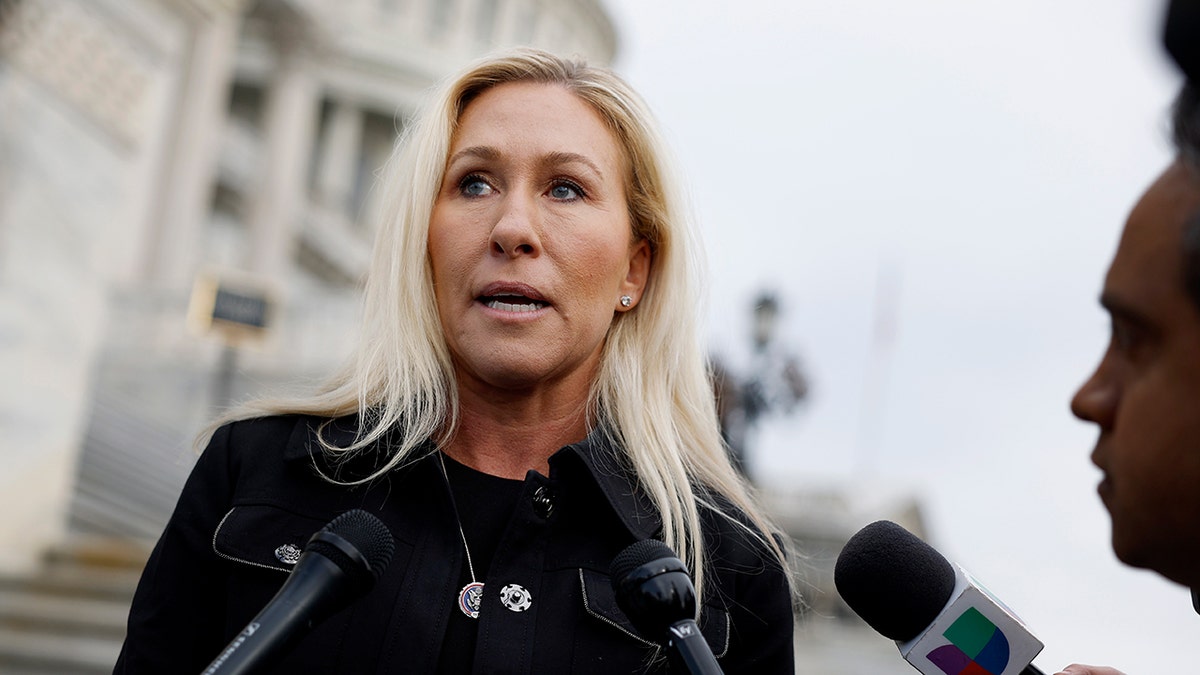
Rep. Marjorie Taylor Greene Says She’s Resigning from Congress
Republican Representative Marjorie Taylor Greene of Georgia, a figure who has frequently commanded national headlines and sparked intense debate, officially announced on X Friday, November 21, 2025, that she intends to resign from Congress early next year. This surprising declaration comes after what has been described as a weekslong, dramatic falling-out with former President Donald Trump and, by extension, a significant portion of her own Republican Party. Her final day serving the 14th congressional district of Georgia will be January 5, 2026. The announcement marks a pivotal moment in the often-turbulent political landscape, signifying a potential shift in the conservative movement and the dynamics within the Republican caucus.
In a comprehensive statement released alongside her social media post, the outspoken and hard-right congresswoman articulated a profound sense of frustration with both her party’s leadership and what she perceived as an overall lack of legislative progress within the halls of Congress. Greene, known for her aggressive political style and unwavering advocacy for specific conservative causes, detailed her disillusionment, writing that the Republican leadership had demonstrably refused to engage meaningfully on critical issues such as addressing escalating healthcare costs. She further lamented that numerous bills she had meticulously drafted and championed, particularly those pertaining to her robust stance on immigration reform and other domestic policies, had been left to languish, metaphorically "collecting dust" in legislative limbo. Her frustration culminated in a stinging indictment of the current legislative environment, where she asserted that the "legislature has been mostly sidelined," suggesting a profound stagnation in the primary function of the body.
Beyond the general legislative gridlock, Greene’s statement heavily alluded to, and in part explicitly addressed, her dramatic and highly public break with former President Donald Trump. This rift represents a particularly significant development, given Greene’s previous unwavering loyalty and vocal support for Trump throughout his presidency and post-presidency. Just last week, Mr. Trump publicly withdrew his support from Greene, unleashing a barrage of criticism where he branded her as "wacky" and, more damningly, a "traitor" following her increasingly critical remarks regarding Republicans’ handling of several high-profile issues. This public rebuke from a figure she had consistently championed sent shockwaves through the conservative base and political observers alike.
Greene, however, offered her own interpretation of the precipitating events that led to Trump’s ire. She vehemently claimed that the former president’s sudden and aggressive turn against her was directly triggered by her persistent push to disclose long-sealed records related to the late convicted sex offender Jeffrey Epstein. This particular issue had become a flashpoint, with Trump initially opposing the release of these sensitive documents. However, under considerable public and political pressure, including potentially Greene’s own persistent advocacy, he later endorsed the disclosure and, earlier this week, ultimately signed a bill mandating the release of those very records. Greene saw this as a vindication of her stance, yet paradoxically, it appears to have been the very issue that fractured her relationship with her erstwhile political mentor.
In a powerful and deeply personal segment of her resignation statement, Greene directly challenged Trump’s accusations and defended her actions. She wrote, "Standing up for American women who were raped at 14, trafficked and used by rich powerful men, should not result in me being called a traitor and threatened by the President of the United States, whom I fought for." This statement underscored her belief in the moral imperative of her actions, positioning herself as a defender of vulnerable victims rather than a disloyal party member. She further asserted a profound sense of self-reliance and faith, adding that her "self worth is not defined by a man, but instead by God." This declaration not only served as a direct rebuke to Trump but also projected an image of a politician guided by a higher purpose, independent of any singular political figure.
Marjorie Taylor Greene’s ascent to national prominence has been marked by controversy, bold statements, and an undeniable ability to galvanize a segment of the conservative base. Since her election in 2020, she quickly established herself as a firebrand, known for her uncompromising stance on cultural issues, her embrace of conspiracy theories, and her staunch defense of Donald Trump. Her career in Congress has been characterized by her willingness to challenge establishment norms, her frequent use of social media to communicate directly with her followers, and her consistent presence in the national media spotlight. For many of her supporters, she represented an authentic voice for the populist right, unafraid to speak truth to power, even within her own party. Her departure signals not just the end of a congressional term but potentially a significant recalibration for the segment of the Republican Party she so effectively represented.
The implications of Greene’s resignation are multifaceted and far-reaching. For the Republican Party, her departure could elicit a mixed reaction. While some moderate Republicans might privately express relief at the removal of a figure often seen as an electoral liability or a distraction, others within the hardline conservative wing could view it as a significant loss of a vocal champion. Her exit could either create a vacuum in the populist-right wing of the party, leading to a scramble for influence, or it could embolden other dissenting voices who might feel less constrained by the party line. The dynamic within the House Republican caucus, already prone to internal divisions, is likely to be impacted, potentially leading to further fracturing or, conversely, a renewed effort to consolidate power.
For Georgia’s 14th congressional district, Greene’s resignation will undoubtedly trigger a heated special election. The district, reliably conservative, will likely see a crowded field of Republican hopefuls vying to fill her shoes, each attempting to appeal to the strong conservative base that elected Greene. The nature of the candidates who emerge will offer insights into the current state of conservative politics in Georgia and the nation. Will the district seek another firebrand, or will it lean towards a more traditional conservative? The outcome will be keenly watched as a barometer of the broader political climate.
Looking ahead, Greene’s future in politics remains a subject of considerable speculation. A figure as prominent and polarizing as she is rarely fades entirely from the public eye. She could choose to remain a powerful voice in conservative media, leveraging her substantial social media following and established platform. Alternatively, her statement, particularly her emphasis on self-worth and a divine calling, might hint at a future run for a different office, perhaps even a statewide position in Georgia, or a return to activism with a renewed focus on specific policy issues. Her break with Trump, while seemingly costly in the short term, could also be interpreted as an attempt to carve out an independent political identity, allowing her greater flexibility in future endeavors.
Ultimately, Marjorie Taylor Greene’s decision to resign from Congress is more than just a personnel change; it is a significant political event that underscores the deep ideological fissures within the Republican Party and the ongoing struggle for its soul. Her departure, fueled by frustration with legislative inertia and a very public spat with the party’s de facto leader, Donald Trump, highlights the challenges of governing in an increasingly polarized political landscape. As the political scene continues to evolve, the ramifications of this resignation will undoubtedly reverberate for months and years to come, shaping debates and influencing the trajectory of conservative politics in America.