Appeals court lets Trump administration keep National Guard deployed in D.C. for now.
A federal appeals court delivered a significant, albeit temporary, victory to the Trump administration on Thursday, issuing an administrative stay that pauses a lower court’s ruling to end the controversial deployment of National Guard troops in Washington, D.C. This decision means that for the foreseeable future, thousands of Guard members will remain on the streets of the nation’s capital, a situation that has ignited a fierce constitutional and legal battle over federal versus local authority. The one-page order from the appellate judges indicated their need for more time to meticulously consider the complex legal arguments at play, explicitly stating that their move "should not be construed in any way as a ruling on the merits of that motion." This nuanced language underscores the provisional nature of the stay, leaving the ultimate fate of the deployment uncertain as the Trump administration presses for a longer-term reversal of the District Court’s decision.
The legal saga began with U.S. District Court Judge Jia Cobb’s landmark ruling last month. Judge Cobb had concluded that President Trump’s extensive military deployment in Washington, D.C., which encompasses both the D.C. National Guard and forces dispatched from other states, represented an illegal overreach and an intrusion into the sacrosanct authority of local officials to direct law enforcement within the district. Her ruling was a direct challenge to the President’s assertion of executive power in domestic policing matters. While acknowledging the President’s legitimate authority to safeguard federal functions and properties, Cobb drew a clear line, asserting that the President cannot unilaterally deploy the D.C. National Guard for general crime control, nor can he commandeer troops from other states for such purposes without the consent of local D.C. leadership. To facilitate an appeal by the Trump administration, Judge Cobb had wisely placed her order on hold for a period of 21 days, a window that the administration promptly utilized to seek relief from the appellate court.
The Trump administration did not mince words in its appeal, filing a robust challenge last week that characterized Judge Cobb’s ruling as a "wholly unjustified incursion into the territory of both the President and Congress." The administration’s legal team argued vehemently that the President was acting within his constitutional and statutory prerogatives to ensure public order and safety in the capital. White House spokeswoman Abigail Jackson reiterated this stance, telling the Associated Press, "As we have always maintained, the President exercised his lawful authority to deploy the National Guard to D.C. We look forward to ultimate vindication on this issue." This statement reflects the administration’s unwavering conviction in the legality and necessity of the deployment, framing it as a vital measure to protect the capital from what it perceives as a burgeoning crime emergency.
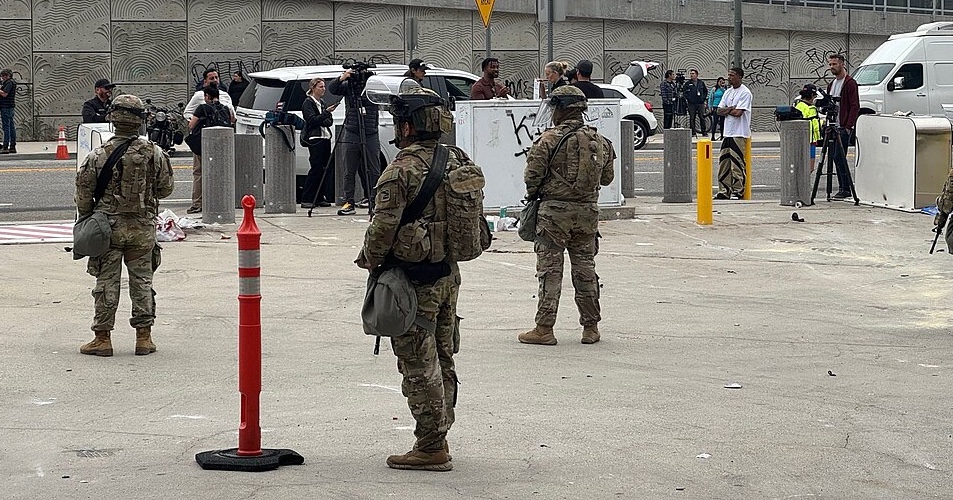
The genesis of this large-scale deployment traces back to August when President Trump issued an executive order declaring a severe crime emergency in Washington, D.C. This order paved the way for an unprecedented surge of military presence. Within a mere month, over 2,300 National Guard troops, drawn from eight different states and the District of Columbia itself, were actively patrolling the city. These forces operated under the direct command of the Secretary of the Army, a critical detail that emphasizes the federal government’s firm control over the operation. In addition to Guard members, hundreds of federal agents were also dispatched to augment the patrols, further intensifying the federal footprint in the district’s law enforcement landscape.
The District of Columbia’s Attorney General, Brian Schwalb, swiftly moved to challenge these deployments in court. Schwalb’s lawsuit underscored the fundamental principle of local governance, arguing that the federal deployment usurped the authority of the democratically elected mayor and other local officials to manage public safety within their jurisdiction. He specifically asked the judge to issue an injunction that would bar the White House from deploying Guard troops without the explicit consent of the mayor, a request rooted in the unique semi-autonomous status of D.C. and the traditional role of local authorities in policing. Schwalb’s office was not immediately available for comment following Thursday’s administrative stay, but their legal fight against what they view as an overreach of federal power is far from over.
The urgency and sensitivity surrounding the deployment have been tragically amplified by recent events. Just eight days prior to the appeals court’s decision, West Virginia National Guard members Specialist Sarah Beckstrom and Staff Sgt. Andrew Wolfe were ambushed while on patrol at a subway station, chillingly close to the White House. Specialist Beckstrom succumbed to her injuries on November 27, marking a profound loss for the Guard and the nation. Staff Sgt. Wolfe continues his arduous recovery. Rahmanullah Lakanwal, a 29-year-old Afghan national who was also shot during the confrontation last Wednesday, has since been charged with murder and has entered a plea of not guilty. This horrific incident not only brought the risks faced by deployed Guard members into stark relief but also injected a new, somber dimension into the ongoing legal and political debate.
In the immediate aftermath of the shooting, the administration called for an additional 500 National Guard members to be deployed to Washington, signaling a hardening of its resolve to maintain and even expand the military presence. Arkansas Governor Sarah Huckabee Sanders promptly announced her state’s commitment to sending 100 military members as part of this reinforcement, illustrating the complex interplay between federal directives and state cooperation in National Guard deployments.
This dispute in D.C. is not an isolated incident but rather part of a broader pattern of federal-local clashes over the deployment of National Guard troops under the Trump administration. The administration has also deployed Guard troops to Los Angeles, a move that a federal appeals court subsequently allowed to proceed. Attempts to send troops into Chicago and Portland, Oregon, however, have met with stiff resistance and additional court challenges. In Portland, a federal judge permanently blocked the Trump administration from deploying National Guard troops there, ruling that the President lacked the authority to call up or deploy such troops in that context. The administration is currently appealing that decision, highlighting a nationwide struggle over the interpretation of presidential powers, federalism, and the command structure of the National Guard in domestic law enforcement roles.
The unique status of the District of Columbia further complicates these legal arguments. As a federal district rather than a state, D.C.’s National Guard is subject to a dual chain of command, answering both to the President and to the D.C. Mayor. This creates a fertile ground for jurisdictional disputes, especially when federal and local priorities diverge. The core of the legal battle often hinges on whether the deployment falls under Title 10 (federal active duty) or Title 32 (federal funding, state control) of the U.S. Code, and how these provisions interact with the Posse Comitatus Act, which generally prohibits the use of the military for domestic law enforcement.
For now, the appeals court’s administrative stay maintains the status quo, allowing the National Guard to continue its patrols in Washington, D.C. This temporary reprieve gives the Trump administration crucial breathing room as it prepares its full arguments to defend the legality of its deployment. The case now moves into a more deliberative phase at the appellate level, where judges will weigh the intricate constitutional questions, the balance of power between federal and local governments, and the pressing public safety concerns. The eventual ruling by the appeals court will not only determine the fate of the National Guard in D.C. but could also set a significant precedent for future presidential actions regarding military deployment within U.S. cities, shaping the contours of executive power for years to come.