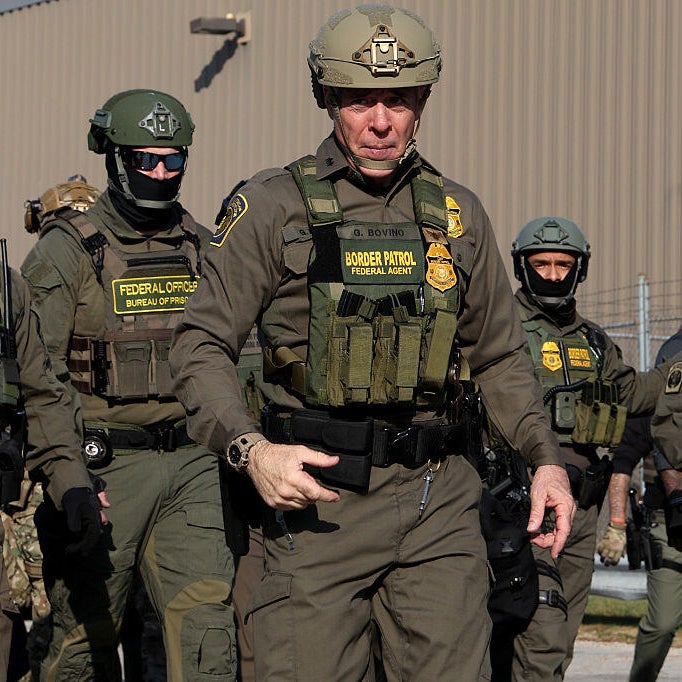
Border Patrol plans to expand Trump’s immigration crackdown to Charlotte and New Orleans, with armored vehicles and special agents, marking a significant escalation in the Trump administration’s sweeping nationwide immigration enforcement efforts. Internal government documents and U.S. officials have revealed the ambitious and controversial plans to deploy scores of Border Patrol agents to these two major American cities, overseeing operations that could involve the highly visible presence of armored vehicles and specialized tactical teams. This strategic move, detailed in confidential Department of Homeland Security (DHS) preparations reviewed by CBS News, designates Charlotte and New Orleans as the next critical targets in what has been described as President Trump’s mass deportation campaign.
The blueprint for these impending operations draws heavily from the administration’s recent controversial deployments in Chicago and Los Angeles, where federal immigration arrests have generated widespread public outcry and intense scrutiny. In Charlotte and New Orleans, green-uniformed Border Patrol agents are expected to assume a prominent, often leading, role in these enforcement actions. The planned Border Patrol operation in Charlotte is set to commence imminently, with an operations center already being established, potentially as early as the upcoming week, according to two sources familiar with the intricate details of the plans.
The proactive acknowledgment from local officials underscores the seriousness of the impending federal presence. Garry McFadden, the Sheriff of Mecklenburg County, North Carolina, confirmed on Thursday that he had been "contacted by two separate federal officials confirming US Customs and Border Protection (CBP) personnel will be arriving in the Charlotte area as early as this Saturday or the beginning of next week." This official confirmation highlights the tangible nature of the federal government’s intent and the immediate impact on local communities.
Charlotte Mayor Vi Lyles, in a joint statement issued Saturday with other local officials, voiced profound concerns that the expected Border Patrol operations are "causing unnecessary fear and uncertainty" within the community. Drawing parallels to "previous operations in other cities like Chicago," Mayor Lyles lamented that these actions "have resulted in people without criminal records being detained and violent protests being the result of unwarranted actions." This sentiment reflects a broader anxiety among city leaders about the potential for federal operations to disrupt community trust, civil liberties, and public order, especially given the documented instances of non-criminal individuals being swept up in earlier crackdowns.
Following the initial phase in Charlotte, Border Patrol’s focus is anticipated to shift to New Orleans, where an even larger contingent of CBP agents could be deployed, potentially numbering up to 200, according to both the internal DHS documents and the same sources. The internal planning documents reveal a request for substantial resources for both cities, including armored vehicles, specifically "BearCats," alongside the deployment of special operations agents. These militarized assets suggest a readiness for potential resistance or high-risk scenarios, signaling a departure from conventional immigration enforcement tactics. Internally, officials have assigned codenames to these highly sensitive operations: "Charlotte Web" for the Charlotte deployment, a reference to the beloved children’s novel, and "Catahoula Crunch" for New Orleans, a nod to Louisiana’s official state dog, the Catahoula Leopard Dog. These seemingly innocuous monikers belie the gravity and potential impact of the planned enforcement actions.
Notably, many of the seasoned Border Patrol agents who participated in the contentious Chicago region deployment earlier in the fall are expected to be redirected to Charlotte and New Orleans. This includes the outspoken commander Gregory Bovino, who has been a central figure in the administration’s more aggressive enforcement strategies. CBS News had previously reported that Bovino and a significant portion of Border Patrol agents would be departing Chicago, with indications that they might be redeployed to other locations like Charlotte, a prediction now being realized.
When pressed for comment, Tricia McLaughlin, DHS assistant secretary for public affairs, adhered to the standard departmental policy, stating that the department does "not discuss future or potential operations." She added, however, a boilerplate affirmation: "Every day, DHS enforces the laws of the nation across the country," underscoring the federal government’s mandate for nationwide enforcement regardless of local sentiment or jurisdiction.
The impending operations have also drawn sharp criticism from state officials. North Carolina Gov. Josh Stein, a Democrat, released a statement emphasizing that "Public safety is the top priority for all of us in government – that means fighting crime, not stoking fear or causing division." He argued that the focus should be on "arresting violent criminals and drug traffickers," and regrettably, "that’s not always what we have seen with ICE and Border Patrol Agents in Chicago and elsewhere around the country." Governor Stein specifically referenced data indicating that a majority of those detained in previous operations had "no criminal convictions," highlighting a core concern about the indiscriminateness of these federal actions. He urged North Carolinians "to remember our values," to follow the law, and to remain peaceful, but also advised citizens, "If you see any inappropriate behavior, use your phones to record and notify local law enforcement," a direct call for public oversight and accountability amidst the anticipated federal presence.
These latest plans unequivocally illustrate the Trump administration’s persistent and increasing reliance on Border Patrol agents to execute its expansive, nationwide crackdown on illegal immigration. This strategy is particularly notable because, while Immigration and Customs Enforcement (ICE) is the federal agency primarily tasked with enforcing U.S. immigration laws within the interior of the country, the Trump administration has consistently deployed teams of Border Patrol agents to cities like Chicago, Los Angeles, and now Charlotte and New Orleans – locations far removed from the U.S.-Mexico border, the traditional operational domain of Border Patrol. This shift in deployment strategy comes even as illegal crossings at the southern border plunged to a 55-year low in fiscal year 2025, suggesting a reallocation of resources towards interior enforcement rather than solely border security.
The operations conducted by Border Patrol agents in both Chicago and Los Angeles, often personally led by Commander Bovino, have attracted considerable scrutiny and sparked intense protests. Local residents and immigrant rights advocates have vociferously denounced the agency’s actions as overly aggressive and frequently indiscriminate. While both ICE officers and Border Patrol agents possess the same federal legal authority to arrest individuals suspected of being in the country illegally, their operational methodologies typically diverge significantly in style and nature.
ICE, under Mr. Trump, has also aggressively expanded immigration enforcement across the country. However, its arrests traditionally tend to be, to a large extent, targeted operations driven by meticulous intelligence gathering and prior surveillance, often specifically aiming at individuals in the U.S. illegally who also have documented criminal histories. In stark contrast, Border Patrol agents in Chicago and Los Angeles have engaged in "roving" operations. These tactics are characterized by their more indiscriminate nature, targeting public spaces like Home Depot parking lots and various worksites – locations they perceive as frequently visited by individuals lacking legal permission to reside in the U.S. This broad-brush approach has been a major point of contention, leading to concerns about racial profiling and the apprehension of individuals with no criminal record, which Mayor Lyles and Governor Stein highlighted.
Furthermore, the level of force employed by Border Patrol against protesters has also elicited scathing criticism. A federal judge in Chicago, for instance, took the extraordinary step of imposing drastic limits on the ability of agents to deploy tear gas and various crowd control tactics against demonstrators. Despite these judicial constraints and public outcries, Trump administration officials have consistently maintained that agents have utilized only the necessary and appropriate force, citing instances where civilians allegedly interfered with operations or resorted to violence. Commander Bovino himself defended his agents’ actions last month, telling CBS News, "The use of force that I’ve seen has been exemplary – the least amount of force necessary to accomplish the mission." This stark contrast in perception between federal officials and local communities underscores the deep divisions and distrust generated by these aggressive enforcement campaigns.
The deployment of armored vehicles, such as "BearCats," and special operations teams further militarizes interior immigration enforcement, blurring the lines between domestic law enforcement and military-style interventions. This approach raises significant civil liberties concerns, particularly in cities like Charlotte and New Orleans, which have diverse populations and vibrant communities that could be deeply affected by such a heavy-handed federal presence. The fear and uncertainty Mayor Lyles described can ripple through immigrant communities, discouraging individuals from seeking essential services, reporting crimes, or engaging with local institutions, thereby undermining public safety at a foundational level.
The political ramifications are also profound. These operations are not merely about enforcing immigration law; they are potent symbols of the Trump administration’s "America First" agenda and its uncompromising stance on immigration. By targeting cities perceived as potentially less cooperative or "sanctuary" jurisdictions, the federal government asserts its authority over local governance, intensifying the ongoing federalism debate. This could lead to increased legal challenges, community organizing, and potential civil unrest, creating a volatile environment in the targeted cities.
In essence, the expansion of Border Patrol’s operations to Charlotte and New Orleans represents a significant escalation of a controversial national strategy. It signifies a continued shift towards a more visible, militarized, and less discriminate approach to immigration enforcement in the heart of American cities, with potentially far-reaching consequences for civil liberties, community trust, and the delicate balance between federal and local authority. The stage is set for heightened tensions and further confrontations as these new phases of the Trump administration’s immigration crackdown unfold.