Dick Cheney remembered at funeral as having "devotion to America" over party.
Washington D.C. gathered on a solemn Thursday, November 20, 2025, at the majestic National Cathedral to bid farewell to former Vice President Dick Cheney, a figure whose long and impactful career was remembered as one defined by an unwavering "devotion to America" that transcended partisan divides. The service, attended by a bipartisan array of political luminaries, family, and friends, painted a portrait of a man known for his quiet strength, profound conviction, and deep love for his nation and loved ones.
The solemn procession began at 11:00 AM, as military body bearers carried Cheney’s flag-draped casket into the cathedral. His wife, Lynne Cheney, in a wheelchair, and his daughters, Liz and Mary Cheney, followed closely behind, their grief palpable. Among the distinguished guests were former Presidents George W. Bush and Joe Biden, former Vice Presidents Kamala Harris, Mike Pence, Al Gore, and Dan Quayle, as well as Supreme Court Chief Justice John Roberts and several Associate Justices, numerous senators, and House members. Notably, former President Trump was not invited, and former President Bill Clinton was unable to attend due to a scheduling conflict. House Speaker Emerita Nancy Pelosi, despite past policy disagreements, was also present, a testament to Cheney’s ability to earn respect across the political spectrum, particularly in later years concerning shared constitutional values.
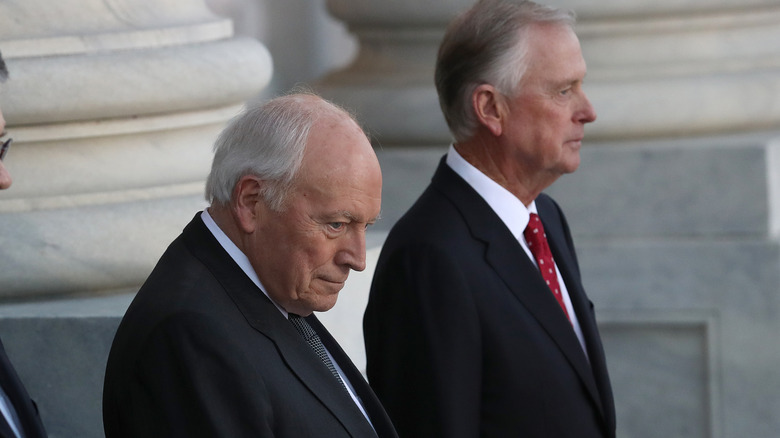
Former Representative Liz Cheney delivered a poignant eulogy, emphasizing her father’s steadfast belief that "a choice between defense of the Constitution and defense of your political party was no choice at all." She recounted how her father instilled in his children and grandchildren a profound understanding of American history and the sacrifices made for freedom, ensuring they understood that "you couldn’t truly appreciate what it means to live in freedom if you didn’t understand the sacrifices of the generations who came before." Liz shared a personal anecdote about her father’s unconventional path, including his expulsion from Yale twice, before finding his calling after hearing John F. Kennedy’s call to public service in 1963 at the University of Wyoming. This moment, she suggested, ignited his commitment, leading him to become a Republican but always prioritizing the "single bond we share as Americans" above party loyalty. Her father’s "devotion to America was deep and substantive," she affirmed, concluding with a touching revelation that his last words were to tell his beloved wife, Lynne, that he loved her.
Former President George W. Bush, who served two terms with Cheney as his Vice President, delivered a heartfelt tribute, remembering Cheney as a loyal colleague and a cherished friend. Bush described Cheney as "everything a president should expect as a second-in-command," praising his focus and capability. He revealed a telling detail from the challenging 2004 reelection campaign: Cheney, ever the team player, offered to step aside if Bush believed a different running mate would be more beneficial. Bush underscored Cheney’s unique character in a profession often dominated by rhetoric, stating, "In a profession that attracts talkers, he was a thinker and a listener." He wished all Americans could have known the "gentleman by nature, and a true man of the west" that the people of Wyoming knew. Bush concluded his eulogy with a hopeful sentiment: "We are grateful for his good life, we honor his service, and we pray that somewhere up the trail, we will meet him again."
Cheney’s grandchildren – Elizabeth Perry, Richard Perry, and Grace Perry – offered a tender glimpse into his private life, remembering him as a loving "rodeo grandpa" who enjoyed cooking Thanksgiving turkey, driving them to college, fishing, and watching John Wayne movies. Grace Perry noted his aversion to GPS navigation, reflecting his deep love for his land and Wyoming. They affectionately described him as "tough with a kind heart" and promised to follow his example.
Pete Williams, former NBC News correspondent and Cheney’s press secretary, shared a deeply personal account of Cheney’s character, recalling his boss’s love for fly fishing and, more significantly, his unwavering support when Williams’s sexual orientation was about to be publicly disclosed in 1991. Cheney dismissed Williams’s offer to resign and continued to check on him for days after the article was published. Williams concluded, "Dick Cheney was a good and decent man. He loved his family and his home state… His highest aspiration was serving the country. And I’m so lucky and so deeply grateful that I was along for part of that ride."
Dr. Jonathan Reiner, Cheney’s cardiologist and friend for 27 years, provided insights into Cheney’s remarkable resilience. Cheney suffered his first heart attack at 37 during his first congressional campaign, defying doctors’ advice to quit. Reiner recalled Cheney’s calm demeanor even in life-threatening situations, including a dangerously high potassium level on September 11, 2001, which Cheney famously postponed addressing, stating, "No, not today." Reiner noted, "He never looked over his shoulder. He only looked ahead." Cheney’s eventual heart transplant, a "gift," granted him many more years to witness his grandchildren grow, underscoring his enduring spirit.
Cheney’s life was a testament to an early and rapid rise in American politics. Born in Lincoln, Nebraska, in 1941 and raised in Wyoming, Richard Bruce Cheney’s career began after a brief, self-admitted turbulent time at Yale and graduation from the University of Wyoming, marrying his high-school sweetheart, Lynne. By the age of 34, he became the youngest White House Chief of Staff for President Gerald Ford. He served six terms as a Congressman for Wyoming starting in 1978 and was appointed Secretary of Defense by President George H.W. Bush, overseeing the successful 1991 Gulf War. After a stint as CEO of Halliburton, he was chosen by George W. Bush to lead the search for a running mate in 2000, only to emerge as the top choice himself, serving two transformative terms as Vice President.
During his vice presidency, Cheney redefined the role, particularly in the aftermath of the September 11, 2001, terrorist attacks. He was a central figure in the Bush administration’s response, advocating for military action in Iraq and firmly believing in the necessity of robust national security measures. Though the absence of weapons of mass destruction in Iraq later drew significant criticism, his conviction in his decisions remained firm. In 2015, co-authoring "Exceptional: Why the World Needs a Powerful America" with his daughter Liz, he fiercely defended the Bush administration’s policies, including controversial interrogation techniques, asserting, "I don’t believe we sacrificed our values… I think the No. 1 responsibility of senior public officials is to safeguard the nation."
In his later years, Cheney, along with his daughter Liz, took a strong stance against former President Donald Trump. Liz Cheney’s vote to impeach Trump after the January 6, 2021, Capitol attack, and her role as vice chair of the select committee investigating it, garnered her father’s full support. Dick Cheney himself appeared in a campaign ad for Liz’s failed 2022 reelection bid, declaring Trump "a greater threat to our republic than Donald Trump." In 2024, both Dick and Liz Cheney publicly endorsed Democratic presidential nominee Kamala Harris, emphasizing their commitment to putting "country above partisanship to defend our Constitution." This principled stand echoed the sentiment expressed at his funeral: a profound dedication to America’s foundational values, even when it meant diverging from party lines.
As the Battle Hymn of the Republic filled the cathedral, Cheney’s casket was carried out shortly after 1 p.m., marking the final farewell to a statesman whose long life was inextricably linked to the fabric of American politics. Dick Cheney’s funeral was not just a remembrance of a public servant but a profound reflection on a life lived with deep convictions, an unyielding dedication to his country, and an enduring love for his family, solidifying his legacy as a man whose "devotion to America" always superseded partisan allegiance.