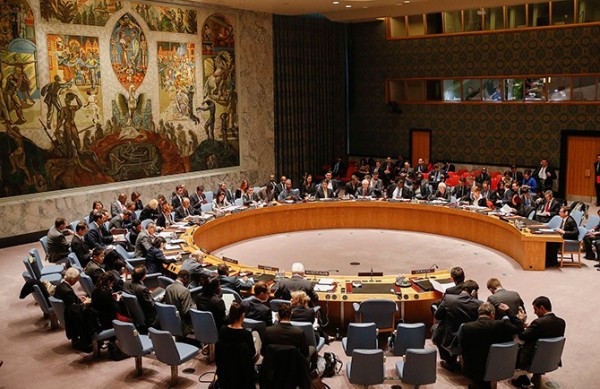
U.N. Security Council approves U.S.-brokered Gaza peace plan
The United Nations Security Council on Monday, November 17, 2025, delivered a landmark approval of a U.S.-brokered peace plan for Gaza, a move hailed by Washington as a crucial step towards de-escalation and long-term stability in the war-torn territory. The resolution authorizes the deployment of an international stabilization force, tasked with providing security and overseeing the reconstruction of the devastated enclave, while also charting a potential future course towards an independent Palestinian state. The vote, standing at 13-0 with Russia and China abstaining, showcased a rare moment of international consensus on a deeply contentious issue, as fears that Moscow might wield its veto power on the Security Council’s most formidable body ultimately proved unfounded.
This vote marks a pivotal juncture in the fragile ceasefire efforts and the painstaking process of outlining Gaza’s post-war future, following two grueling years of conflict between Israel and Hamas. A critical element underpinning the resolution’s adoption was the expressed interest from several Arab and other Muslim nations in contributing troops to an international force, contingent upon formal Security Council authorization. Their participation is deemed essential for the credibility and operational effectiveness of any such mission, highlighting the diplomatic heavy lifting undertaken by the U.S. to secure broad regional backing.
The ceasefire, initially implemented on October 10, had been precarious, marred by accusations of violations from both Hamas and Israel, consistently threatening to unravel the delicate agreement in the weeks following its inception. The initial phase of the deal stipulated the release of all living and deceased hostages held by Hamas in exchange for approximately 2,000 Palestinian prisoners detained by Israel. While the living hostages were repatriated by the agreed deadline, the recovery of remains for some deceased hostages proved problematic. Both Hamas and U.S. officials cited the immense difficulties in locating and retrieving these remains amidst the widespread destruction across the Gaza Strip, a situation Israeli Prime Minister Benjamin Netanyahu deemed a clear violation of the agreement’s terms.
Further complicating the ceasefire’s stability, Gaza experienced recurrent flare-ups of violence, including Israeli airstrikes that Jerusalem maintained were retaliatory responses to Hamas attacks on Israeli forces. Concurrently, international humanitarian advocates raised serious concerns, accusing Israel of failing to adhere to its commitments regarding the comprehensive delivery of promised aid into Gaza, exacerbating an already dire humanitarian crisis. These breaches underscored the profound trust deficit and the inherent challenges in enforcing the terms of a ceasefire in a region scarred by prolonged conflict.
The U.S. resolution formally endorses President Trump’s comprehensive 20-point ceasefire plan. A central, and somewhat unconventional, feature of this plan is the establishment of a "Board of Peace," a transitional authority that President Trump himself is slated to chair. This board is envisioned as a high-level oversight body, guiding the transition and stabilization process. Beyond the board, the resolution grants the stabilization force an expansive mandate, encompassing border oversight, internal security provision, and, crucially, the demilitarization of the territory. The authorization for both the Board of Peace and the stabilization force is set to expire at the close of 2027, indicating a defined transitional period.
In the immediate aftermath of the U.N. vote, President Trump took to social media to express his triumph, stating, "Congratulations to the World on the incredible Vote of the United Nations Security Council, just moments ago, acknowledging and endorsing the BOARD OF PEACE, which will be chaired by me, and include the most powerful and respected Leaders throughout the World." He extended gratitude to the Security Council members, including Russia and China for their abstention, and promised "many more exciting announcements" regarding the board’s composition in the forthcoming weeks.
Hamas, however, swiftly voiced its strong criticism of the U.N.’s adoption of the plan. According to Reuters, the militant group declared that "Assigning the international force with tasks and roles inside the Gaza Strip, including disarming the resistance, strips it of its neutrality, and turns it into a party to the conflict in favor of the occupation." Al Jazeera reported further comments from Hamas, asserting, "Any international force, if established, must be stationed solely on the borders to separate the forces and monitor the ceasefire, and must be entirely under the supervision of the United Nations." This firm stance highlights a fundamental point of contention that will undoubtedly pose significant hurdles to the plan’s implementation.
The diplomatic negotiations surrounding the U.S. resolution spanned nearly two weeks, during which Arab nations and the Palestinians vigorously lobbied Washington to strengthen the initial, rather weak, language concerning Palestinian self-determination. Their persistent advocacy bore fruit, leading to a revision that now states that following reforms within the Palestinian Authority – which currently governs parts of the West Bank – and advancements in the redevelopment of the devastated Gaza Strip, "the conditions may finally be in place for a credible pathway to Palestinian self-determination and statehood." The resolution further commits the U.S. to "establish a dialogue between Israel and the Palestinians to agree on a political horizon for peaceful and prosperous coexistence," signaling a longer-term diplomatic engagement.
This language, however, provoked a strong reaction from Israeli Prime Minister Benjamin Netanyahu, who on Sunday unequivocally vowed to oppose any attempts to establish a Palestinian state. Netanyahu has consistently argued that the creation of a Palestinian state would not only reward Hamas for its aggression but would ultimately lead to the emergence of an even larger Hamas-controlled entity on Israel’s borders, posing an intolerable security threat. His stance underscores the deep-seated ideological and security divisions that continue to complicate any prospects for a two-state solution.
A critical factor in securing the resolution’s adoption was the robust support from key Arab and Muslim nations. Their endorsement was vital not only for the resolution’s political legitimacy but also for the practical consideration of potentially contributing troops to the international force. The U.S. mission to the U.N. proactively distributed a joint statement on Friday, co-signed by Qatar, Egypt, United Arab Emirates, Saudi Arabia, Indonesia, Pakistan, Jordan, and Turkey, all vocally advocating for the "swift adoption" of the U.S. proposal. This broad regional backing was instrumental in overcoming potential resistance.
The vote unfolded against the somber backdrop of a war triggered by Hamas’s surprise terror attack on southern Israel on October 7, 2023, which resulted in the deaths of approximately 1,200 people. Israel’s subsequent military offensive, spanning more than two years, has exacted a devastating toll on the Palestinian population, with over 69,000 Palestinians killed, according to the Hamas-run Gaza Health Ministry. The ministry’s figures, while not distinguishing between civilians and combatants, assert that the majority of casualties are women and children, highlighting the profound human cost of the conflict.
Just last week, Russia unexpectedly circulated a rival proposal that featured significantly stronger language in support of a Palestinian state alongside Israel. Moscow’s draft also emphasized the imperative of uniting the West Bank and Gaza as a single state under the Palestinian Authority. Furthermore, it deliberately stripped out references to President Trump’s transitional board, instead requesting U.N. Secretary-General Antonio Guterres to present options for an international force to ensure security in Gaza and oversee the ceasefire plan’s implementation, thereby stressing the primacy of a Security Council-led role. The U.S. managed to garner enough support for its own resolution, sidestepping a direct confrontation with Russia’s alternative.
The U.S. resolution explicitly mandates the stabilization force to ensure "the process of demilitarizing the Gaza Strip" and "the permanent decommissioning of weapons from non-state armed groups." The practical execution of disarming Hamas, an organization deeply entrenched and ideologically committed to armed resistance, represents a monumental challenge that could easily derail the entire peace effort. The resolution further authorizes the force "to use all necessary measures to carry out its mandate" in compliance with international law, which is standard U.N. terminology for the legitimate use of military force, underscoring the robust nature of the force’s powers.
Delving deeper into its operational specifics, the resolution outlines that the stabilization troops will collaborate with a trained and vetted Palestinian police force to secure border areas. They will also coordinate closely with other countries to facilitate the unhindered flow of humanitarian assistance, a critical component for the recovery of Gaza’s beleaguered population. Furthermore, the force is required to maintain close consultation and cooperation with neighboring Egypt and Israel, whose security concerns and regional influence are paramount to the mission’s success.
As the international force gradually establishes control and brings stability to the region, the resolution stipulates that Israeli forces will commence their withdrawal from Gaza. This withdrawal will be "based on standards, milestones, and timeframes linked to demilitarization," which must be mutually agreed upon by the stabilization force, Israeli forces, the United States, and the guarantors of the ceasefire. This phased withdrawal mechanism ties Israeli disengagement directly to the successful demilitarization of Gaza, a condition that will likely be subject to intense scrutiny and negotiation. The complexities of this agreement underscore the immense diplomatic and logistical hurdles that lie ahead for a region yearning for an elusive peace.