The Alienware Aurora Gaming Desktop Punches Above Its Weight
The Alienware Aurora Gaming Desktop emerges as a compelling contender in the fiercely competitive mid-to-high-range PC gaming market, presenting an offering that, for its price point of $1,550, genuinely punches above its weight. This particular configuration, featuring two sticks of Kingston Fury 16-GB RAM (totaling 32GB) and a cutting-edge Wi-Fi 7 card, represents a remarkably solid deal. While it’s true that the savvy builder or bargain hunter might unearth cheaper pathways to achieve RTX 5070-level performance – systems like the iBuyPower Element Pro, for instance, often present a formidable alternative – the Alienware Aurora manages to carve out a distinct niche for itself. It steers clear of being the most exorbitantly priced option, a position often occupied by high-end pre-builts such as the Asus ROG G700, which can demand hundreds of dollars more even when similarly configured. The value proposition here isn’t solely about raw performance per dollar but also encompasses brand prestige, design, and a complete, ready-to-play package that appeals to a broad spectrum of gamers.
One of the initial considerations for any pre-built system is the balance between performance, components, and cost. The inclusion of 32GB of Kingston Fury RAM is a significant plus, providing ample memory for demanding games, multitasking, and future-proofing. The upgrade to Wi-Fi 7 is another forward-thinking addition, ensuring that users are equipped with the latest wireless connectivity standard, offering faster speeds and lower latency for online gaming, provided they have a compatible router. These are not trivial inclusions and contribute substantially to the overall value of the $1,550 package. While I haven’t personally conducted exhaustive tests on the specific iBuyPower or Asus ROG G700 systems mentioned to directly compare their acoustic profiles or performance nuances against the Aurora, the Alienware’s integrated offering presents a cohesive and attractive package. Its appeal is further amplified when considering the potential for sales, which can often push an already solid deal into truly exceptional territory.
In terms of raw computational prowess, the Alienware Aurora Gaming Desktop performs commendably, if not groundbreakingly. Benchmarking reveals that it typically trails the average RTX 5070 scores in 3DMark Steel Nomad – a widely recognized and rigorous benchmark for evaluating gaming PC performance – by approximately 5 percent. While a 5 percent differential might raise an eyebrow for the most ardent enthusiasts, it’s often negligible in real-world gaming scenarios, especially when considering the overall user experience. The RTX 5070 itself is primarily lauded as an excellent 1080p video card, capable of delivering smooth and visually rich experiences at that resolution. However, its capabilities extend to 1440p gaming, where it can still provide highly playable frame rates, depending on the specific game and its graphical demands. This versatility makes the Aurora, powered by the RTX 5070, a strong choice for gamers looking for a sweet spot between performance and affordability for current-generation titles.
To illustrate its in-game performance, a series of popular and demanding titles were tested at maximum settings, deliberately excluding ray tracing, frame generation, or upscaling technologies to gauge the raw power. The results, as depicted in the accompanying chart, provide a clear picture. Games like Cyberpunk 2077 and Black Myth: Wukong are notoriously GPU-intensive, pushing graphics cards to their limits. Conversely, titles such as Marvel Rivals and Monster Hunter Wilds tend to be more bottlenecked by the CPU, offering insights into the system’s overall balance.
The performance in Cyberpunk 2077 was particularly noteworthy and felt genuinely impressive. Even when pushed to the demanding Ray Tracing Ultra preset at 1080p, the system managed to average a very respectable 71 frames per second (fps) – and critically, this was achieved without relying on DLSS (Deep Learning Super Sampling). This is a testament to the system’s ability to handle highly detailed and graphically advanced environments, delivering a fluid and immersive experience right out of the box. For a game as visually stunning and hardware-intensive as Cyberpunk 2077, maintaining such a high frame rate without AI upscaling is a significant achievement and speaks volumes about the Aurora’s graphical horsepower. Engaging DLSS would undoubtedly push these frame rates even higher, offering an even smoother experience or enabling higher resolutions with ray tracing.
However, the experience with Black Myth: Wukong presented a slight snag. Despite the system’s robust capabilities, it struggled to consistently push beyond 60 fps at 1080p. While Black Myth: Wukong is undeniably a graphically heavy game, this outcome might be a point of minor disappointment for a system priced over $1,500. Gamers investing in this tier of hardware typically harbor expectations of playing modern titles at 1080p with consistently smooth frame rates. The slight dip below the coveted 60 fps threshold, while not a deal-breaker, highlights the game’s intense optimization demands. Fortunately, this can often be mitigated by making minor adjustments to in-game graphics presets or by applying a touch of DLSS upscaling, which can yield significant performance gains without a substantial compromise in visual quality. This performance characteristic, along with the 3DMark Steel Nomad results, puts the Alienware Aurora approximately 5 percent behind our test bench’s results for the RTX 5070 Founders Edition, suggesting that while it performs admirably, there might be slight variations in thermal management, power delivery, or specific card binning that lead to this minor difference.
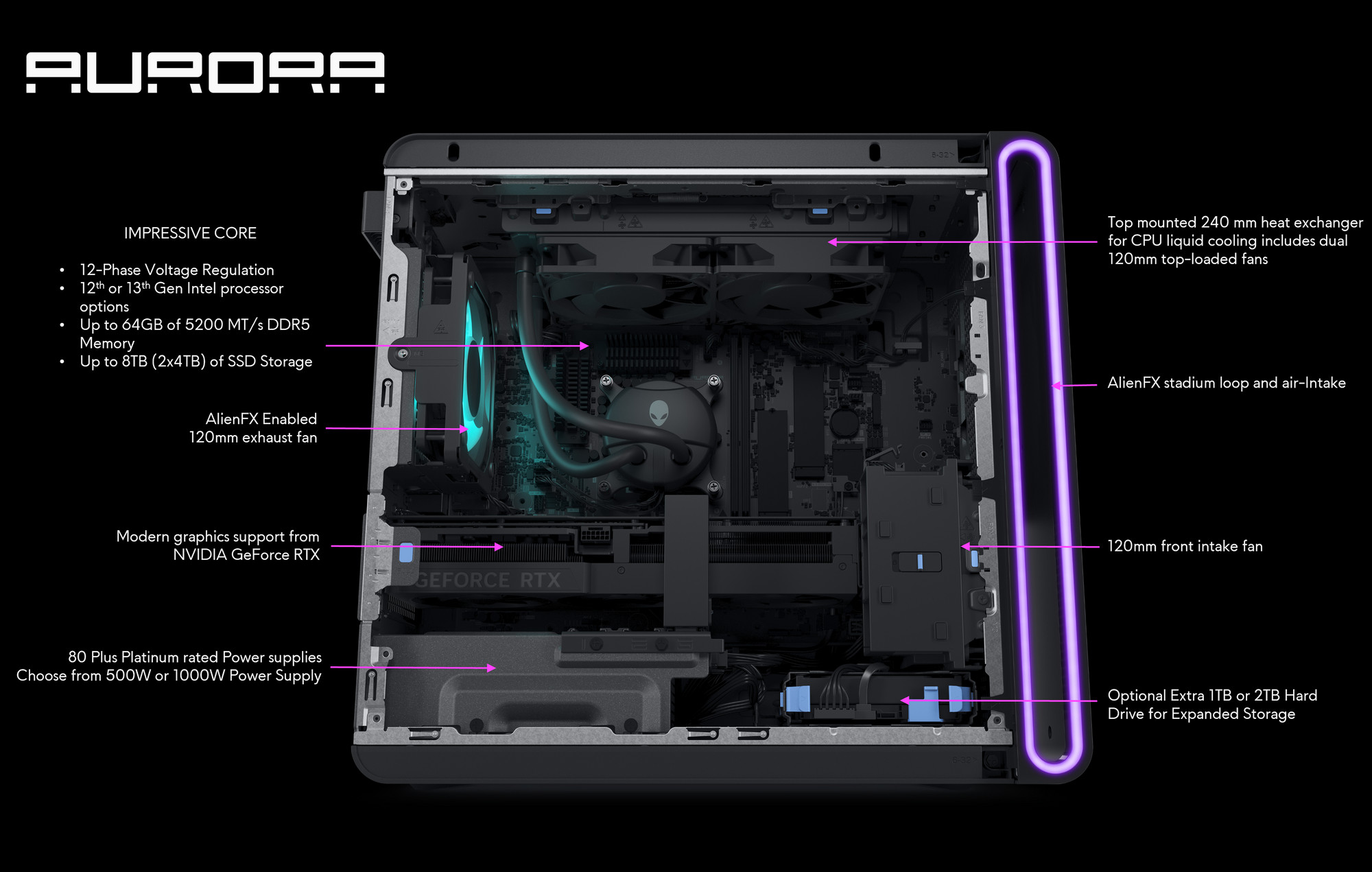
Beyond raw numbers, the Alienware Aurora distinguishes itself through its iconic design. Alienware has long been synonymous with distinctive, often futuristic aesthetics, and the Aurora line continues this tradition. The description of it as a "pretty computer" is apt. Its chassis typically features aggressive lines, customizable RGB lighting zones (often through AlienFX), and a robust, premium build quality that sets it apart from more utilitarian-looking competitors. This design ethos contributes significantly to the "punches above its weight" feeling; while its performance might be marginally behind a Founders Edition GPU in some benchmarks, the overall package – including the visual appeal and brand experience – adds tangible value. The unique chassis design, often featuring a tool-less entry system, also hints at a thoughtful user experience, even if internal component layouts can be proprietary.
However, the distinct design and brand-specific engineering that define Alienware also come with certain implications for future upgrades. The provided text accurately notes that this isn’t the PC for those who demand ultimate control over future component swaps or those who seek the most powerful gaming desktop available for their budget. Alienware, like many other major OEMs, often employs proprietary motherboards, power supply units, and cooling solutions. While these components are perfectly functional and optimized for the system they come in, they can make standard upgrades challenging. For instance, swapping out the motherboard for an off-the-shelf option might be difficult due to non-standard mounting points or power connectors. The cooling solutions, while effective, might be specifically designed for the Aurora chassis, limiting options for aftermarket coolers.
Despite these potential limitations, the Alienware Aurora does offer a pathway for certain upgrades, particularly concerning the graphics card. This makes it a viable option for users who anticipate upgrading their GPU in the future to keep pace with evolving game demands. Crucially, and as strongly advised, any prospective buyer should ensure they acquire the system configured with the 1,000-watt power supply. This recommendation is not merely for current stability but is absolutely vital for future-proofing. A higher wattage PSU provides ample headroom for more powerful GPUs that may consume significantly more power than the current RTX 5070. Opting for a lower wattage PSU (e.g., 750W or 850W, if offered) could severely restrict future graphics card upgrades, forcing a costly PSU replacement down the line and potentially limiting choices to less powerful GPUs. The 1,000-watt PSU ensures peace of mind, allowing users to slot in a top-tier GPU a few years down the road without worrying about power constraints.
In conclusion, while the Alienware Aurora Gaming Desktop may not universally "blow away" every enthusiast with its raw, unadulterated benchmark scores, I was overall genuinely impressed by the comprehensive package it offers. It strikes an excellent balance between performance, aesthetics, and price, especially when considering the premium brand experience. This PC is not tailored for the hardcore PC builder who thrives on modularity and constant component swapping, nor is it aimed at those who demand the absolute peak of gaming performance at any cost. Instead, it targets a distinct demographic: gamers who appreciate a beautifully designed, branded system that performs exceptionally well out of the box, provides a smooth gaming experience across a wide range of titles, and offers a straightforward path for a graphics card upgrade in the future. For such users, particularly when caught during a sale, the Alienware Aurora Gaming Desktop indeed punches above its weight, delivering a high-quality, reliable, and visually appealing gaming experience that justifies its position in the market. Just remember that crucial 1,000-watt power supply to ensure its longevity and upgrade potential.