Thailand Launches Airstrikes Along Border with Cambodia as Ceasefire Falters
A dangerous escalation in the long-simmering border dispute between Thailand and Cambodia erupted on Monday, December 8, 2025, as Thailand launched a series of airstrikes along their contested frontier. The offensive came amidst a rapid deterioration of a fragile ceasefire agreement, brokered just two months prior by U.S. President Trump, with both Southeast Asian nations accusing the other of violating the truce. This latest outbreak of hostilities has sent shockwaves through the region, rekindling fears of a wider conflict and prompting a mass exodus of civilians from the borderlands.
The immediate trigger for Monday’s airstrikes appears to be a deadly skirmish on Sunday, December 7, which saw an exchange of fire resulting in casualties. According to Thai army spokesperson Maj. Gen. Winthai Suvaree, Cambodian troops initiated the attack on Sunday by firing into Thai territory, injuring two Thai soldiers. Thai forces retaliated, leading to a 20-minute firefight. Cambodia, however, presented a starkly different account, asserting that Thai forces fired first and their own troops did not retaliate. This cycle of conflicting narratives has become a dangerous hallmark of the intractable dispute.
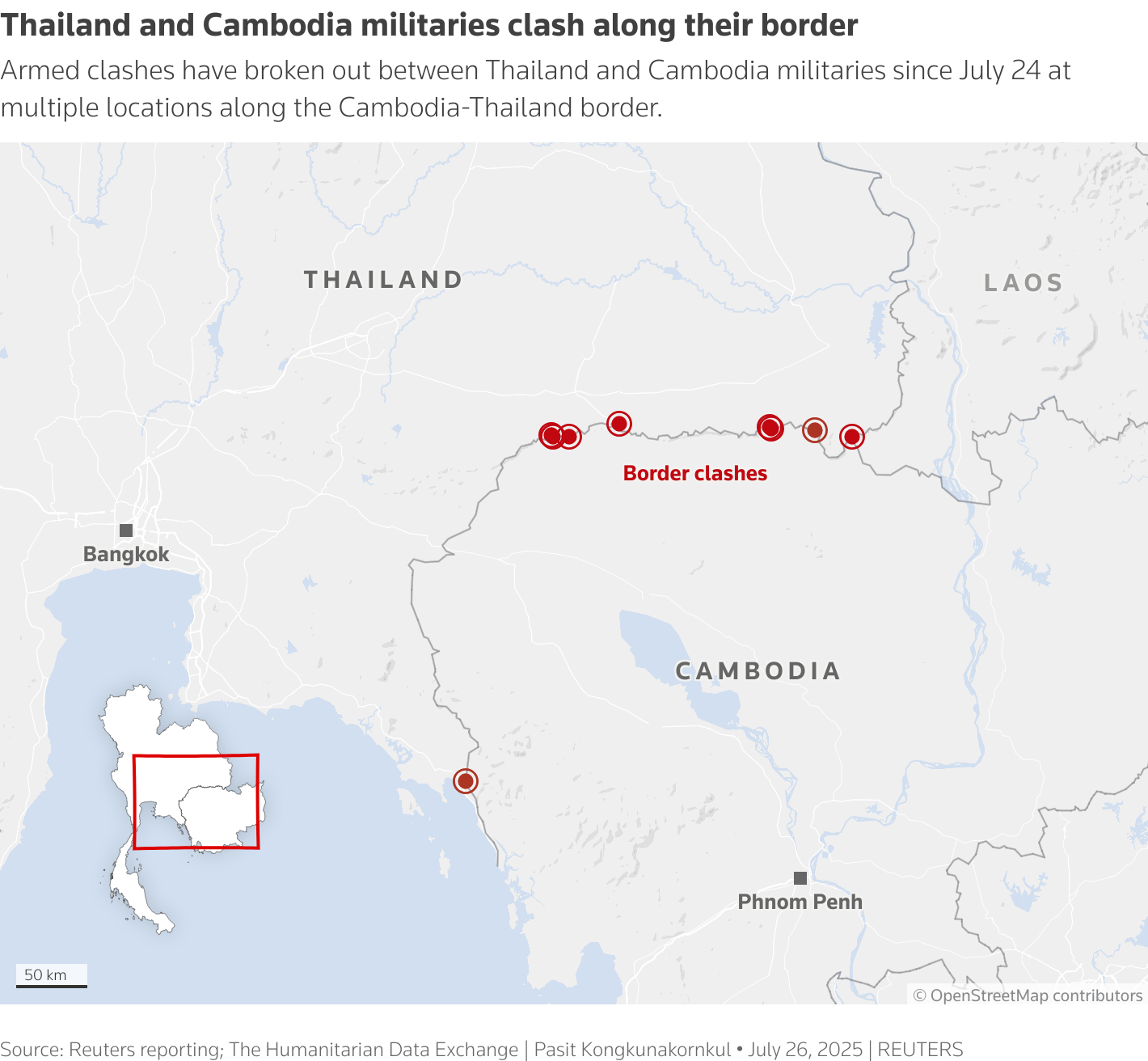
The situation dramatically worsened on Monday. Maj. Gen. Winthai Suvaree reported that Cambodian troops again fired first into multiple areas within Thai territory. This time, the consequences were graver, with one Thai soldier killed and four others wounded. In response, Thailand deployed aircraft "to strike military targets in several areas to suppress Cambodian supporting fire attacks," marking a significant escalation from ground-based exchanges to aerial bombardment. The Thai Ministry of Defense confirmed that these operations were deemed necessary to defend the country’s sovereignty and protect public safety.
Cambodian Defense Ministry spokesperson Maly Socheata quickly countered Thailand’s claims, stating unequivocally that the Thai military attacked Cambodian troops first on Monday and that Cambodia did not retaliate during the initial assaults. "Cambodia urges that Thailand immediately stop all hostile activities that threaten peace and stability in the region," Socheata pleaded, emphasizing the potential for broader destabilization.
The human cost of this renewed violence is already significant. The Thai ministry of defense reported that over 35,000 people have fled their homes near the border, seeking refuge in designated shelters. An additional unconfirmed number are believed to have sought safety with relatives further inland, highlighting the widespread fear gripping communities in the affected zones. Cambodia’s Information Minister Neth Pheaktra confirmed that residents of several villages near the border had also been evacuated, painting a grim picture of displacement on both sides.
This latest flare-up marks a troubling relapse for a border that has long been a flashpoint. Longstanding territorial disputes had previously erupted into five days of intense combat in July, resulting in dozens of soldiers and civilians killed. The memory of that deadly confrontation, which saw artillery exchanges and ground incursions, still haunts the region. It was in the wake of this destructive period that U.S. President Trump stepped in, successfully pushing the Southeast Asian neighbors to sign a truce agreement in October. However, that agreement, while temporarily halting active combat, failed to address the fundamental issues, leaving tensions to simmer dangerously beneath the surface.
The fragility of the October ceasefire became evident in early November when Thai troops were injured by landmines, leading Thailand to announce an indefinite suspension of its implementation of the agreement. The irony of this situation is particularly poignant, as both nations were theoretically supposed to be cooperating on mine clearance efforts as part of the truce. Instead, the incident became another point of contention, with both sides trading accusations over responsibility for the explosions. Mr. Trump had even stated in mid-November that he had intervened again to preserve the ceasefire as tensions persisted, underscoring the constant need for external mediation to maintain a semblance of peace.
Thai Prime Minister Anutin Charnvirakul delivered a televised address on Monday, asserting his nation’s position. "Thailand has never wished for violence. I’d like to reiterate that Thailand has never initiated a fight or an invasion, but will never tolerate a violation of its sovereignty," he declared. His words, while aiming to project strength and resolve to the domestic audience, also conveyed a clear message to Cambodia and the international community: Thailand views its actions as defensive and proportionate to perceived provocations.
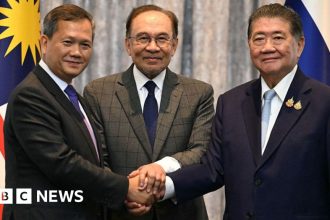
The international community has reacted with concern. Malaysian Prime Minister Anwar Ibrahim, a leader in a neighboring regional power, swiftly called for restraint in a statement posted to social media. He offered his country’s readiness to support any efforts to avert further fighting, emphasizing, "Our region cannot afford to see long-standing disputes slip into cycles of confrontation." This sentiment is widely shared among ASEAN members, who fear that prolonged instability between two of its key members could undermine regional unity and economic progress.
The roots of this enduring animosity between Thailand and Cambodia stretch back centuries, to a time when they were powerful, warring empires vying for regional dominance. Their modern territorial claims, however, largely stem from a 1907 map drawn during Cambodia’s period under French colonial rule. Thailand has consistently argued that this map is inaccurate and does not reflect historical or geographical realities, leading to persistent disagreements over where the precise border should run.
A significant flashpoint in this historical dispute is the 1,000-year-old Preah Vihear temple, a magnificent Khmer Hindu temple perched atop a cliff in the Dângrêk Mountains. In 1962, the International Court of Justice (ICJ) awarded sovereignty over the temple to Cambodia, a ruling that continues to "rankle many Thais," who view it as an unjust historical decision and a symbol of perceived national humiliation. While the temple itself is relatively small, the surrounding land and access routes have become highly militarized and fiercely contested, often serving as the epicenter of border clashes. The underlying issue, which the October ceasefire notably failed to address, is the lack of a clearly demarcated and mutually recognized border, leaving vast stretches of the frontier open to interpretation and conflict.
As airstrikes continue and accusations fly, the immediate priority remains the protection of civilians and de-escalation of the military confrontation. However, without a comprehensive framework to resolve the fundamental border dispute, any ceasefire, no matter how robustly brokered, will likely remain a temporary pause rather than a lasting peace. The international community, particularly regional bodies like ASEAN, faces a critical challenge in facilitating a genuine dialogue that addresses the historical grievances and clarifies the ambiguous territorial claims, thereby preventing further cycles of violence along this volatile border.