USS Gerald R. Ford Aircraft Carrier Arrives in Caribbean in Major Buildup Near Venezuela
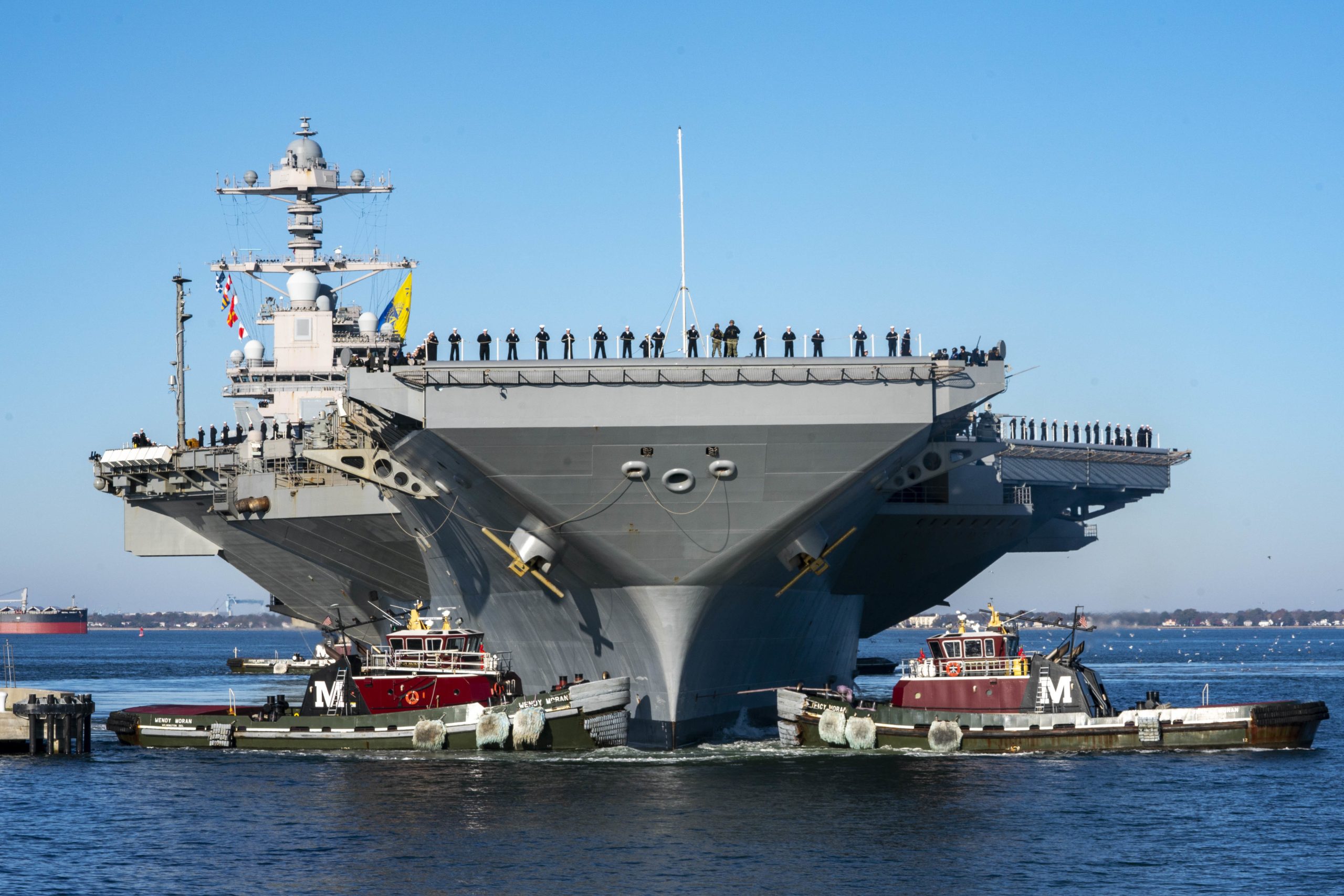
The nation’s most advanced aircraft carrier, the USS Gerald R. Ford, heralded its formidable presence in the Caribbean Sea on Sunday, marking a significant escalation of U.S. military might in a region increasingly fraught with geopolitical tension. The U.S. Navy officially confirmed the arrival, underscoring a move that has been widely interpreted as a dual-purpose operation: ostensibly a counter-drug initiative, but simultaneously a palpable pressure tactic directed at Venezuelan President Nicolás Maduro.
Operating as the vanguard of a powerful strike group, the USS Gerald R. Ford is not merely another warship. As the lead ship of its class, it represents the pinnacle of naval engineering and combat readiness, boasting advanced nuclear reactors, electromagnetic aircraft launch systems (EMALS), and a capacity to deploy a wide array of cutting-edge fighter jets, including F-35C Lightning IIs and F/A-18E/F Super Hornets. Its entry into the Caribbean, transiting the strategic Anegada Passage near the British Virgin Islands, signals an unparalleled projection of power, the largest concentration of U.S. firepower in the region in generations.
The Trump administration has branded this extensive deployment as "Operation Southern Spear," framing it primarily as a robust counter-narcotics campaign. U.S. officials assert that President Maduro and his regime are deeply complicit with armed criminal gangs facilitating the smuggling of illicit drugs into the United States. Maduro has vehemently rejected these allegations, dismissing them as a pretext for intervention. Yet, the U.S. military has, over the past two months, already conducted strikes against at least 21 vessels suspected of ferrying drugs from South America, resulting in the deaths of at least 80 individuals. These actions have ignited a fierce debate regarding their legality and the evidence supporting the "narco-terrorist" label applied to those killed.
Admiral Alvin Holsey, commander of U.S. Southern Command (SOUTHCOM), the principal combatant unit responsible for operations across the Caribbean and South America, articulated the strategic imperative behind the deployment. In a statement coinciding with the Ford’s arrival, Adm. Holsey declared, "Through unwavering commitment and the precise use of our forces, we stand ready to combat the transnational threats that seek to destabilize our region." He further emphasized the broader implications: "The USS Gerald R. Ford Carrier Strike Group’s deployment represents a critical step in reinforcing our resolve to protect the security of the Western Hemisphere and the safety of the American Homeland." His words echo a firm commitment to regional stability and national security, particularly concerning the perceived nexus between drug trafficking and state actors.
Rear Admiral Paul Lanzilotta, who commands the Ford’s carrier strike group, reiterated this stance, asserting that the deployment would significantly bolster the existing fleet of American warships. Its objective, he stated, is to "protect our nation’s security and prosperity against narco-terrorism in the Western Hemisphere." This consistent messaging from military leadership aims to solidify the narrative of a focused anti-drug mission.
However, the administration’s insistence on the counter-drug narrative has been met with skepticism. Critics, both domestically and internationally, point to the lack of concrete, publicly released evidence linking those killed in the vessel strikes directly to "narco-terrorist" organizations. This opacity has fueled accusations that the counter-drug operation serves as a convenient cover for broader geopolitical objectives.
President Trump himself has been notably outspoken regarding Venezuela’s future. Following a series of high-level discussions, he remarked to CBS News aboard Air Force One that he had "sort of" made up his mind on how to proceed in Venezuela, though he refrained from disclosing specifics. These deliberations, which reportedly included Vice President JD Vance, Defense Secretary Pete Hegseth, Joint Chiefs of Staff Chairman Dan Caine, and Secretary of State Marco Rubio, have been ongoing for at least three consecutive days at the White House. Sources familiar with the matter indicate that potential military operations, including strikes on land targets within Venezuela, were presented as options to the President. The daily intelligence briefing also reportedly touched upon Venezuela, indicating the high priority this issue holds within the administration.
The heightened U.S. military posture has not gone unnoticed by Caracas. Venezuela responded by announcing a massive nationwide military exercise, reportedly mobilizing some 200,000 forces. President Maduro and many observers, both within and outside Venezuela, perceive the increased U.S. military pressure as a thinly veiled attempt to force a regime change. Maduro’s government has long accused the U.S. of orchestrating plots to overthrow him, citing a history of U.S. intervention in Latin American affairs.
President Trump’s public statements have only intensified these suspicions. In a recent "60 Minutes" interview, when asked if Maduro’s "days were numbered," Mr. Trump unequivocally responded, "I would say yeah. I think so, yeah." Furthermore, he confirmed last month that he had authorized covert CIA operations in Venezuela, signaling a multi-pronged approach to undermining the Maduro regime.
The administration’s justification for the vessel strikes—that the U.S. is in "armed conflict" with drug cartels operated by foreign terror organizations—has faced significant pushback. Leaders across the region, including several Latin American nations, have expressed alarm, fearing broader instability. The U.N. human rights chief has also called for a cessation of the alleged drug boat strikes and demanded more information on the targeting criteria and legal basis for the operations. Domestically, lawmakers, including some Republicans, have pressed for greater transparency and adherence to constitutional war powers.
A recent Senate vote highlighted this internal division. A resolution aimed at checking President Trump’s authority to launch an attack against Venezuela without congressional authorization failed by a narrow margin of 49-51. Only two Republican senators, Rand Paul of Kentucky and Lisa Murkowski of Alaska, broke ranks to support the measure, underscoring the deep partisan divide on the executive branch’s military prerogatives. The debate underscored the constitutional tension between presidential power and congressional oversight in matters of war.
Experts remain divided on the likelihood of American warplanes striking land targets inside Venezuela. The legal framework for such an action, particularly under the guise of counter-narcotics, remains highly contentious. Nevertheless, the sheer presence of the 100,000-ton USS Gerald R. Ford sends an unmistakable message. Elizabeth Dickinson, a senior analyst for the Andes region at the International Crisis Group, aptly captured the regional sentiment: "This is the anchor of what it means to have U.S. military power once again in Latin America. And it has raised a lot of anxieties in Venezuela but also throughout the region. I think everyone is watching this with sort of bated breath to see just how willing the U.S. is to really use military force."
The historical context of U.S.-Venezuela relations further complicates the situation. Decades of strained ties, marked by ideological clashes, U.S. sanctions targeting key Venezuelan officials and industries, and the ongoing humanitarian crisis within Venezuela, provide a volatile backdrop for this military buildup. While the U.S. has consistently supported the opposition and recognized Juan Guaidó as Venezuela’s legitimate interim president, direct military intervention has largely been avoided due to the significant geopolitical risks.
The arrival of the USS Gerald R. Ford, therefore, represents a critical juncture. It is a powerful symbol of American resolve, but also a stark reminder of the escalating tensions in the Western Hemisphere. The coming days and weeks will undoubtedly reveal whether this massive show of force will achieve its stated counter-drug objectives, or if it will catalyze a more profound shift in the precarious balance of power in the Caribbean, potentially pushing the region closer to a military confrontation that many fear.