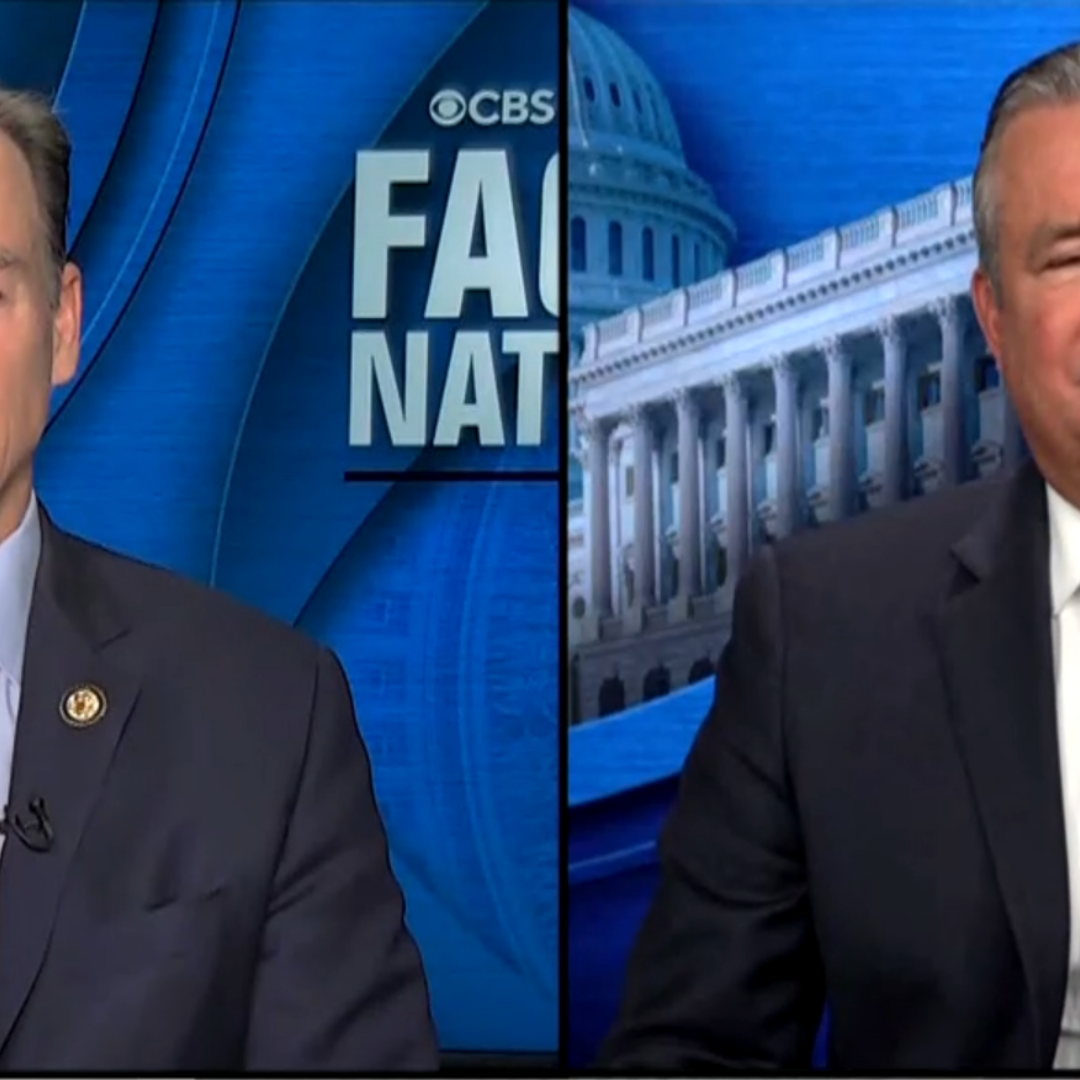
Transcript: Reps. Tom Suozzi and Don Bacon on "Face the Nation with Margaret Brennan," Nov. 16, 2025
On November 16, 2025, Representatives Tom Suozzi, a Democrat from New York, and Don Bacon, a Republican from Nebraska, offered a rare glimpse into bipartisan problem-solving during their appearance on "Face the Nation with Margaret Brennan." Both members of the influential House Problem Solvers Caucus, the lawmakers delved into pressing national issues, from the looming healthcare affordability crisis to the politically charged debate surrounding the Jeffrey Epstein files and the escalating threat of AI-powered cyber espionage. Their discussion underscored the urgent need for congressional cooperation amidst a deeply polarized political landscape.
The interview commenced with a critical focus on healthcare, a sector consuming an astounding one in every five dollars spent in the United States. Margaret Brennan immediately highlighted the impending expiration of crucial COVID-era tax credit subsidies for Obamacare, set to lapse at the end of December 2025. This expiration threatens to impact approximately 22 to 24 million Americans who rely on these programs, potentially leading to dramatic increases in premiums come January.

Congressman Don Bacon opened the discussion by advocating for a temporary extension of these tax credits. He emphasized that neither Republicans nor Democrats desired to see premiums "skyrocket," a certainty if the subsidies were allowed to expire without an alternative. Bacon, a key figure in bipartisan efforts, revealed his collaboration with Congressman Suozzi and other colleagues to forge a compromise. While pushing for a "clean extension," Bacon also articulated Republican concerns, suggesting the need for income caps to ensure the credits are directed more efficiently. He pointed out that currently, "about a third of the money doesn’t make it to the premiums," indicating a desire for reforms that would channel funds directly to lowering costs for consumers. Bacon also stressed the "unaffordable" nature of the Affordable Care Act (ACA) itself, asserting that an extension would buy Congress time to devise a "bigger and deeper" solution to bring down overall healthcare costs. He expressed pride in his partnership with Suozzi on this critical endeavor.
Congressman Tom Suozzi elaborated on their proposed solution: a two-year extension of enhanced premium tax credits, incorporating an income cap that would gradually phase out for individuals earning between $200,000 and $400,000 annually. While Brennan noted that this cap would affect a relatively small percentage—less than 10%—of current recipients, Suozzi passionately defended the proposal. He explained that it would "dramatically" help those making under $200,000, potentially saving some individuals "thousands and thousands of dollars, literally $1,000 a month." Suozzi underscored that affordability in healthcare remains the number one concern for Americans. He expressed confidence in strong Democratic support for extending the premium tax credits, even with the proposed income caps, aligning with the party’s focus on supporting lower and middle-income families. He reiterated that the vast majority—95% to 99%—of those currently benefiting would continue to do so under the revised framework.
Bacon interjected, reinforcing the Republican stance against individuals earning upwards of $600,000 receiving substantial tax credits, citing this as a primary concern among party leaders like Senator John Thune. Brennan pressed Bacon on the lack of comprehensive Republican alternatives to Obamacare, questioning if the entire system required a reboot and when such a plan might materialize. Bacon acknowledged the necessity for Republicans and Democrats to "sit down at the table" to develop solutions beyond merely increasing spending. He recognized the unsustainability of healthcare premiums rising faster than inflation and stressed that a "Republican only fix" would be politically unviable, requiring 60 votes in the Senate. He floated ideas such as directly subsidizing high-risk individuals in a separate pool, which could significantly reduce premiums for healthier enrollees. Bacon’s remarks underscored a pragmatic recognition that any impactful reform must be bipartisan.
Congressman Suozzi echoed this sentiment, responding to Brennan’s observation about major insurance companies like Aetna and CVS pulling out of the Obamacare marketplace due to significant losses. He affirmed that Democrats "absolutely should be looking at any kind of reform," adopting a "mend it, not end it" philosophy. Suozzi referenced the numerous past attempts, primarily by Republicans, to repeal Obamacare entirely, which he deemed a "terrible idea." However, he expressed openness to improving the system to make healthcare more affordable and accessible. He lamented the current "toxic environment" in Congress, asserting that complex problems cannot be solved through "fear and anger." Instead, he championed the approach of reasonable individuals, like those in the Problem Solvers Caucus, engaging in dialogue and seeking compromise.
The conversation then pivoted to a politically charged topic: the House Democrats’ recent focus on the Jeffrey Epstein files. Brennan directly questioned Suozzi whether this emphasis was a tactic to "distract from the failure to extract health care changes." Suozzi acknowledged that Epstein was an "important topic" and that he would vote to release the files, but clarified that it was "not my priority." He firmly reiterated his focus on the issues that genuinely concern the American people: "affordability, immigration, taxes, crime and health care."
Congressman Bacon offered a Republican perspective on the Epstein files, suggesting that Speaker Mike Johnson recognized the "train has left the station" and that it was time to "rip the Band-Aid off." He criticized the White House’s handling of the issue, particularly the Attorney General’s initial promise to release information followed by a reversal, labeling it a "PR blunder." Bacon confirmed that the House Oversight Committee, with bipartisan participation, was already actively releasing thousands of pages of evidence and issuing subpoenas. Like Suozzi, Bacon stated his intention to vote yes on releasing the files, emphasizing his commitment to transparency and protecting victims. He noted that even if passed by the House, the measure would still need Senate approval and the President’s signature.
Finally, Brennan turned to Congressman Bacon’s expertise as the head of the Cyber Subcommittee, addressing a significant development from the past week: AI firm Anthropic’s revelation that Chinese state-sponsored hackers had utilized their AI technology to automate break-ins and execute the first major cyber espionage operation, targeting some 30 companies. Bacon confirmed the gravity of the report, stating unequivocally that "China has replaced Russia as the most formidable cyber threat." He highlighted China’s superior technology and its use of AI to enhance capabilities in identifying vulnerabilities in adversaries’ cyber defenses.
Bacon then raised a stark warning about the United States’ own cyber preparedness. He expressed deep concern that while China and Russia relentlessly attack US systems daily, the position of commander of Cyber Command had been vacant for over eight months. Furthermore, the top two positions at the National Security Agency (NSA) had also remained unfilled for the same duration. Adding to this alarming scenario, Bacon revealed that CISA (Cybersecurity and Infrastructure Security Agency), responsible for protecting the private sector, businesses, and critical infrastructure, had seen its budget cut by approximately one-third. He starkly concluded that "our cyber capabilities are going backwards" and that the nation was "rudderless" in the face of escalating threats, urging the White House to confront this pressing national security challenge.
Margaret Brennan concluded the segment by thanking both congressmen for their efforts as "problem solvers," underscoring the vital, albeit often difficult, role of bipartisan engagement in navigating the nation’s most complex challenges. The interview served as a crucial reminder of the multifaceted issues confronting the United States and the imperative for its leaders to bridge divides for effective governance.