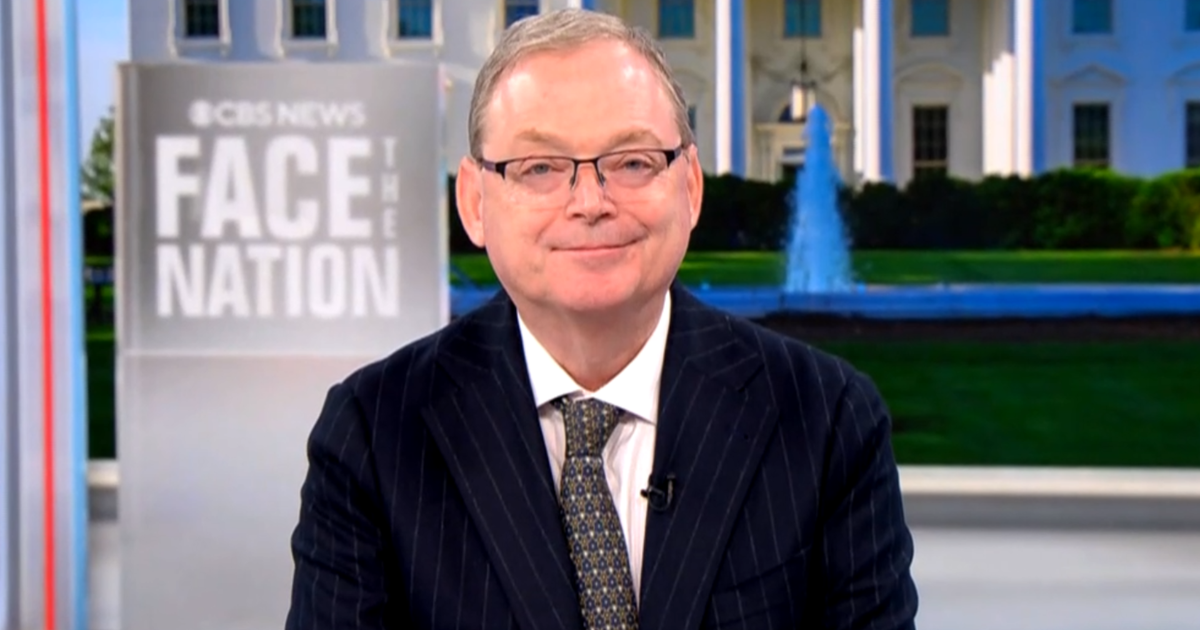
Transcript: Kevin Hassett on "Face the Nation with Margaret Brennan," Nov. 30, 2025
The following is an enriched and expanded report based on the interview with Kevin Hassett, Director of the White House National Economic Council, aired on "Face the Nation with Margaret Brennan" on November 30, 2025. The interview, conducted by Nancy Cordes, provided a detailed look into the administration’s economic perspectives, covering holiday spending, inflation, healthcare policy, and significant speculation regarding the leadership of the Federal Reserve.
A Deep Dive into the Holiday Shopping Season: Optimism vs. Skepticism

As the crucial holiday shopping season commenced, following the Thanksgiving festivities, all eyes were on consumer spending. Nancy Cordes initiated the discussion by referencing recent surveys from prominent financial institutions like Goldman Sachs and Bank of America. These reports painted a cautious picture, suggesting a "modest" outlook for holiday spending, particularly among low and middle-income Americans. The underlying reason cited was a perceived increase in prices, leading these demographic groups to plan a slight pullback in their expenditures. The surveys further indicated that any overall increase in spending this year might largely be attributable to goods simply costing more, rather than consumers purchasing a greater volume. Cordes directly challenged Hassett, asking whether these trends were a temporary economic blip or a more entrenched consequence of the Trump administration’s tariffs.
Kevin Hassett, however, presented a more sanguine assessment, directly contrasting the survey data with real-time sales figures from the post-Thanksgiving weekend. He characterized the period as a "blockbuster weekend," citing impressive online sales growth of nearly 10% and a solid 4% increase in in-store sales. Hassett asserted that these robust figures effectively "disproven" the earlier anxieties about consumer reluctance to spend. He attributed this surge in activity to a combination of factors: an overall increase in incomes throughout the year, a strong jobs report that boosted household finances, and a likely "pent-up demand" following a recent government shutdown. "I think that the folks who are saying, wow, maybe people are going to be anxious about going back and getting presents for the kids and so on. They’ve been disproven this weekend," Hassett confidently stated, projecting a "great recovery from a weak few weeks because of the shutdown." This optimistic stance from the White House’s chief economic advisor aimed to underscore the resilience of the American consumer and the broader economy.
The Intricate Dance of Inflation, Tariffs, and Consumer Prices
The conversation quickly transitioned to the highly debated topic of inflation and its connection to the administration’s trade policies, particularly the tariffs imposed on imports. Cordes pressed Hassett on the extent to which the observed increase in spending was merely a reflection of higher prices rather than genuine growth in purchasing power. She offered a compelling, real-world example: the manufacturer of Tonka Trucks had indicated that a toy truck priced at $30 last year would now cost $40, partly due to an eight-week shipping delay directly linked to the U.S. trade war with China. Cordes sought Hassett’s advice for holiday shoppers striving to maintain their spending levels from the previous year or those simply unable to afford increased costs.
Hassett acknowledged the variability of prices across different sectors, stating, "it depends on what you’re looking at." He selectively highlighted areas of price relief, mentioning that "egg prices are down. Gasoline prices drop below $2 a gallon in a lot of places, mortgage rates are down." When Cordes interjected to clarify that average gas prices across the nation remained closer to $3 a gallon, Hassett conceded that the sub-$2 figures were specific to "a few states." His core argument, however, pivoted to the aggregate economic picture, stressing that "in the end, what matters is in the aggregate, the average across everything that everybody buys." He claimed that aggregate inflation under President Trump was "a little bit above two and a half percent—about cut in half for President Trump" compared to "about 5% under Joe Biden." This comparison aimed to portray the current administration as effectively managing inflation, even in the face of specific price increases for certain consumer goods affected by tariffs.
Wages, Real Incomes, and the Promise of the "Big, Beautiful, Bill"
A central pillar of Hassett’s economic defense was the assertion that "wages have been growing faster than prices, and that’s why real incomes this year are up by about $1,200 so far." This increase in real disposable income, he argued, was the fundamental driver behind the strong performance during the Black Friday and Thanksgiving sales weekend, as "people feel like they have more money in their pockets." He reiterated that despite individual price fluctuations, the overall trend indicated enhanced consumer purchasing power.
To further buttress his optimistic projections, Hassett introduced the "Big, Beautiful, Bill," a legislative initiative he contended would significantly boost purchasing power. He specified that this bill was designed to cut "taxes on overtime, taxes for tips and so on," with the explicit expectation that "all that money is going to start to be in people’s pockets." He went on to predict a robust economic expansion in the first half of the coming year, echoing Scott Bessent’s forecast of growth "in the 4% range." Hassett clarified that the tax cuts, enacted in July, had not yet fully impacted individuals due to the time required to adjust tax forms, leading to an anticipation of "really, really big refunds in the fall" of the next year. This, he suggested, would catalyze even greater consumer confidence and economic dynamism, providing a significant tailwind for the economy.
The Discrepancy: Public Sentiment Versus Official Economic Data
Despite the administration’s positive economic narrative and the data points presented by Hassett, public opinion polls revealed a growing undercurrent of skepticism. Nancy Cordes highlighted a recent CBS News poll that indicated a significant portion of the American public—68%—believed that President Trump’s policies were responsible for pushing grocery prices higher. She noted that grocery prices had indeed increased "about 1.4% year to date." Furthermore, the poll revealed a decline in overall economic sentiment, with the number of people who perceived the economy as "good" having "actually dropped six points since he took office." Cordes directly asked Hassett to reconcile this apparent divergence between official economic data and widespread public perception.
Hassett, in response, downplayed the increase in grocery prices, characterizing the 1.4% rise as "way below the Fed’s target of two for everything else, right? And so you’d have to concede that 1.4% is very, very low inflation." He reiterated his belief in the impending positive effects of the "Big, Beautiful, Bill," suggesting that public optimism would align with the administration’s view once the full benefits of the tax cuts were realized. This segment underscored a persistent challenge for the administration: effectively communicating aggregate economic improvements in a way that resonates with the tangible, daily financial experiences of individual households, especially concerning essential expenses like groceries, which often serve as a direct and immediate indicator of economic health for many Americans. The observed disconnect highlighted the complexities of economic messaging and the powerful influence of personal financial realities on broader public sentiment.
Navigating the Complexities of Obamacare Premium Subsidies
The interview then shifted to a pressing legislative matter: the imminent expiration of Obamacare premium subsidies, a development poised to affect 22 million Americans. Cordes described a peculiar sequence of events from the preceding week: the White House initially "floated this plan to extend the subsidies for two years," only to subsequently withdraw the proposal. This was followed by President Trump’s reported comment on Air Force One, "Somebody said I wanted to extend it for two years. I don’t want to extend it for two years. I’d rather not extend them at all." Cordes questioned whether these conflicting signals pointed to a lack of internal coordination within the administration.
Hassett dismissed the notion of internal disarray, attributing the mixed messages to premature "leaks" of "pre-decisional things that are confidential." He maintained that President Trump’s overarching concern remained the cost of healthcare. Hassett cited the "Big, Beautiful, Bill" as allocating "$50 billion for rural hospitals" and an attempt to secure "$30 billion in for cost sharing," which he claimed Democrats had rejected in favor of an "alternative approach." He expressed confidence that a resolution would be reached "between now and Christmas," emphasizing that the White House had a "solution for cost-sharing" and was actively engaging with Democratic counterparts. Hassett also sought to alleviate public anxiety, noting that "the vast majority of people in the Affordable Care Act are getting their insurance for less than $50 a month." He clarified that the most significant "problem" primarily affected "the very, very high cost people who are closer to retirement age," and that the administration was committed to preventing "massive increases" for this specific demographic. This intricate legislative maneuvering underscored the ongoing challenge of balancing fiscal considerations with the critical objectives of healthcare access and affordability for millions of Americans.
Kevin Hassett: A Frontrunner for the Federal Reserve Chair?
In the final segment, the interview turned to significant speculation regarding Kevin Hassett’s own professional future. Bloomberg had reported that Hassett was considered the "front runner" to succeed Federal Reserve Chair Jay Powell when his term concluded in the spring. Cordes noted that Secretary Bessent, who was spearheading the search for Powell’s replacement, was conducting "final interviews this week," and playfully inquired about the outcome of Hassett’s own interview.
Hassett skillfully sidestepped a direct answer about his interview, stating, "You know, I am not sure that Bloomberg has the story right." While acknowledging his honor "to be amongst a group of really great candidates," he promptly redirected the focus to the broader market reaction to the emerging news. He highlighted that "the news for markets was that President Trump is close to announcing a new person who is going to replace Jay Powell," and that the market response had been "very, very positive." Hassett pointed to "a great Treasury auction" and a subsequent decrease in interest rates, suggesting that these indicators reflected market confidence in President Trump’s eventual choice for the pivotal role. He concluded by asserting that "the American people could expect President Trump to pick somebody who’s going to help them, you know, have cheaper car loans and easier access to mortgages at lower rates." With a touch of humor, he then equated the reliability of the rumor concerning his potential nomination to the earlier "rumor about the health care policy that we just talked about." This strategic deflection allowed Hassett to address the speculation surrounding his future without confirming or denying the report, while simultaneously projecting an image of market stability and confidence in the administration’s forthcoming economic leadership decisions.
The interview concluded with Nancy Cordes thanking Director Hassett for his insights, leaving viewers with a comprehensive, albeit at times contrasting, perspective on the economic realities and political dynamics shaping the end of 2025.