U.S., Ukrainian Officials Discussing Bringing Zelenskyy to U.S. Amid Intense Peace Push
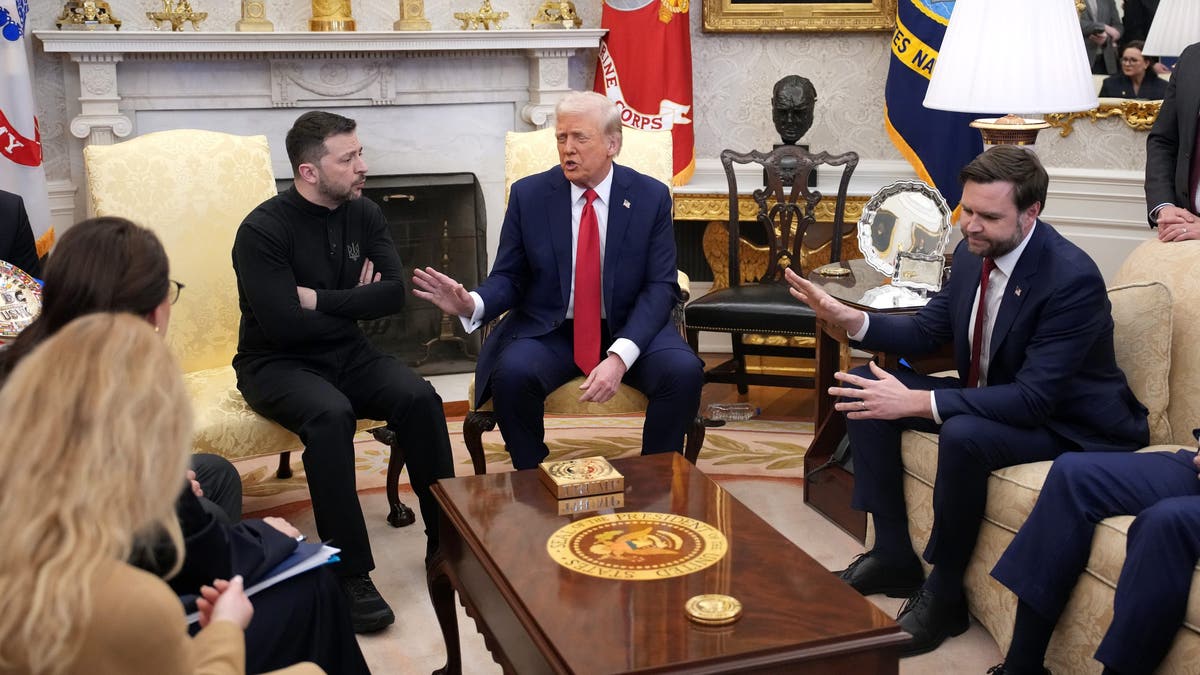
In a dramatic diplomatic push, U.S. and Ukrainian officials are actively discussing the potential for Ukrainian President Volodymyr Zelenskyy to visit the United States this week. This high-stakes visit is envisioned as a critical component of President Trump’s ambitious drive to secure an agreement on Ukraine before the Thanksgiving holiday, according to multiple U.S. and Ukrainian sources privy to these sensitive negotiations. The prospect of Zelenskyy’s arrival underscores the urgency and the complex, often contradictory, diplomatic maneuvers currently underway.
The feasibility of Zelenskyy’s trip remains contingent on the outcomes of ongoing peace negotiations in Geneva, which concluded their latest round on Sunday. President Trump himself has indicated a degree of flexibility regarding his self-imposed deadline, telling reporters on Saturday that the proposed plan was "not my final" proposal, signaling an openness to further adjustments and protracted discussions. This nuanced stance adds another layer of complexity to an already intricate diplomatic landscape.

Speaking from Geneva, Secretary of State Marco Rubio conveyed a cautiously optimistic tone, touting significant progress in discussions with a diverse group of European and Ukrainian officials. Rubio characterized the recent engagements as "a very, very meaningful – I would say probably best – meeting and day we’ve had so far in this entire process, going back to when we first came into office in January." Despite this reported headway, he stressed that "there’s still some work left to do," promising further updates following additional meetings. Echoing this sentiment, Andriy Yermak, Zelenskyy’s influential chief of staff, stated after his meeting with Rubio, "We have very good progress and we are moving forward to the just and lasting peace." Such public statements, while encouraging, often mask deeper disagreements and the immense pressure exerted behind closed doors.
Despite the positive remarks, a senior White House official clarified that no firm plans for a Zelenskyy visit have been cemented, given the dynamic nature of active diplomacy. Furthermore, there are no scheduled talks involving or in Russia at this juncture. An alternative outcome of the Geneva negotiations could see Army Secretary Dan Driscoll traveling to Russia or meeting with Russian officials in another neutral location, a possibility suggested by another U.S. official. However, Russian officials, when contacted by CBS News, confirmed that no such meetings are currently scheduled, highlighting the persistent communication gaps and mistrust between the warring parties.
Central to these discussions is a contentious 28-point peace plan, a draft of which was controversially leaked to the press last week. Ukraine’s Ambassador to the U.S., Olga Stefanishyna, addressed the leaked document on "Face the Nation with Margaret Brennan" on Sunday, unequivocally stating that her country had not agreed to all its terms. Stefanishyna articulated Ukraine’s fundamental objection: "This plan is not about justice and the truth of this war and the aggression. It’s about, you know, ending the war and stopping the military engagement." This statement underscores a profound philosophical divide, with Ukraine seeking a peace based on principles of international law and accountability, while the proposed plan appears to prioritize a cessation of hostilities, potentially at the expense of justice. She further emphasized that Russia has not made any meaningful concessions to date, and crucially, none of the points within the leaked 28-point plan contained provisions designed to impose obligations or consequences on the Russian side. This imbalance fuels Ukraine’s skepticism and complicates any path towards a truly equitable resolution.
In addition to the 28-point proposal, U.S. and Ukrainian officials confirmed the existence of an accompanying document focused on security guarantees. Stefanishyna confirmed this, referring to it as "the framework of security assurances." She explained that this framework outlines the U.S.’s intention to provide a commitment akin to Article 5 of the Washington NATO Treaty, a defense promise. However, Stefanishyna highlighted a significant challenge: unlike NATO’s Article 5, these security assurances lack a detailed blueprint of specific guarantees and, crucially, do not carry the weight of Congressional approval and backing that a treaty would entail. This lack of robust, legally binding commitment poses a serious concern for Ukraine, a nation scarred by past failures of international security assurances. She pointed specifically to the 1994 Budapest Memorandum, under which Ukraine surrendered its nuclear weapons in exchange for security guarantees that ultimately proved insufficient in the face of Russian aggression. The historical precedent casts a long shadow over current discussions, making Ukraine deeply wary of any agreement that lacks ironclad commitments.
The urgency of these diplomatic efforts is framed by a stark assessment of the battlefield reality. A U.S. official told CBS News that Russian President Vladimir Putin appears convinced he will secure the Donetsk region of Ukraine, whether through a negotiated settlement or direct military conquest. The Trump administration’s negotiations in Geneva, therefore, began from the pragmatic premise that Putin’s conviction is accurate. While the same U.S. official refrained from offering a direct assessment of whether Ukraine is losing the war in the East, they indicated that the current trajectory of the fighting strongly points to Russia eventually taking Donetsk. The official specifically cited Russian progress in the eastern frontline city of Pokrovsk, a vital logistics hub for Ukraine, as a "not positive sign" for Kyiv’s defensive prospects. Russian state media frequently refers to Pokrovsk as the "gateway" to Ukraine’s industrial Donbas region, underscoring its strategic importance and the imminent threat it poses to Ukraine’s remaining positions in the east.
Adding to the complexity are the intertwined and sometimes conflicting diplomatic efforts taking place within the Trump administration. Initially, there were separate but parallel initiatives concerning Ukraine, which are now reportedly being merged. Notably, President Trump’s son-in-law, Jared Kushner, and U.S. special envoy to the Middle East Steve Witkoff, had been working on what they termed a "term sheet" to end the war, drawing parallels with their broad-strokes proposal for a Gaza ceasefire. In an unconventional twist, while the Trump administration had imposed sanctions on Russian oil and gas to compel Putin to the negotiating table, Putin’s advisor Kirill Dmitriev was simultaneously engaged in discussions with Witkoff in Miami at the end of last month. Treasury Secretary Scott Bessent had previously dismissed Dmitriev as a "Russian propagandist," yet it was Dmitriev who played a role in drafting the very 28-point proposal that the U.S. is now backing. A senior White House official confirmed that Vice President JD Vance and Secretary of State Marco Rubio were kept "apprised" of these Miami talks. The unusual nature of these back-channel discussions, coupled with the leak of the Kushner-Witkoff term sheet to the press via an opposition politician in Ukraine and an interview Dmitriev gave to Axios, highlighted the fragmented and often opaque nature of the administration’s foreign policy approach, particularly at a time when Zelenskyy himself faces domestic political scrutiny.
The revelation of the peace plan and the unusual diplomatic channels sparked significant concern and confusion on Capitol Hill. On Saturday, a number of senators, including Democratic Sen. Jeanne Shaheen, ranking member of the Senate Foreign Relations Committee, as well as Republican Sen. Mike Rounds of South Dakota and independent Sen. Angus King of Maine, stated that Secretary Rubio had assured them that the 28-point proposal was not of American origin. Rubio reportedly also assured them that he had not personally heard of any threat to cut off U.S. military and intelligence sharing with Ukraine if it did not agree to the terms. However, in a subsequent and somewhat contradictory move, Rubio posted on social media Saturday that the "plan was authored by the U.S." This discrepancy fueled further questions about the plan’s provenance and the administration’s messaging.
Adding to the controversy, both a Ukrainian official and a U.S. official informed CBS News that the threat to cut off aid had indeed been made during talks with other senior U.S. officials in Kyiv. This delegation was led last week by Army Secretary Dan Driscoll, a close confidante of Vice President Vance, who is now also participating in the Geneva talks. A senior White House official acknowledged to CBS News that while the threat to cut off aid to Ukraine might not have been explicitly stated, it was certainly "implied" during discussions with Ukraine’s leadership, when U.S. officials conveyed that Mr. Trump was growing "weary and frustrated" and could not "keep doing this forever." This veiled ultimatum, regardless of its explicit phrasing, placed immense pressure on Kyiv and sparked a strong reaction among pro-Ukraine lawmakers.
In response to the growing unease, the same senior White House official reported that Vance and Rubio held a call Saturday night with Driscoll and U.S. military leadership to address questions from lawmakers. Rubio also made additional phone calls to individual senators, including Shaheen, King, and Rounds, detailing the situation. Senator King, however, remained critical, issuing a statement Sunday that highlighted "many problems with the plan as it has been reported." He specifically pointed out that "the two most obvious are that it rewards Russia’s illegal and unprovoked aggression by handing over substantial portions of Ukraine’s sovereign territory, and its security guarantees against further Russian aggression are vague and inadequate." King concluded by expressing his hope that "after consultation with Ukraine and the Europeans, a more fair and responsible agreement will emerge."
The Army’s unexpected foray into high-level diplomacy is a testament to the unconventional nature of the Trump administration’s foreign policy. Army Secretary Dan Driscoll, initially scheduled to travel to Ukraine in mid-December to discuss drone technology, was recently asked by President Trump to pivot and restart ceasefire talks. Driscoll’s role in these discussions has expanded to include intricate details of the security guarantees being offered to Ukraine. His two missions were combined on this trip; however, following the leak of the 28-point plan by an anti-Zelenskyy politician while Driscoll was en route to Ukraine, his mission was "adjusted" to incorporate the emerging diplomatic efforts building off the leaked Kushner-Witkoff term sheet, according to multiple U.S. officials familiar with the planning. These officials, however, declined to discuss the specifics of how the 28-point plan or the additional security guarantee document have evolved in recent days. Vice President Vance, a close friend of Driscoll’s, has been identified by a European diplomat and a source familiar with the matter as a driving force behind this renewed Ukraine diplomacy, with Driscoll serving as a key conduit for these efforts.
The political implications of these frantic diplomatic maneuvers are far-reaching. The Trump administration has been actively engaging with senators and congressmen, particularly powerful pro-Ukraine Republicans who have voiced strong objections to the reported concessions being demanded of Ukraine. Republican Rep. Mike McCaul, chair emeritus of the House Foreign Affairs Committee, publicly acknowledged outreach from Vance and Rubio, stating he was assured that the proposal was of American origin, not Russian. The administration is also acutely aware of the potential for a rift between Rubio and Witkoff, particularly given Witkoff’s role in orchestrating the August summit with Putin in Alaska. This period has seen much "retroactive policymaking and recasting of events," as evidenced by public remarks from Rubio’s former Senate colleagues who recall his hawkish stance on Russia during his time in the Senate. Meanwhile, Vance has consistently argued that Ukraine should not be a top priority for the U.S., a position that aligns with the administration’s current push for a quick resolution. Witkoff, for his part, appears driven by the desire to deliver President Trump the deal he so covets to end the war, regardless of the complexities and potential compromises involved. As the Thanksgiving deadline approaches, the path to peace remains fraught with uncertainty, balancing battlefield realities with political ambitions and the profound aspirations for justice and security.
Olivia Gazis contributed to this report.