Australian far-right Senator Pauline Hanson slammed for wearing burqa to parliament to demand ban.
In a highly contentious move that reverberated through Australia’s political landscape, far-right Senator Pauline Hanson ignited a firestorm of condemnation on Monday, November 24, 2025, by donning a burqa in the nation’s parliament. The provocative act, executed in the Senate chamber in Canberra, was a theatrical protest aimed at pushing her decades-long campaign for a nationwide ban on full face coverings, which she argues pose significant security risks and represent an oppressive ideology incompatible with Australian values. However, instead of garnering support for her proposed legislation, Hanson’s stunt was met with immediate and widespread outrage, with fellow lawmakers denouncing it as "racist," "unsafe," and profoundly "disrespectful" to both parliamentary decorum and Australia’s diverse multicultural fabric.
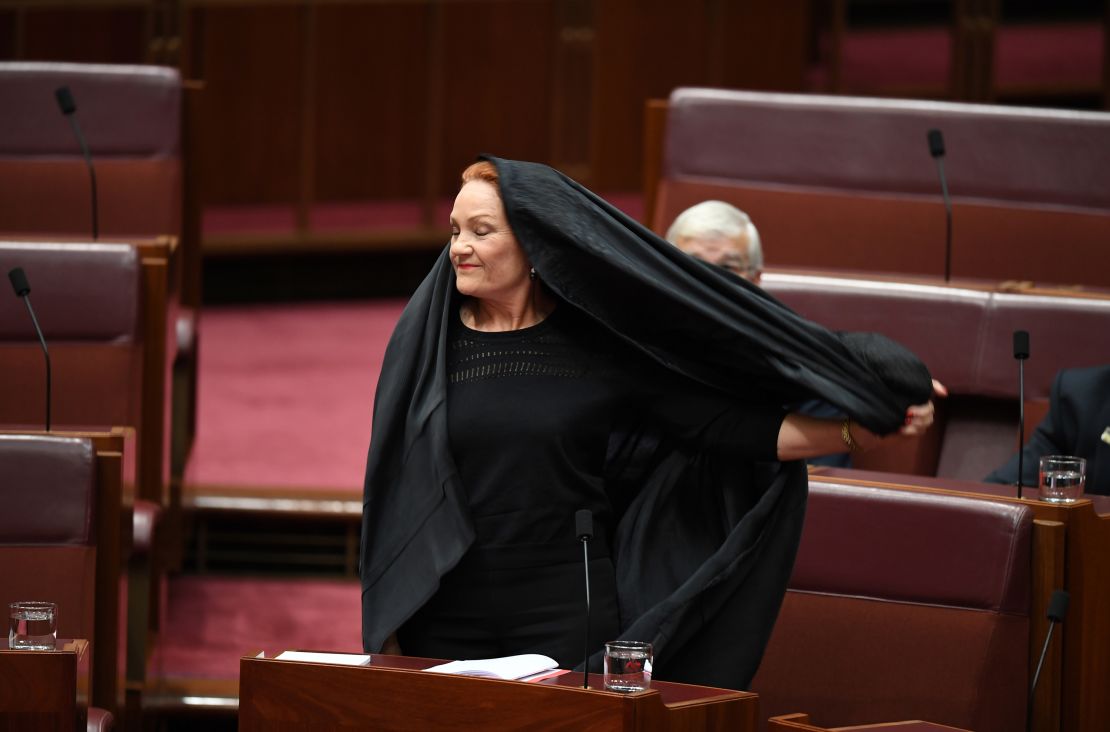
The day’s events unfolded with a palpable tension that quickly escalated into a national debate. Senator Hanson, leader of the anti-immigration One Nation party, had sought to introduce a bill in the Senate that would impose a sweeping ban on full face coverings across Australia. This legislative push is a cornerstone of her political platform, reflecting deeply entrenched views that have defined her controversial career. Just moments after her attempt to present the bill was thwarted by other lawmakers, signaling broad opposition to its premise, Senator Hanson made her dramatic return to the chamber. Clad in a full black burqa, an Islamic garment that covers the entire face and body, leaving only the eyes visible, she took her seat amidst a stunned silence that quickly gave way to audible gasps and murmurs of disbelief. Her refusal to remove the garment, even when challenged, underscored the deliberate nature of her protest and her unwavering commitment to the divisive message she sought to convey. The spectacle brought parliamentary proceedings to an unprecedented halt, forcing the suspension of the Senate as the Speaker grappled with how to address the extraordinary breach of conduct and the profound disrespect it signaled.
In the aftermath of the incident, Senator Hanson wasted no time in publicly defending her actions, posting a lengthy statement on her endorsed Facebook account. She framed her stunt as a direct and necessary protest against the Senate’s rejection of her proposed ban. "So if the Parliament won’t ban it, I will display this oppressive, radical, non-religious head garb that risk our national security and the ill-treatment of women on the floor of our parliament so that every Australian knows what’s at stake," Hanson wrote. She doubled down on her challenge: "If they don’t want me wearing it – ban the burqa." This statement encapsulates the core tenets of her long-standing anti-Islam rhetoric, linking the burqa directly to national security threats and the subjugation of women, rather than acknowledging it as a religious or cultural choice for many Muslim women. Her argument deliberately conflates a garment with radicalism, seeking to ignite fear and prejudice under the guise of public safety, a tactic often employed by populist movements worldwide.
The reaction from her parliamentary colleagues was swift, severe, and overwhelmingly negative. Australian Greens leader in the Senate, Larissa Waters, articulated the sentiments of many, describing Hanson’s move as "the middle finger to people of faith." Waters did not mince words, unequivocally stating, "It is extremely racist and unsafe." This accusation of racism stems from the perception that Hanson’s act specifically targeted and caricatured a religious minority, contributing to an environment of hostility and discrimination. The "unsafe" aspect refers not only to the potential for incitement but also to the creation of an unwelcoming and intimidating atmosphere for Muslim Australians, particularly women who choose to wear the burqa. Foreign Minister Penny Wong, who also serves as the leader of the government in the Senate, condemned the display as "disrespectful." Wong emphasized the gravity of their roles as parliamentarians: "All of us in this place have a great privilege in coming into this chamber. We represent in our states, people of every faith, of every faith, of all backgrounds. And we should do so decently." Her words highlighted the fundamental responsibility of elected officials to uphold inclusivity and respect for all constituents, a principle Hanson’s actions were seen to flagrantly violate. The presence of Independent Senator Fatima Payman, herself a Muslim woman, looking on in the chamber, as depicted in media coverage, added another layer of poignancy to the scene, symbolizing the direct impact of Hanson’s protest on Muslim communities and underscoring the perceived insensitivity of the act.
This latest controversy marks the second time Senator Hanson has utilized the burqa for a parliamentary stunt. In 2017, she similarly donned a full burqa in the Senate, purportedly to underscore what she then claimed were significant security issues associated with the garment, explicitly linking it to terrorism. That previous incident also drew widespread criticism, with then-Attorney General George Brandis admonishing her for "mocking" the Muslim community and urging her to reflect on the offense caused. While the core message – a call for a burqa ban based on security concerns – remains consistent, the political climate and the direct context of this year’s protest differ. In 2025, the act followed the immediate rejection of her bill, making it a more direct and aggressive challenge to parliamentary authority and the legislative process. The repetition of the stunt also suggests a calculated strategy to maintain media attention and reinforce her anti-immigration and anti-Islam platform, regardless of the backlash, demonstrating a consistent pattern of using provocative imagery to advance her political agenda.
Senator Hanson’s latest act is deeply rooted in her long-standing and often inflammatory views on immigration and multiculturalism. Throughout her career, she has consistently portrayed Islam as "a culture and ideology that is incompatible with our own," a statement that has fueled accusations of xenophobia and religious bigotry. In a particularly controversial 2016 speech, she asserted that Australia was being "swamped by Muslims," a phrase echoing historical fears of cultural dilution and racial anxieties. These sentiments form the bedrock of the One Nation party’s platform, which advocates for stricter immigration policies, a reduction in Muslim immigration, and a staunch defense of what it perceives as ‘Australian values.’ The party, despite its controversial nature, has seen a notable increase in public support. A recent poll reported by The Australian Financial Review indicated a still modest but record 18% support for One Nation, a significant uptick that reflects a growing disillusionment with mainstream parties and a susceptibility to populist, anti-establishment narratives. This rise in support often comes amidst infighting within the country’s main conservative opposition, creating a vacuum that One Nation adeptly fills by tapping into anxieties about national identity, security, and economic hardship, mirroring similar trends of right-wing populism observed in various Western democracies.
The context of this incident is further complicated by a recent government envoy report, issued in September, which concluded that Australia has demonstrably failed to tackle persistent and intensifying Islamophobia. The report highlighted a worrying trend of discrimination, prejudice, and hostility towards Muslim communities across various sectors of Australian society, including employment, education, and public life. Senator Hanson’s public stunts and rhetoric are widely seen as contributing significantly to this environment, legitimizing anti-Muslim sentiment and making it more challenging for government and civil society to address the root causes of Islamophobia. Her actions, therefore, are not isolated incidents but rather potent symbols within a broader landscape of rising intolerance and division, actively exacerbating the very issues the government envoy sought to highlight and mitigate.
The burqa stunt by Senator Hanson underscores a persistent tension between parliamentary freedom of speech and the need to maintain decorum, respect, and inclusivity within a diverse democratic institution. While Hanson claims to be exercising her right to protest and raise legitimate security concerns, her critics argue that her methods cross a line into hate speech and divisive theatrics that undermine social cohesion. The incident forces a critical examination of how Australia grapples with religious freedom, national security, and the integration of minority communities. It poses questions about the responsibility of elected officials to foster unity rather than division, and the impact of such performative politics on the national discourse. As Australia navigates its multicultural identity, Senator Hanson’s provocative display serves as a stark reminder of the ongoing challenges in bridging cultural divides and ensuring that all citizens, regardless of faith or background, feel respected and safe within their own country and its highest institutions, while simultaneously reflecting the global struggle to balance liberal democratic values with the rise of nativist and anti-immigrant sentiments.