Woman found alive, moving in coffin after she was taken to Buddhist temple for cremation
In an event that has stunned local communities and captured global attention, a 65-year-old Thai woman, believed to be deceased for two days, was miraculously discovered alive and moving inside her coffin just moments before her scheduled cremation at a Buddhist temple. The extraordinary incident, which unfolded at Wat Rat Prakhong Tham, a serene Buddhist temple in the Nonthaburi province on the outskirts of Bangkok, has been hailed by many as nothing short of a miracle, prompting profound reflection on the fragility of life and the crucial importance of accurate medical pronouncements.
The harrowing journey began in the province of Phitsanulok, located approximately 300 miles north of Bangkok. For two years, the woman had been bedridden, her health steadily declining. According to her brother, who has remained unnamed in reports, she had become unresponsive and appeared to have stopped breathing two days prior to the fateful journey. Overwhelmed by grief and convinced of his sister’s passing, the brother made the solemn decision to transport her body. His initial intention was not immediate cremation, but rather to fulfill what he believed to be her last wish: to donate her organs to a hospital in Bangkok. This act of profound generosity, even in sorrow, set in motion a series of events that would ultimately lead to her astonishing resurrection.
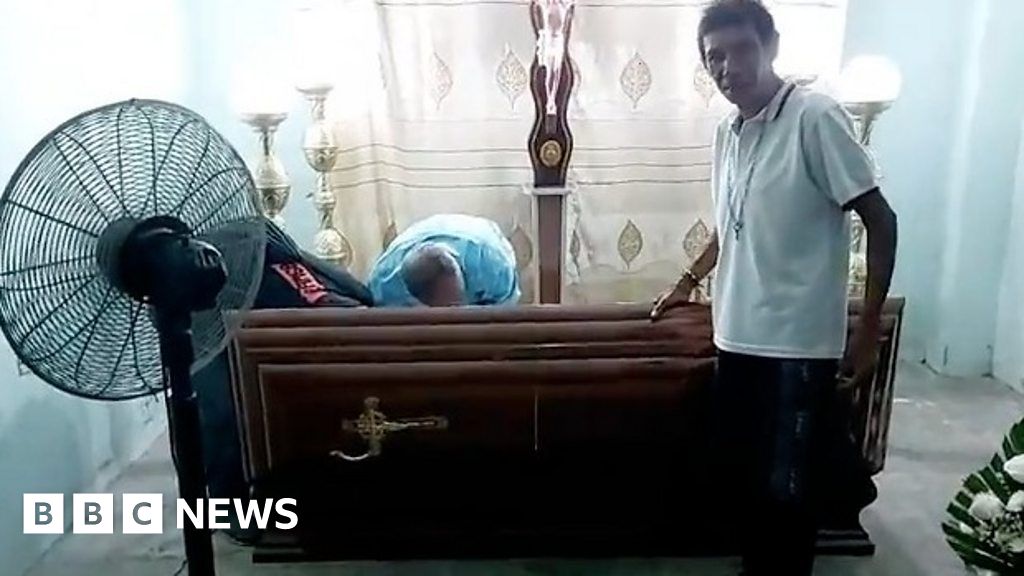
The long, somber drive from Phitsanulok to Bangkok, with his sister’s coffin resting in the back of a pickup truck, must have been an agonizing ordeal for the brother. Each mile brought him closer to the final farewell, a poignant journey steeped in sorrow and the heavy weight of loss. Upon arriving in Bangkok, he presented his sister’s body to the hospital she had designated for organ donation. However, fate, or perhaps a bureaucratic oversight, intervened in a way no one could have predicted. The hospital staff, adhering to strict protocols, refused to accept the body without an official death certificate. This seemingly minor administrative hurdle, which frustrated the grieving brother at the time, would prove to be the single most important factor in saving his sister’s life.
Unable to proceed with the organ donation, the brother then turned to Wat Rat Prakhong Tham, a local Buddhist temple renowned for its compassionate services, to arrange for cremation. Here again, he encountered the same obstacle: the absence of an official death certificate. Pairat Soodthoop, the temple’s general and financial affairs manager, was in the process of explaining the necessary procedures to obtain such a document when the impossible happened. A faint, almost imperceptible knock echoed from inside the pristine white coffin.
“I was a bit surprised, so I asked them to open the coffin, and everyone was startled,” recounted Pairat Soodthoop, still visibly shaken by the memory. The initial knock was soft, easily dismissed as a trick of the mind or perhaps the shifting of the coffin’s contents. But then came another, clearer. A collective gasp swept through the temple staff and the grieving brother as they cautiously approached the casket. With bated breath, they unlatched and gently lifted the lid. What they saw defied belief and shattered their perception of reality.
Inside, the woman, whom they had all presumed dead, was not only opening her eyes slightly but was also moving her arms and head, confirming the source of the mysterious knocking. “I saw her opening her eyes slightly and knocking on the side of the coffin. She must have been knocking for quite some time,” Soodthoop added, emphasizing the chilling realization that she had been conscious and desperately trying to signal her presence while trapped within the confines of her wooden prison. The scene was captured on video, later posted on the temple’s Facebook page, showing the woman’s subtle movements, a testament to the incredible moment she was brought back from the brink. The quiet solemnity of the temple grounds was instantly replaced by a flurry of urgent activity as disbelief gave way to an overwhelming sense of relief and urgency.
This astonishing revival raises critical questions about the nature of death and the protocols for its pronouncement. Medically, conditions such as catalepsy, profound coma, or a rare phenomenon known as the "Lazarus phenomenon" (a delayed return of spontaneous circulation after cessation of resuscitation efforts) can mimic death, making accurate diagnosis incredibly challenging. In cases where vital signs become extremely faint or imperceptible to an untrained eye, or even to medical professionals without advanced diagnostic tools, misdiagnosis can occur. The woman’s two-year bedridden state might have contributed to a weakened physiological state, making her vital signs difficult to detect, leading to the premature conclusion of her demise.
Immediate action followed the discovery. Temple staff, after assessing her condition, promptly contacted emergency services, and the woman was swiftly transported to a nearby hospital for comprehensive medical treatment and observation. In a remarkable display of compassion and community support, the temple’s abbot announced that Wat Rat Prakhong Tham would cover all her medical expenses, ensuring she received the best possible care during her recovery. This act of generosity underscores the profound impact the incident had on the temple community, transforming a day of sorrow into one of profound gratitude and wonder.
The incident in Thailand is not an isolated one. Throughout history, and even in recent times, there have been documented cases of individuals mistakenly declared dead only to be found alive. These occurrences serve as stark reminders of the fallibility of human judgment and the complexities of determining the precise moment of death.
In June 2024, a 74-year-old Nebraska woman was pronounced dead at her nursing home. Two hours later, staff at the funeral home where she had been transported discovered her breathing. The shocking find prompted investigations into the nursing home’s protocols and the circumstances surrounding the initial declaration of death, highlighting the critical need for meticulous verification procedures.
Similarly, in January 2023, a 66-year-old woman in Iowa was mistakenly pronounced dead at a care facility after an employee reported not feeling a pulse and observing no breathing. She, too, was taken to a funeral home, where staff were horrified to find her "gasping for air." This incident led to severe scrutiny of the care facility and emphasized the potential for catastrophic errors in environments where resources or training might be insufficient for definitive death pronouncements.
The same year, another unsettling case emerged from New York, where an 82-year-old woman, declared deceased at a nursing home, was found alive and breathing shortly after arriving at a funeral home. These consecutive incidents within a short span underscore a troubling pattern, suggesting systemic vulnerabilities in how death is verified in certain care settings, particularly for elderly or infirm patients whose vital signs may be difficult to ascertain.
Perhaps one of the most widely reported and dramatic instances occurred in 2002 in Shanghai, China. A video, which circulated globally, showed funeral parlor workers returning a body bag to a retirement home after discovering that the person inside was still alive. The shocking footage led to severe repercussions, with five officials in Shanghai being punished and a doctor having their license revoked, illustrating the serious legal and ethical consequences that follow such egregious errors.
The Thai woman’s miraculous recovery is a poignant reminder of the intricate and often mysterious boundary between life and death. Her story, preserved through the temple’s social media and reported globally, serves as a powerful cautionary tale for medical professionals, caregivers, and funeral service providers worldwide. It reinforces the absolute necessity of rigorous, multi-faceted verification processes before a death is officially declared, especially in an era where technology could aid in preventing such heart-wrenching errors. For the woman herself, and her family, it marks an incredible second chance, a life unexpectedly returned from the shadows of a coffin, leaving an indelible mark on all who witnessed or heard of her astonishing journey back to the living.